

Is the S&P 500 Headed for a Correction Ahead of the Midterm Elections? Here's What History Says Will Happen Before November, and What Comes Next.

Source The Motley Fool

Key Points

  • The S&P 500 nearly entered correction territory in the first quarter.

  • Political uncertainty can push investors to safer assets.

  • Is the market dip currently a buying opportunity, or are more declines ahead after the election?

  • 10 stocks we like better than S&P 500 Index ›

There's a growing amount of political and economic uncertainty in 2026. The ongoing conflict in Iran is only the latest factor to affect the stock market. It's exacerbating stubborn inflation, while many remain worried about how the jobs market will hold up and whether tariffs are actually here to stay or not.

In other words, there's a lot riding on the midterm elections in November -- and that might include your portfolio.

Will AI create the world's first trillionaire? Our team just released a report on the one little-known company, called an "Indispensable Monopoly" providing the critical technology Nvidia and Intel both need. Continue »

While we came close to a full-on correction in the S&P 500 (SNPINDEX: ^GSPC) in the first quarter, the benchmark index narrowly avoided officially falling 10% from its high. The Nasdaq Composite Index (NASDAQINDEX: ^IXIC) and Dow Jones Industrial Average (DJINDICES: ^DJI) both dipped their toes into correction territory before quickly bouncing back higher. But investors aren't out of the woods yet. Here's what's happened to the S&P 500 in previous midterm election years, and what history says happens once a new Congress starts its session.
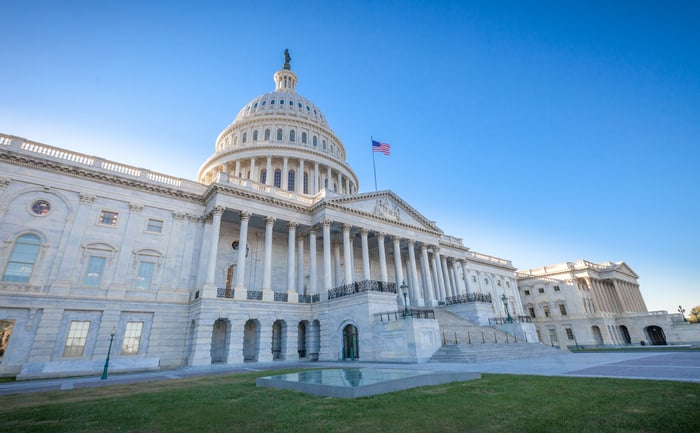
The U.S. Capitol building.

The U.S. Capitol building. Image source: Getty Images.

Are we headed for a correction?

Midterm elections can have a very meaningful effect on markets. Congress is responsible for drafting and adopting important legislation that can have far-reaching effects on businesses and investors.

But the run-up to a midterm election can be filled with uncertainty, and investors dislike uncertainty. Stock prices are based on expectations for the future. The less confidence investors have in their outlooks, the greater the margin of safety they require to reduce the risk of being wrong about a company or the economic environment. So, it makes sense that many investors might shift from riskier assets like stocks to less risky assets like bonds or cash ahead of an election.

The analysts at Neuberger Berman took a look at the S&P 500's performance over the last 72 years of midterm elections, excluding years when the U.S. was already in a recession. It found that the median peak-to-trough decline in those years was 15%. Three of the last four midterm election years resulted in corrections, including 2022, when the index fell into a bear market.

Importantly, the analysts found that all midterm market troughs occurred before the elections. That means if history repeats itself, investors won't have to wait around very long to see the market reach its bottom (if it hasn't already). But what comes next could be even more important for investors.

What happens after the market bottoms?

If a midterm election brings uncertainty, the opposite is true once the election is behind us. That might explain why the S&P 500 has historically seen a very strong rebound following the midterm election sell-off. The Neuberger Berman analysts found that the median increase in the index in the year following the midterm sell-off was 30%.

Four of the last five midterm election years saw the S&P 500 recover by more than 20% in a single year. Granted, that's measuring from the market bottom and going forward one year. So, investors should expect returns well above the average S&P 500 annual return.

But if you look at the combined results of the past five midterm elections, the median total return starting from the prior peak to one year after the market bottom is about 9.2%. That is to say, in normal economic environments, the market recovers very quickly, especially around midterm elections.

That should give investors confidence to invest into the current market downturn. While there's a lot of uncertainty in the geopolitical climate and its ultimate effect on the economy, the long-term results of the top U.S. companies in the S&P 500 have proven resilient across a range of political environments.

The analysts at Neuberger Berman point out that the underlying finances of S&P 500 companies remain very strong. As such, it expects a smaller-than-average decline in the market compared to the past. If we haven't already put in a bottom for the market in March, buying opportunities might not get much better anyway later in the year. So investors should buy with confidence that the market will bounce back swiftly.

Should you buy stock in S&P 500 Index right now?

Before you buy stock in S&P 500 Index, consider this:

The Motley Fool Stock Advisor analyst team just identified what they believe are the 10 best stocks for investors to buy now… and S&P 500 Index wasn’t one of them. The 10 stocks that made the cut could produce monster returns in the coming years.

Consider when Netflix made this list on December 17, 2004... if you invested $1,000 at the time of our recommendation, you’d have $532,066!* Or when Nvidia made this list on April 15, 2005... if you invested $1,000 at the time of our recommendation, you’d have $1,087,496!*

Now, it’s worth noting Stock Advisor’s total average return is 926% — a market-crushing outperformance compared to 185% for the S&P 500. Don't miss the latest top 10 list, available with Stock Advisor, and join an investing community built by individual investors for individual investors.

See the 10 stocks »

*Stock Advisor returns as of April 4, 2026.

Adam Levy has no position in any of the stocks mentioned. The Motley Fool has no position in any of the stocks mentioned. The Motley Fool has a disclosure policy.

Disclaimer: For information purposes only. Past performance is not indicative of future results.
placeholder
Bitcoin CME gaps at $35,000, $27,000 and $21,000, which one gets filled first?Prioritize filling the $27,000 gap and even try higher.
Author  FXStreet
Aug 22, 2023
Prioritize filling the $27,000 gap and even try higher.
placeholder
Elon Musk’s xAI and Neuralink Launch New Funding Rounds​Billionaire Elon Musk recently raised funds for his two high-profile tech companies, xAI and Neuralink.
Author  Insights
Jun 03, 2025
​Billionaire Elon Musk recently raised funds for his two high-profile tech companies, xAI and Neuralink.
placeholder
The dollar weakened, equities dipped, and gold hit record highsThe dollar weakened, equities fell, and gold set new records on Wednesday as investors waited for a Fed rate cut later in the day.
Author  Cryptopolitan
Sep 17, 2025
The dollar weakened, equities fell, and gold set new records on Wednesday as investors waited for a Fed rate cut later in the day.
placeholder
Bitcoin briefly loses 2025 gains as crypto plunges over the weekend.Bitcoin experienced a sharp decline this weekend, briefly erasing its 2025 gains and dipping below its year-opening value of $93,507. The cryptocurrency fell to a low of $93,029 on Sunday, representing a 25% drop from its all-time high in October. Although it has rebounded slightly to around $94,209, the pressures on the market remain significant. The downturn occurred despite the reopening of the U.S. government on Thursday, which many had hoped would provide essential support for crypto markets. This year initially appeared promising for cryptocurrencies, particularly after the inauguration of President Donald Trump, who has established the most pro-crypto administration thus far. However, ongoing political tensions—including Trump's tariff strategies and the recent government shutdown, lasting a historic 43 days—have contributed to several rapid price pullbacks for Bitcoin throughout the year. Market dynamics are also being influenced by Bitcoin whales—investors holding large amounts of Bitcoin—who have been offloading portions of their assets, consequently stalling price rallies even as positive regulatory developments emerge. Despite these sell-offs, analysts from Glassnode argue that this behavior aligns with typical patterns seen among long-term investors during the concluding stages of bull markets, suggesting it is not indicative of a mass exodus. Notably, Bitcoin is not alone in its struggles, as Ethereum and Solana have also recorded declines of 7.95% and 28.3%, respectively, since the start of the year, while numerous altcoins have faced even steeper losses. Looking ahead, questions linger regarding the viability of the four-year cycle thesis, particularly given the increasing institutional support and regulatory frameworks now in place in the crypto landscape. Matt Hougan, chief investment officer at Bitwise, remains optimistic, suggesting a potential Bitcoin resurgence in 2026 driven by the “debasement trade” thesis and a broader trend toward increased adoption of stablecoins, tokenization, and decentralized finance. Hougan emphasized the soundness of the underlying fundamentals, pointing to a positive outlook for the sector in the longer term.
Author  Mitrade
Nov 17, 2025
Bitcoin experienced a sharp decline this weekend, briefly erasing its 2025 gains and dipping below its year-opening value of $93,507. The cryptocurrency fell to a low of $93,029 on Sunday, representing a 25% drop from its all-time high in October. Although it has rebounded slightly to around $94,209, the pressures on the market remain significant. The downturn occurred despite the reopening of the U.S. government on Thursday, which many had hoped would provide essential support for crypto markets. This year initially appeared promising for cryptocurrencies, particularly after the inauguration of President Donald Trump, who has established the most pro-crypto administration thus far. However, ongoing political tensions—including Trump's tariff strategies and the recent government shutdown, lasting a historic 43 days—have contributed to several rapid price pullbacks for Bitcoin throughout the year. Market dynamics are also being influenced by Bitcoin whales—investors holding large amounts of Bitcoin—who have been offloading portions of their assets, consequently stalling price rallies even as positive regulatory developments emerge. Despite these sell-offs, analysts from Glassnode argue that this behavior aligns with typical patterns seen among long-term investors during the concluding stages of bull markets, suggesting it is not indicative of a mass exodus. Notably, Bitcoin is not alone in its struggles, as Ethereum and Solana have also recorded declines of 7.95% and 28.3%, respectively, since the start of the year, while numerous altcoins have faced even steeper losses. Looking ahead, questions linger regarding the viability of the four-year cycle thesis, particularly given the increasing institutional support and regulatory frameworks now in place in the crypto landscape. Matt Hougan, chief investment officer at Bitwise, remains optimistic, suggesting a potential Bitcoin resurgence in 2026 driven by the “debasement trade” thesis and a broader trend toward increased adoption of stablecoins, tokenization, and decentralized finance. Hougan emphasized the soundness of the underlying fundamentals, pointing to a positive outlook for the sector in the longer term.
placeholder
Silver Price Forecast: XAG/USD falls to near $72.00 amid fading safe-haven demandSilver price (XAG/USD) continues to lose ground after registering tiny losses in the previous day, trading around $72.90 during the Asian hours on Thursday. The safe-haven demand for the precious metal fades amid rising optimism over Middle East peace.
Author  FXStreet
Apr 02, Thu
Silver price (XAG/USD) continues to lose ground after registering tiny losses in the previous day, trading around $72.90 during the Asian hours on Thursday. The safe-haven demand for the precious metal fades amid rising optimism over Middle East peace.
goTop
quote