


Microsoft: A Stock to Avoid or a Once-in-a-Decade Buying Opportunity?
Key Points
Microsoft is a leader in the artificial intelligence transition.
Microsoft's valuation has reached nearly decade lows.
- 10 stocks we like better than Microsoft ›
Microsoft (NASDAQ: MSFT) has had an interesting couple of months. What started as a warranted sell-off to bring its valuation down to a more reasonable level has transformed into one of the biggest sell-offs Microsoft has faced in recent history. The question investors must answer is whether this sell-off is happening for a good reason or it is a mistake that presents a once-in-a-decade stock buying opportunity.
Let's take a look at what the data says and get to the bottom of Microsoft's sell-off.
Will AI create the world's first trillionaire? Our team just released a report on the one little-known company, called an "Indispensable Monopoly" providing the critical technology Nvidia and Intel both need. Continue »
Image source: Getty Images.
Microsoft doesn't have any holes in its business
Microsoft has always been one of the major providers of productivity tools, be it its operating system back in the day or its Office suite of products. Microsoft has transitioned that role into the artificial intelligence (AI) realm and has become an integrator of AI tools in its existing product lineup, as well as a facilitator in the cloud computing realm.
Azure is one of the most popular cloud computing platforms to run AI workloads on and has experienced strong growth as a result. This has trickled over into Microsoft's overall results, and it posted revenue growth of 17% during its most recent quarter. That's impressive growth considering Microsoft's size and maturity, and it's a figure that investors can't really complain about.
Microsoft is a staple in the business world, and its transition into AI makes it so that it will have a difficult time being disrupted. I think this rules out needing to avoid the stock, but is this really a once-in-a-decade buying opportunity?
I think it is.
There are countless ways to value Microsoft's stock. The most common is the trailing price-to-earnings ratio, but I also like its operating earnings ratio because it removes the effect of investment gains. Regardless of which valuation measure you use, Microsoft is nearing a decade-low valuation from both metrics.
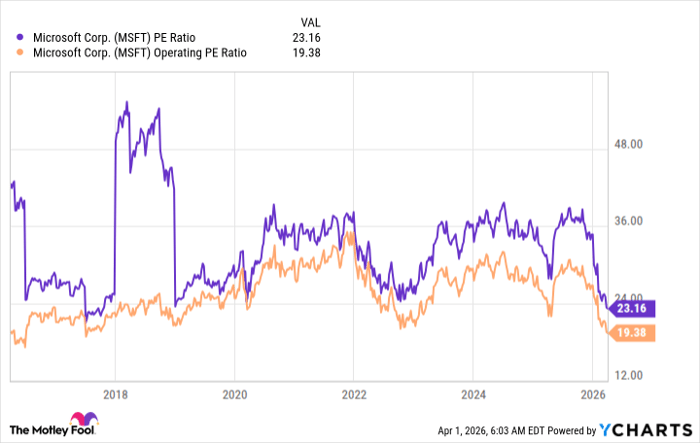
Data by YCharts. PE Ratio = price-to-earnings ratio.
Microsoft isn't in a massive crisis, the economy is doing fairly well, and if we can get some stability in the geopolitical realm through a wind-down in the Iran war, Microsoft's stock could end up skyrocketing. Investors don't get this kind of opportunity with Microsoft's stock very often, so I wouldn't be waiting for a lower price to come around. I think the stock could be slated to take off once it reports its next quarterly earnings, which should occur later in April.
There are few better values in the market than Microsoft's stock, and now is the perfect time to scoop up shares.
Should you buy stock in Microsoft right now?
Before you buy stock in Microsoft, consider this:
The Motley Fool Stock Advisor analyst team just identified what they believe are the 10 best stocks for investors to buy now… and Microsoft wasn’t one of them. The 10 stocks that made the cut could produce monster returns in the coming years.
Consider when Netflix made this list on December 17, 2004... if you invested $1,000 at the time of our recommendation, you’d have $532,066!* Or when Nvidia made this list on April 15, 2005... if you invested $1,000 at the time of our recommendation, you’d have $1,087,496!*
Now, it’s worth noting Stock Advisor’s total average return is 926% — a market-crushing outperformance compared to 185% for the S&P 500. Don't miss the latest top 10 list, available with Stock Advisor, and join an investing community built by individual investors for individual investors.
See the 10 stocks »
*Stock Advisor returns as of April 4, 2026.
Keithen Drury has positions in Microsoft. The Motley Fool has positions in and recommends Microsoft. The Motley Fool has a disclosure policy.
Recommended Articles


