

Ford Faces a Profitability Threat It Hasn't Seen Since the 2008 Financial Crisis

Source The Motley Fool

Key Points

  • Ford Credit is one of the automaker's most profitable units.

  • Over the past two decades, Ford Credit has had only one annual loss -- in 2008.

  • Off-lease EVs have lost substantial residual value and captive finance arms can be on the hook for billions.

  • 10 stocks we like better than Ford Motor Company ›

Many potential Ford Motor Company (NYSE: F) investors aren't aware that one of the automaker's best generators of profit isn't a vehicle. That's right, Ford Credit, which acts as a banking entity for the company, is a major driver of profit for the Blue Oval. While Ford Credit is often overlooked, and typically generates only about 5% of revenue any given year, it provides 15% to 20%, sometimes more, of the company's profits. You can see in the graphic below that Ford Credit is highly profitable, except for 2008. Let's dive into why, and how, Ford is again facing such a serious threat to profits.

One of these is not the same
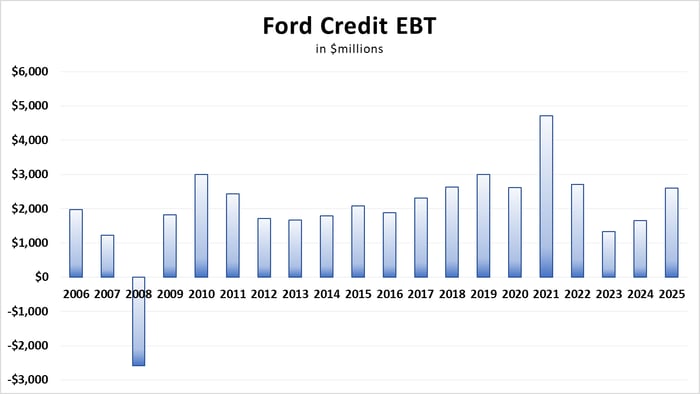
Graphic showing all profitable Ford Credit years except 2008.

Data source: Ford SEC filings. Chart by author.

Will AI create the world's first trillionaire? Our team just released a report on the one little-known company, called an "Indispensable Monopoly" providing the critical technology Nvidia and Intel both need. Continue »

That's a great long-term look at Ford Credit and its ability to generate earnings before taxes (EBT). Not only is Ford Credit a high-margin business for the automaker, it also distributes cash back to the parent company, Ford. In fact, just last year Ford Credit generated $2.6 billion in EBT and sent $1.7 billion in cash back to Ford, which can be used to fund growth in electric vehicles (EVs), among other things, or even help pay the company's lucrative dividend.

Ford Credit finances some of its customer sales and leases, and for the latter the banking entity projects expected residual values and return volumes of the vehicles it leases. Actual proceeds realized by Ford Credit are upon the return of the leased vehicle, which could be lower than the initial value projected. When this happens on a large scale it can cripple profitability.

That's what happened during 2008, when a significant economic downturn hurt vehicle demand and values. Further, during the 2008 financial crisis credit markets tightened, which increased Ford Credit's cost of borrowing. Fast-forward to today and there is no financial crisis, but there is a coming wave of off-lease EVs that are significantly less valuable than they were recently -- potentially leaving entities like Ford Credit on the hook for big losses.

Years after consumers and early adopters jumped into the EV market, sometimes taking lease deals that were easier on monthly payments and could sometimes include incentives, those are now coming off-lease. Credit agency Experian estimates that off-lease EV volume will peak in 2028 with nearly 800,000 EVs flooding the market. Already we're seeing movement, with EVs expected to make up 15% of off-lease used vehicles by the end of 2026, compared to only 7.7% during the first quarter.

Ford Mustang Mach-E

Image source: Ford Motor Company.

Why it matters now

Here's the kicker: Industry experts are expecting the resale value of those EVs will check in around $10,000 less than automaker finance entities projected, and could range anywhere from $5,000 to $20,000 less, depending on make and model. Using the $10,000 figure, that would be an industrywide loss of about $8 billion for expected models coming off lease in 2028 -- that's big time loss.

Here's the good news for Ford investors, and the not-so-good news for Tesla (NASDAQ: TSLA) and General Motors (NYSE: GM). According to Automotive News Research & Data Center, Tesla and GM dominated EV lease volume last year. The data estimates roughly 228,000 Tesla EVs were leased last year, and nearly 102,000 EV leases for General Motors. Ford checks in at about half that of its Detroit rival, with a little over 52,000 EV leases last year.

For investors, it's not time to panic. This situation is far less dire, and at far smaller volumes, than the situation in 2008. While automakers with captive finance arms that lease vehicles likely can't avoid losses from these EV off-lease vehicles, it won't by any means bankrupt an automaker. That said, off-lease EVs are a development investors must watch through 2028, because it could impact the automaker's bottom line more than anyone would have guessed a couple of short years ago.

Should you buy stock in Ford Motor Company right now?

Before you buy stock in Ford Motor Company, consider this:

The Motley Fool Stock Advisor analyst team just identified what they believe are the 10 best stocks for investors to buy now… and Ford Motor Company wasn’t one of them. The 10 stocks that made the cut could produce monster returns in the coming years.

Consider when Netflix made this list on December 17, 2004... if you invested $1,000 at the time of our recommendation, you’d have $515,294!* Or when Nvidia made this list on April 15, 2005... if you invested $1,000 at the time of our recommendation, you’d have $1,077,442!*

Now, it’s worth noting Stock Advisor’s total average return is 914% — a market-crushing outperformance compared to 184% for the S&P 500. Don't miss the latest top 10 list, available with Stock Advisor, and join an investing community built by individual investors for individual investors.

See the 10 stocks »

*Stock Advisor returns as of April 3, 2026.

Daniel Miller has positions in Ford Motor Company and General Motors. The Motley Fool has positions in and recommends Tesla. The Motley Fool recommends Experian Plc and General Motors. The Motley Fool has a disclosure policy.

Disclaimer: For information purposes only. Past performance is not indicative of future results.
placeholder
Bitcoin To Anchor America Party—’Fiat Is Hopeless,’ Says Elon MuskMusk Pitches Bitcoin As Pillar Of America Party
Author  Bitcoinist
Jul 07, 2025
Musk Pitches Bitcoin As Pillar Of America Party
placeholder
Bitcoin briefly loses 2025 gains as crypto plunges over the weekend.Bitcoin experienced a sharp decline this weekend, briefly erasing its 2025 gains and dipping below its year-opening value of $93,507. The cryptocurrency fell to a low of $93,029 on Sunday, representing a 25% drop from its all-time high in October. Although it has rebounded slightly to around $94,209, the pressures on the market remain significant. The downturn occurred despite the reopening of the U.S. government on Thursday, which many had hoped would provide essential support for crypto markets. This year initially appeared promising for cryptocurrencies, particularly after the inauguration of President Donald Trump, who has established the most pro-crypto administration thus far. However, ongoing political tensions—including Trump's tariff strategies and the recent government shutdown, lasting a historic 43 days—have contributed to several rapid price pullbacks for Bitcoin throughout the year. Market dynamics are also being influenced by Bitcoin whales—investors holding large amounts of Bitcoin—who have been offloading portions of their assets, consequently stalling price rallies even as positive regulatory developments emerge. Despite these sell-offs, analysts from Glassnode argue that this behavior aligns with typical patterns seen among long-term investors during the concluding stages of bull markets, suggesting it is not indicative of a mass exodus. Notably, Bitcoin is not alone in its struggles, as Ethereum and Solana have also recorded declines of 7.95% and 28.3%, respectively, since the start of the year, while numerous altcoins have faced even steeper losses. Looking ahead, questions linger regarding the viability of the four-year cycle thesis, particularly given the increasing institutional support and regulatory frameworks now in place in the crypto landscape. Matt Hougan, chief investment officer at Bitwise, remains optimistic, suggesting a potential Bitcoin resurgence in 2026 driven by the “debasement trade” thesis and a broader trend toward increased adoption of stablecoins, tokenization, and decentralized finance. Hougan emphasized the soundness of the underlying fundamentals, pointing to a positive outlook for the sector in the longer term.
Author  Mitrade
Nov 17, 2025
Bitcoin experienced a sharp decline this weekend, briefly erasing its 2025 gains and dipping below its year-opening value of $93,507. The cryptocurrency fell to a low of $93,029 on Sunday, representing a 25% drop from its all-time high in October. Although it has rebounded slightly to around $94,209, the pressures on the market remain significant. The downturn occurred despite the reopening of the U.S. government on Thursday, which many had hoped would provide essential support for crypto markets. This year initially appeared promising for cryptocurrencies, particularly after the inauguration of President Donald Trump, who has established the most pro-crypto administration thus far. However, ongoing political tensions—including Trump's tariff strategies and the recent government shutdown, lasting a historic 43 days—have contributed to several rapid price pullbacks for Bitcoin throughout the year. Market dynamics are also being influenced by Bitcoin whales—investors holding large amounts of Bitcoin—who have been offloading portions of their assets, consequently stalling price rallies even as positive regulatory developments emerge. Despite these sell-offs, analysts from Glassnode argue that this behavior aligns with typical patterns seen among long-term investors during the concluding stages of bull markets, suggesting it is not indicative of a mass exodus. Notably, Bitcoin is not alone in its struggles, as Ethereum and Solana have also recorded declines of 7.95% and 28.3%, respectively, since the start of the year, while numerous altcoins have faced even steeper losses. Looking ahead, questions linger regarding the viability of the four-year cycle thesis, particularly given the increasing institutional support and regulatory frameworks now in place in the crypto landscape. Matt Hougan, chief investment officer at Bitwise, remains optimistic, suggesting a potential Bitcoin resurgence in 2026 driven by the “debasement trade” thesis and a broader trend toward increased adoption of stablecoins, tokenization, and decentralized finance. Hougan emphasized the soundness of the underlying fundamentals, pointing to a positive outlook for the sector in the longer term.
placeholder
Gold Price Forecast: XAU/USD opens lower around $4,450 on fears of widening Iran conflictsGold price (XAU/USD) opens over 1% lower to near $4,445.00 on Monday, as oil prices have rallied further on fears of further widening of conflicts in the Middle East. WTI Oil price is up almost 3% above $102.50 in the opening trade, increasing fears of higher inflation expectations globally.
Author  FXStreet
Mar 30, Mon
Gold price (XAU/USD) opens over 1% lower to near $4,445.00 on Monday, as oil prices have rallied further on fears of further widening of conflicts in the Middle East. WTI Oil price is up almost 3% above $102.50 in the opening trade, increasing fears of higher inflation expectations globally.
placeholder
Silver Price Forecast: XAG/USD falls to near $72.00 amid fading safe-haven demandSilver price (XAG/USD) continues to lose ground after registering tiny losses in the previous day, trading around $72.90 during the Asian hours on Thursday. The safe-haven demand for the precious metal fades amid rising optimism over Middle East peace.
Author  FXStreet
Yesterday 08: 19
Silver price (XAG/USD) continues to lose ground after registering tiny losses in the previous day, trading around $72.90 during the Asian hours on Thursday. The safe-haven demand for the precious metal fades amid rising optimism over Middle East peace.
placeholder
Gold retreats sharply from two-week top/$4,800 as Trump’s Iran comments boost USDGold (XAU/USD) witnessed an intraday turnaround from the $4,800 mark, or a fresh two-week high set earlier this Thursday, and for now, seems to have snapped a four-day winning streak amid resurgent US Dollar (USD) demand.
Author  FXStreet
Yesterday 07: 03
Gold (XAU/USD) witnessed an intraday turnaround from the $4,800 mark, or a fresh two-week high set earlier this Thursday, and for now, seems to have snapped a four-day winning streak amid resurgent US Dollar (USD) demand.
goTop
quote