


US Nonfarm Payrolls expected to rise by 60K in March
- Nonfarm Payrolls are expected to rise by 60K in March.
- The Unemployment Rate is seen holding steady at 4.4%.
- Markets could have a delayed reaction to employment data due to the Good Friday holiday.
The United States (US) Bureau of Labor Statistics (BLS) will release the Nonfarm Payrolls (NFP) data for March on Friday at 12:30 GMT.
Investors will scrutinize the underlying details of the employment report to assess whether the Federal Reserve (Fed) is likely to consider an interest-rate hike later in the year. Still, the immediate market reaction could remain subdued, with trading volumes staying thin on the Good Friday holiday.
What to expect from the next Nonfarm Payrolls report?
Investors expect NFP to rise by 60K following the disappointing 92K decrease recorded in February. The Unemployment Rate is expected to remain unchanged at 4.4%, while the annual wage inflation, as measured by the change in the Average Hourly Earnings, is projected to hold steady at 3.8%.
Previewing the employment report, TD Securities analysts note that they expect a moderate 30K increase in NFP in March.
“The reversal of weather and strike effects should result in a payrolls composition similar to the end of 2025, with outsized healthcare support. We also look for the Unemployment Rate to remain at 4.4%, with a risk of moving higher. Average Hourly Earnings likely increased a subdued 0.2% m/m, translating to 3.6% y/y,” they add.
Automatic Data Processing (ADP) reported earlier in the week that employment in the private sector rose by 62K in March. This print followed the 66K (revised from 63K) increase reported in February. Assessing the report’s findings, “overall hiring is steady, but job growth continues to favor certain industries, including health care,” said Dr. Nela Richardson, chief economist at ADP. Meanwhile, the Employment Index of the Institute for Supply Management’s (ISM) Manufacturing Purchasing Managers’ Index (PMI) survey came in at 48.7 in March, pointing to an ongoing contraction in the manufacturing sector payrolls.
Danske Bank Research Team also projects the NFP to come in at 30K and see the Unemployment Rate rising to 4.5%. “Recent indicators, including declines in daily job postings and weekly private sector employment growth, point to a softer labour market,” they note.
Economic Indicator
Nonfarm Payrolls
The Nonfarm Payrolls release presents the number of new jobs created in the US during the previous month in all non-agricultural businesses; it is released by the US Bureau of Labor Statistics (BLS). The monthly changes in payrolls can be extremely volatile. The number is also subject to strong reviews, which can also trigger volatility in the Forex board. Generally speaking, a high reading is seen as bullish for the US Dollar (USD), while a low reading is seen as bearish, although previous months' reviews and the Unemployment Rate are as relevant as the headline figure. The market's reaction, therefore, depends on how the market assesses all the data contained in the BLS report as a whole.
Read more.Next release: Fri Apr 03, 2026 12:30
Frequency: Monthly
Consensus: 60K
Previous: -92K
Source: US Bureau of Labor Statistics
America’s monthly jobs report is considered the most important economic indicator for forex traders. Released on the first Friday following the reported month, the change in the number of positions is closely correlated with the overall performance of the economy and is monitored by policymakers. Full employment is one of the Federal Reserve’s mandates and it considers developments in the labor market when setting its policies, thus impacting currencies. Despite several leading indicators shaping estimates, Nonfarm Payrolls tend to surprise markets and trigger substantial volatility. Actual figures beating the consensus tend to be USD bullish.
How will the US March Nonfarm Payrolls affect EUR/USD?
The USD outperformed its rivals in March as it benefited from the risk-averse market atmosphere and growing expectations for a hawkish tilt in the Federal Reserve’s (Fed) policy outlook, with surging crude Oil prices reviving fears over inflation getting out of control. The US Dollar Index (DXY) gained more than 2% in March and experienced heightened volatility in the first days of April.
While speaking at an event organized by Harvard University earlier this week, Fed Chair Jerome Powell noted that there is tension between the Fed’s two mandates, keeping maximum employment and stable prices, and said that they are in a good place to wait and see how the current situation plays out. Commenting on labor market conditions, Powell said that job creation is very low and that it's challenging to enter the job market.
Meanwhile, NY Fed President John Williams acknowledged that the job market is sending signals, adding that the low hiring rate might be feeding into economic pessimism.
According to the CME FedWatch Tool, markets are currently pricing in about an 80% probability that the Fed policy rate will remain unchanged at the range of 3.5%-3.75% by the end of 2026. In early March, markets were projecting a 92% chance that the Fed would cut the policy rate at least once this year.
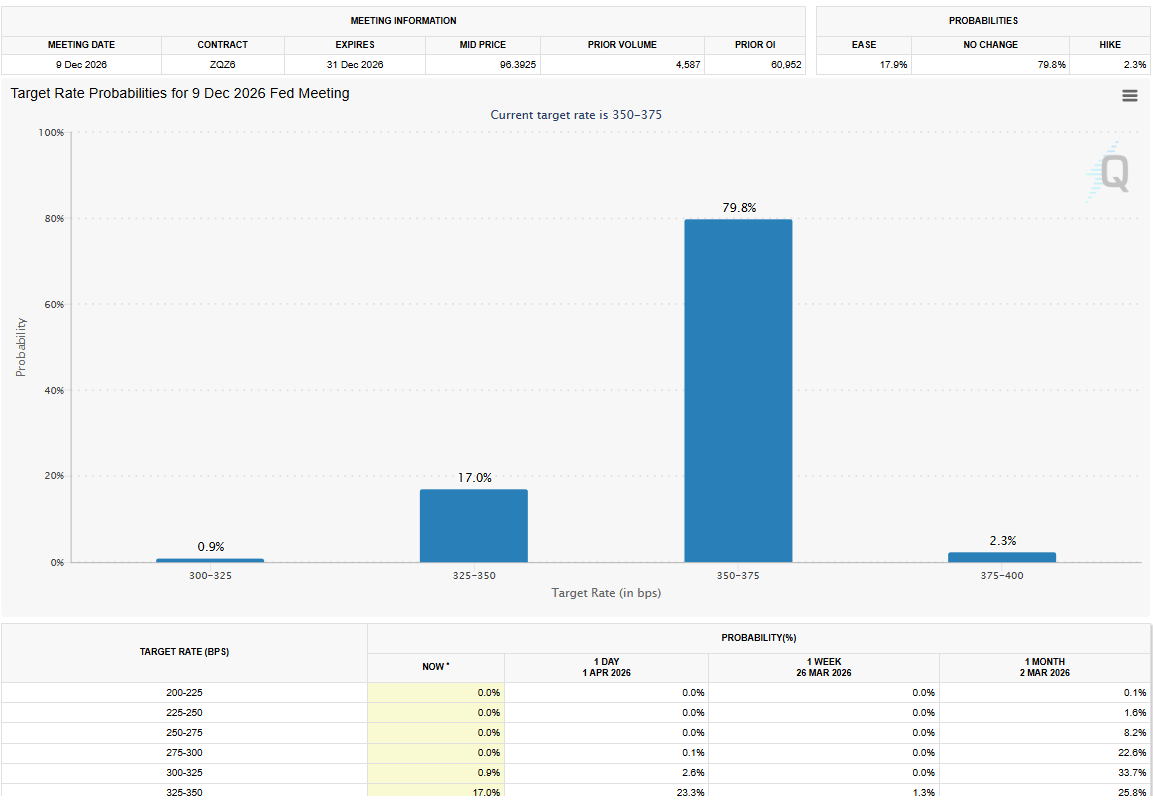
A positive surprise in the NFP, with a reading of at least 70K, could cause markets to reassess the possibility of a Fed rate hike and boost the USD. Conversely, a print below 50K, especially if combined with an uptick in the Unemployment Rate, could make it difficult for the USD to outperform its rivals and help EUR/USD hold its ground. Nonetheless, unless a de-escalation of the Middle East conflict leads to a steady decline in Oil prices, a steady uptrend in EUR/USD could be difficult to come by, even if the NFP misses analysts’ estimates.
Eren Sengezer, European Session Lead Analyst at FXStreet, offers a brief technical outlook for EUR/USD:
“EUR/USD’s near-term technical outlook suggests that the bearish bias remains intact despite the latest recovery attempt. The pair remains below a descending trend line drawn from late-January and the Relative Strength Index (RSI) indicator on the daily chart retreats toward 40 after failing to clear the 50 midline earlier in the week.”
“On the downside, 1.1430-1.1400 (lower limit of the Bollinger Band, static level) aligns as a key support before 1.1300 (round level) and 1.1220 (static level). Looking north, immediate resistance could be spotted at 1.1600 (round level, descending trend line) ahead of the 1.1680-1.1700 region, where the 100-day Simple Moving Average (SMA) and the 200-day SMA align.”
Nonfarm Payrolls FAQs
Nonfarm Payrolls (NFP) are part of the US Bureau of Labor Statistics monthly jobs report. The Nonfarm Payrolls component specifically measures the change in the number of people employed in the US during the previous month, excluding the farming industry.
The Nonfarm Payrolls figure can influence the decisions of the Federal Reserve by providing a measure of how successfully the Fed is meeting its mandate of fostering full employment and 2% inflation. A relatively high NFP figure means more people are in employment, earning more money and therefore probably spending more. A relatively low Nonfarm Payrolls’ result, on the either hand, could mean people are struggling to find work. The Fed will typically raise interest rates to combat high inflation triggered by low unemployment, and lower them to stimulate a stagnant labor market.
Nonfarm Payrolls generally have a positive correlation with the US Dollar. This means when payrolls’ figures come out higher-than-expected the USD tends to rally and vice versa when they are lower. NFPs influence the US Dollar by virtue of their impact on inflation, monetary policy expectations and interest rates. A higher NFP usually means the Federal Reserve will be more tight in its monetary policy, supporting the USD.
Nonfarm Payrolls are generally negatively-correlated with the price of Gold. This means a higher-than-expected payrolls’ figure will have a depressing effect on the Gold price and vice versa. Higher NFP generally has a positive effect on the value of the USD, and like most major commodities Gold is priced in US Dollars. If the USD gains in value, therefore, it requires less Dollars to buy an ounce of Gold. Also, higher interest rates (typically helped higher NFPs) also lessen the attractiveness of Gold as an investment compared to staying in cash, where the money will at least earn interest.
Nonfarm Payrolls is only one component within a bigger jobs report and it can be overshadowed by the other components. At times, when NFP come out higher-than-forecast, but the Average Weekly Earnings is lower than expected, the market has ignored the potentially inflationary effect of the headline result and interpreted the fall in earnings as deflationary. The Participation Rate and the Average Weekly Hours components can also influence the market reaction, but only in seldom events like the “Great Resignation” or the Global Financial Crisis.
Recommended Articles


