


What Is Google TurboQuant Compression Algorithm? How Does It Affect the AI Storage Chip Industry?
TradingKey - Google ( GOOGL) ( GOOG )'s introduction of the TurboQuant vector compression algorithm is like a precisely cast stone, sending ripples throughout the AI memory chip industry.
This new vector compression algorithm is specifically optimized for memory usage efficiency during the AI inference phase, particularly excelling in addressing high Key-Value Cache (KV Cache) occupancy issues. This means AI models can process more data with lower memory consumption, while also presenting new challenges for the industry.
So, what exactly is TurboQuant? What unique technical advantages does it possess? And how will it impact the AI memory industry?
What is TurboQuant?
TurboQuant is a new vector compression algorithm officially released by Google Research in March 2026, targeting the core pain point in the inference phase of large language models (LLMs) and vector search engines—the excessive memory consumption of the Key-Value Cache (KV Cache). Technical details will be formally released and peer-reviewed as an academic paper at ICLR 2026 (International Conference on Learning Representations) from April 23 to 27.
During the inference process of large language models, the KV Cache acts as the model's "temporary notebook," where every round of dialogue and segment of input text is converted into high-dimensional vectors and stored temporarily to provide context for subsequent inference steps. To ensure inference precision, traditional solutions typically store vector data in 16-bit floating-point (FP16/BF16) formats. However, as dialogue length grows or the scale of text expands, the KV Cache consumes GPU high-bandwidth memory like a "data black hole," which not only slows down inference but also significantly inflates computing costs, becoming a key bottleneck for the deployment of large models.
Industry consensus indicates that the current bottleneck for large models is not the number of parameters but memory capacity. The longer the context, the larger the memory footprint of the KV Cache, which eventually hits hardware limits before the model parameters do. This is a shared pain point for tasks such as long-text generation and long-document understanding.
TurboQuant's breakthrough directly addresses this pain point.
Through the synergy of two underlying technologies, TurboQuant achieves extreme KV Cache compression with zero additional memory overhead and almost no impact on inference precision.
The first step uses PolarQuant for primary compression, breaking the traditional Cartesian coordinate (XYZ) encoding logic of AI model vectors by converting them to polar coordinates. For instance, while traditional encoding is like saying "walk 3 blocks east and 4 blocks north," polar coordinates describe "walking 5 blocks at a 37-degree angle," simplifying the vector into "radius (core data intensity) + direction (data semantics)." This transformation maps vectors onto a "circular grid" with fixed boundaries, eliminating expensive data normalization steps required by traditional methods, cutting redundant storage at its root and achieving most of the memory reduction.
The second step utilizes QJL (Quantized Johnson-Lindenstrauss) technology to handle residual errors. Although PolarQuant achieves efficient compression, it can cause slight precision deviations. QJL uses only 1 bit of computing power to add a +1 or -1 correction marker to each vector, acting as a "mathematical error-correction machine" to smooth these errors while fully preserving inter-vector relationships. This ensures the model calculates precise attention scores—the core process for neural networks to judge data importance—with the entire correction phase incurring zero memory overhead.
TurboQuant Leads in Performance Metrics
Google's TurboQuant has achieved breakthrough compression and efficiency performance, compressing 32-bit or 16-bit vector data into approximately 3 bits. With a compression ratio as high as 6x, it can directly reduce the memory footprint of large model KV Cache to one-sixth of its original level.
In hardware benchmarks, the algorithm demonstrated significant speed advantages on devices like the NVIDIA H100, with computational efficiency increasing by up to 8 times.
Crucially, the entire process requires no pre-training or fine-tuning to achieve "zero precision loss." Performance across tasks such as Q&A, code generation, and long-text summarization remains nearly undiminished, and there is no need for parameter tuning on specific datasets, allowing for direct adaptation to various large model inference scenarios.
In vector search testing, TurboQuant also outperformed traditional product quantization methods. While maintaining recall rates, it can reduce indexing time nearly to zero, which is highly significant for modern search engines relying on semantic vector matching. Mainstream search engines currently use billions of high-dimensional vectors for precise semantic retrieval; TurboQuant's high compression ratio directly lowers storage costs while boosting response speeds, creating new optimization space for large-scale semantic search.
From an implementation perspective, TurboQuant directly lowers the operating costs and memory requirements of AI models, enabling higher-quality local outputs on hardware-constrained mobile devices like smartphones. Additionally, the freed-up memory space allows for the operation of more complex models, likely leading to a future implementation trend of simultaneous "cost reduction and model upgrades."
How TurboQuant Impacts Memory Chips
The current AI hardware market is mired in an extreme predicament of "high prices and tight supply," where high-bandwidth, large-capacity storage resources have become the core bottleneck restricting the large-scale implementation of AI. To meet the ultra-high bandwidth demands of large model training and inference, AI servers have developed a strong dependency on HBM (High Bandwidth Memory), which has directly driven up its market price, resulting in a persistent global supply shortage.
To support the operation of large models, enterprises have been forced to adopt a brute-force "hardware stacking" approach, keeping AI deployment and operational costs prohibitively high. However, the emergence of Google's TurboQuant technology may be poised to reshape the demand logic for various memory chips.
Server DRAM (DDR5)
TurboQuant's optimization targets are precisely locked on the KV cache and vector index modules, which are the most memory-intensive components in AI inference scenarios. Once the technology is deployed at scale, a single server will gain the ability to "host more models with less memory." This has triggered market concerns that the growth rate of demand for DRAM capacity may slow down, which is the direct cause of the recent shift in market sentiment.
Nevertheless, the support from the actual supply-demand landscape remains strong. TrendForce's industry report for the first quarter of 2026 indicates that contract prices for standard DRAM are expected to rise by 55%-60% quarter-on-quarter, as the supply-demand gap continues to widen.
HBM (High Bandwidth Memory)
As the core storage medium for AI training scenarios, HBM is virtually immune to any impact from TurboQuant. This is because TurboQuant is essentially an inference optimization technology that has not involved memory logic for training since its design phase. The demand for HBM's high bandwidth and large capacity in AI training continues to climb, and the tight supply-demand situation will remain unchanged.
In inference scenarios, HBM actually stands to gain additional benefits from TurboQuant. With a 6x compression ratio, the technology significantly reduces KV cache occupancy per GPU, effectively increasing the number of concurrent requests a GPU can process. The bandwidth advantages of HBM, which were previously limited by KV cache capacity, can now be more fully unleashed. The resulting improvement in actual inference efficiency will further strengthen HBM's deployment value in high-end AI servers.
NAND Flash (Enterprise SSD)
The logic for TurboQuant impacting NAND Flash is weak. Previous optimistic market expectations for NAND were built on the judgment of exploding storage demand for AI servers, with Samsung having raised NAND Flash contract prices by over 100% just this January.
However, TurboQuant only targets KV cache compression during inference, making its impact on the NAND Flash required for model storage and deployment very indirect and lagging.
According to TrendForce forecasts, enterprise SSDs will become the largest application segment for NAND Flash in 2026, with client SSD contract prices expected to rise by at least 40%, the largest increase among all NAND product categories.
HDD (Hard Disk Drive)
Hard disk drives are also persistent storage media and are completely unrelated to the operational logic of KV caching. TurboQuant's inference optimization technology has zero impact on their demand.
Current demand for HDDs primarily stems from scenarios like cold data storage and archiving. These requirements are unrelated to improvements in AI inference efficiency, and the long-term demand logic remains stable.
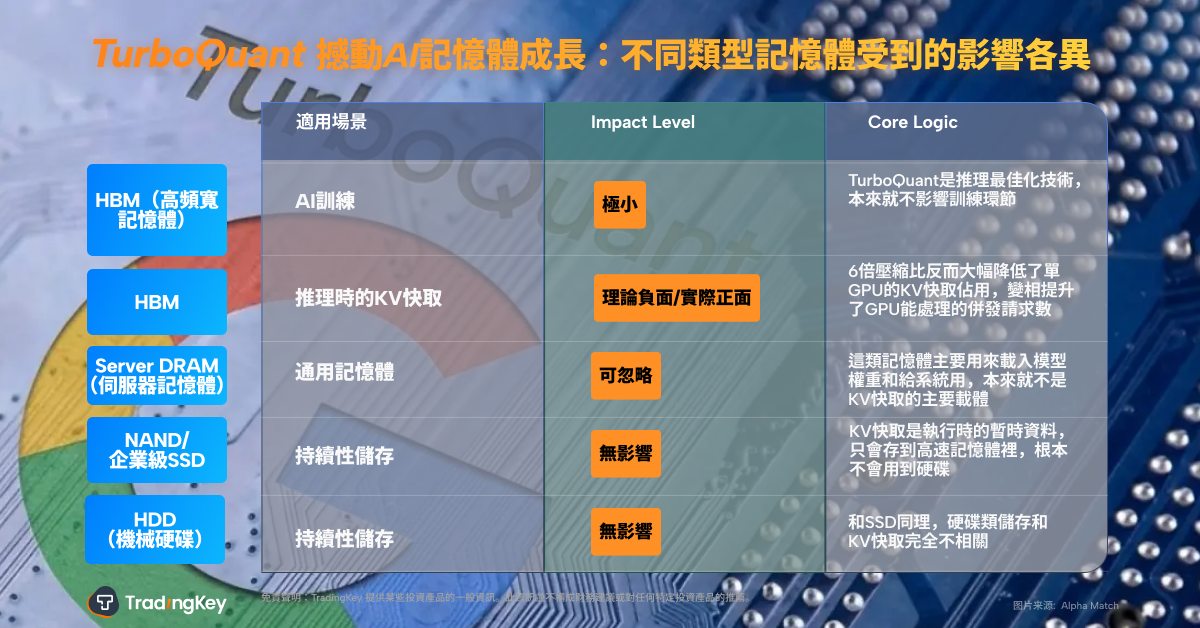
What is the impact of TurboQuant on the AI storage industry?
Following the release of Google's TurboQuant technology, Micron Technology ( MU ), Western Digital ( WDC ), SanDisk ( SNDK) and other memory chip stocks experienced short-term declines, but this panic selling is essentially a market misjudgment of the demand logic within the AI industry—it assumes that "total concurrent demand for AI inference is fixed" and that increasing the capacity of a single card will reduce total hardware demand. This premise, however, is completely invalid in the AI industry.
Historical patterns in the tech industry have long proven that improvements in resource efficiency never reduce total demand; instead, by causing usage costs to plummet, they catalyze a vast number of new scenarios that were previously not economically viable, ultimately driving exponential growth in total demand.
For instance, as the conversion efficiency of photovoltaic cells improved, the cost per kilowatt-hour dropped, leading to a several-dozen-fold surge in global PV installations over a decade. Similarly, upgrades in 4G network bandwidth and lower data prices exploded traffic demand for short videos and live streaming by over a hundred times. This same logic applies to TurboQuant.
First, a significant drop in inference costs will directly trigger an explosion in total AI demand, driving a surge in total memory usage. TurboQuant slashes the marginal cost of AI inference significantly, making scenarios that were previously unfeasible due to high costs—such as intelligent customer service for SMEs, AI shopping guides in brick-and-mortar stores, local AI quality inspection for industrial equipment, and on-device large language models for smartphones and automobiles—now commercially viable.
By then, the volume of concurrent inference will experience exponential growth. Even if the capacity per card increases, the total number of GPUs and the scale of supporting storage required will only be greater than before.
At the same time, the increase in throughput will actually raise requirements for high-end storage, benefiting industry leaders. TurboQuant increases single-card inference throughput by eightfold, meaning the volume of data read/written between the GPU and memory per unit of time has directly increased by eight times. This imposes higher requirements on memory bandwidth, latency, and stability, which ordinary DDR4 simply cannot handle. This will directly accelerate the transition from DDR4 to DDR5 while boosting the penetration of HBM in AI servers, ultimately benefiting leading manufacturers positioned in high-end, high-bandwidth storage.
In the long term, TurboQuant will only alter the structure of storage demand without shaking the macro trend of exploding total demand.
Storage demand for AI servers is 8 to 10 times that of traditional servers. As global large AI models transition from the training phase to large-scale application, demand for memory chips is growing geometrically, becoming the core engine for demand growth in the storage industry.
Meanwhile, the tight supply-demand situation for memory chips continues, with several authoritative institutions predicting that the shortage will persist. Nomura Securities has even significantly raised its price increase forecasts for DRAM and NAND flash memory for the second quarter of 2026, anticipating a "magnitude-level" jump.
A consensus has emerged in the industry that AI-driven growth in storage demand is irreversible. This rigid growth is expected to last at least three to five years, and the bottleneck in the industry chain is gradually shifting from GPUs to storage, packaging, and network bandwidth.
Even if this technology is commercialized on a large scale in the next one to two years, it will at most result in fine-tuning the memory configuration structure per card on the inference side. It will not change the core logic of "continuous improvement in AI server penetration and explosive growth in total AI storage demand," and may even serve as a catalyst to accelerate this trend.
What challenges is TurboQuant facing?
While TurboQuant demonstrates breakthrough advantages in memory compression and inference efficiency, it still faces multiple practical challenges and potential developmental paradoxes, from technical implementation to industrial adaptation; it is not without its flaws.
The balance between compression precision and model performance is an inescapable core challenge. Currently, 3-bit has been verified as the optimal balance point between compression ratio and performance. However, if one aggressively lowers it to 2-bit in pursuit of extreme compression, the model's top-1 accuracy will plummet to 66%, resulting in obvious logical deviations or even irrelevant AI outputs. The degradation in core task performance would directly offset the efficiency gains from compression, meaning TurboQuant's compression capability is not infinitely scalable and must find a precise adaptation range between memory savings and output quality.
TurboQuant’s currently touted "up to 8x acceleration" can only be fully realized on top-tier GPU architectures such as the NVIDIA H100. This hardware is currently high-priced and in short supply, while optimization for consumer-grade PCs, mobile devices, and low-to-mid-range servers will require a longer cycle. In the short term, this prevents the efficiency dividends of this technology from reaching all AI inference scenarios, with hardware barriers serving as a significant hurdle to its rapid popularization.
Meanwhile, TurboQuant's ability to compress AI inference memory to one-sixth of its original level has led cloud providers and data centers to significantly lower their procurement forecasts for high-end memory. Market concerns that memory manufacturers' growth might slow as a result have caused sharp, short-term volatility in the stock prices of storage chip giants like Micron. While these emotional reactions may be somewhat overblown, they reflect the shock to existing industrial supply-demand dynamics during the early stages of new technology adoption.
Most noteworthy is the potential Jevons Paradox effect.
TurboQuant reduces the memory burden and inference cost of individual models, which seemingly reduces memory demand. However, as the marginal cost of AI applications drops significantly, developers tend to develop more complex models, ingest larger training datasets, and deploy AI in more scenarios. This could ultimately trigger an explosion in total global memory demand; the so-called "memory relief" may instead become a catalyst for demand expansion. This paradox makes TurboQuant's long-term impact on the storage industry highly uncertain.
Recommended Articles


