


Is the Stock Market Going to Crash This Year? History Could Not Be Any Clearer on What Should Happen in 2026.
Key Points
The S&P 500 Shiller CAPE ratio is a valuation metric that captures long-term earnings trends relative to growth in the stock market.
The only time in history the CAPE ratio was higher than its current reading was in 2000 -- just prior to the dot-com crash.
With growth stocks continuing to sell off, investors have been hard-pressed to find market-beating opportunities in 2026.
- These 10 stocks could mint the next wave of millionaires ›
Ever since artificial intelligence (AI) emerged as the stock market's next big megatrend, it's been relatively difficult losing money as an investor. Between 2023 and 2025, the S&P 500 and Nasdaq Composite posted average gains of 21% and 30%, respectively.
This year has been a different story entirely. So far in 2026, a number of different factors have caused the S&P and Nasdaq to plummet. Whether its geopolitical tension, uncertainty over the midterm elections, or the direction of the Federal Reserve's policies, generating market-beating growth has suddenly become a challenge.
Will AI create the world's first trillionaire? Our team just released a report on the one little-known company, called an "Indispensable Monopoly" providing the critical technology Nvidia and Intel both need. Continue »
All the while, the stock market is flashing an ominous warning that investors haven't seen in over two decades. Let's explore what direction stocks could be headed later this year and assess how investors should navigate ongoing volatility.
Image source: Getty Images.
The stock market is flashing a warning not seen since the year 2000
There are many different ways to value stocks. Traditional methods used by Wall Street analysts include the price-to-sales (P/S), price-to-earnings (P/E), or forward P/E ratios. Each of these metrics can be helpful when benchmarking a company against a set of industry peers. Where these multiples fall short, however, is their inability to account for one-time anomalies. In other words, these ratios are highly sensitive to nonrecurring business trends.
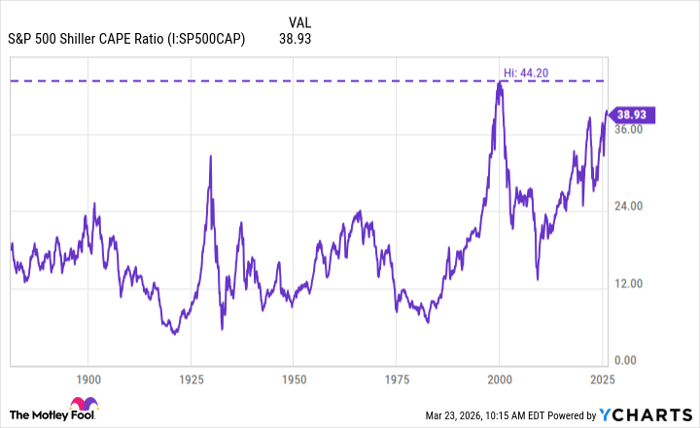
One valuation technique that mitigates this risk is the cyclically adjusted price-to-earnings (CAPE) ratio. The CAPE ratio accounts for 10 years' worth of financial data -- capturing trends in earnings growth and stock prices across various market cycles that may have experienced unusual levels of inflation or interest rate adjustments.
S&P 500 Shiller CAPE Ratio data by YCharts.
Currently, the S&P 500 Shiller CAPE ratio is 39. (It takes its name from the economist Robert J. Shiller, who invented it.) This is the second-highest CAPE reading in history. The only other time it was more inflated relative to its current level was in 2000 -- during the peak of dot-com euphoria.
Will the stock market crash in 2026?
There are two notable periods in financial history where the CAPE ratio soared to abnormal levels. The first was in the late 1920s. The stock market crashed shortly after the CAPE reached its peak during this period, triggering the Great Depression.
As referenced earlier, another notable instance in which the market reversed course after the CAPE ratio soared to unsustainable levels occurred after the dot-com bubble burst. Given these trends, history suggests the stock market is headed for an epic crash sometime in 2026.
In reality, I think the current tailwinds fueling the market -- namely, AI-driven growth -- are very different from those in the 1920s and early 2000s. For example, during the early days of the internet, many companies lacked business plans or product lines that benefited from online services in concrete ways.
In other words, many of the casualties of the dot-com era were companies rooted in wishful thinking from the start. Hence, they never should have achieved their astronomical valuations to begin with.
The AI era is far different. While there are some companies that are likely witnessing undeserved premiums, the biggest influences on the stock market -- namely, the trillion-dollar big tech companies -- are, for the most part, already generating record profits from AI.
How should investors prepare for stock market volatility?
While I do not think the stock market will crash and enter a prolonged bear market, I do think 2026 could feature a prolonged correction. This raises the question: How should smart investors structure their portfolios to reduce downside risk? To me, the answer is simple.
First, I would encourage investors to eliminate exposure to speculative stocks. While buying into the idea of asymmetric upside can be both tempting and entertaining, these businesses are often unprofitable and hinge on moonshots that take off commercially at an unknown point in the future. During periods of market uncertainty, these stocks are usually the first to sell off.
Second, I would opt for a basket of blue chip companies with durable business models to generate cash flow. This approach allows you to build a diversified portfolio and gain exposure to multiple industries. Hence, your portfolio is not over-allocated to one specific theme or market sector. This strategy helps counterbalance volatility.
Lastly, it's generally not a bad idea to stockpile cash. Complementing your stocks with cash can provide you with flexibility during times of harsh selling pressure -- allowing you to buy the dip in quality business and bolster your long-term upside.
Where to invest $1,000 right now
When our analyst team has a stock tip, it can pay to listen. After all, Stock Advisor’s total average return is 912%* — a market-crushing outperformance compared to 185% for the S&P 500.
They just revealed what they believe are the 10 best stocks for investors to buy right now, available when you join Stock Advisor.
See the stocks »
*Stock Advisor returns as of March 27, 2026.
Adam Spatacco has no position in any of the stocks mentioned. The Motley Fool has no position in any of the stocks mentioned. The Motley Fool has a disclosure policy.
Recommended Articles


