


From 1980 to Today: What Past Recessions Tell Us About Future Downturns in the Stock Market
Key Points
A recession is a major decline in economic activity that lasts more than a few months.
The U.S. economy has experienced six recessions since the beginning of 1980.
All major stock market indexes have recovered from past recessions and reached new highs.
- These 10 stocks could mint the next wave of millionaires ›
Nobody likes hearing the word "recession" because it typically comes with high unemployment, less money to spend, or more overall economic stress. However, recessions are a natural part of the economic cycle, and have been since the start of modern trade.
The National Bureau of Economic Research (NBER) defines a recession as a major decline in economic activity that lasts more than a few months. The length and severity of these recessions vary widely, but each one we've experienced has eventually ended and led to growth.
Will AI create the world's first trillionaire? Our team just released a report on the one little-known company, called an "Indispensable Monopoly" providing the critical technology Nvidia and Intel both need. Continue »
Although the economy and stock market operate separately, there is an inherent connection between them. Past happenings don't guarantee future happenings, but it's worth reflecting on how past recessions have played out in the stock market.
Image source: Getty Images.
How recessions have played out since 1980
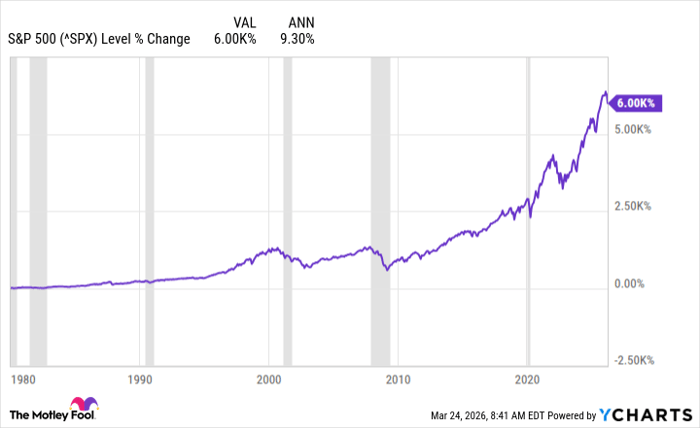
Below is a snapshot of the past six recessions the U.S. has experienced since 1980, and how the S&P 500 has performed since bottoming out during that time (gains are through market close on March 23):
- 1980: High inflation and rising energy costs
- Length: 6 months
- S&P 500 trough date: March 27, 1980
- Gains since trough: 6,600%
- 1981 to 1982: High interest rate hikes
- Length: 16 months
- S&P 500 trough date: Aug. 12, 1982
- Gains since trough: 6,325%
- 1990 to 1991: War in the Middle East and rising oil prices
- Length: 8 months
- S&P 500 trough date: Oct. 11, 1990
- Gains since trough: 2,127%
- 2001: Tech bubble beginning to burst
- Length: 8 months
- S&P 500 trough date: Oct. 9, 2002
- Gains since trough: 747%
- 2007 to 2009: Financial crisis
- Length: 18 months
- S&P 500 trough date: March 9, 2009
- Gains since trough: 872%
- 2020: COVID-19
- Length: 2 months
- S&P 500 trough date: March 23, 2020
- Gains since trough: 194%
There's one key takeaway from this: Every recession has led to a full market recovery, with major indexes surging past their pre-recession highs.
This isn't to say a recession is on the way, but according to research from The Motley Fool, a good number of investors believe there's a real risk of one. It's the biggest concern, along with inflation. These past results should provide a sense of relief for investors that even if it happens, it's not the end of the world.
^SPX data by YCharts. Gray columns indicate recessions.
How should investors approach the market?
One thing you want to avoid is trying to time the market. You don't want to stop investing because you're anticipating a recession or bear market, nor would you want to hurry and invest lump sums because you're anticipating a recovery or bull market.
Timing the stock market might be smart if the market were rational, but unfortunately, it's not. Nobody -- and I do mean nobody -- can predict how the market will move in the near term. You can make educated guesses, but at the end of the day, they're just that: guesses.
A better approach would be to use dollar-cost averaging, which involves investing fixed amounts at set intervals regardless of how the market or economy is performing at the time. Whether stock prices are skyrocketing or free-falling at the time, your goal should be to stick with your set investing schedule.
By putting yourself on a set schedule, you remove much of the temptation to try to time the market.
Always keep a long-term mindset when investing
Investing isn't something you should do with a get-rich-quick mindset (since getting rich quick rarely happens). It should always be about the long-term benefits. There's a reason why "time in the market beats timing the market" has held true across decades.
Admittedly, this is easier said than done, especially when you're seeing your portfolio value drop. However, those "losses" are only on paper unless you decide to sell.
That's why having an emergency fund saved up is important. It allows you to have a financial cushion, so you're not forced to sell your investments when prices are low or falling, and potentially lose money or gain much less than you would have otherwise. Having an emergency fund allows you to better ride out rough patches and keep a long-term mindset.
Where to invest $1,000 right now
When our analyst team has a stock tip, it can pay to listen. After all, Stock Advisor’s total average return is 912%* — a market-crushing outperformance compared to 185% for the S&P 500.
They just revealed what they believe are the 10 best stocks for investors to buy right now, available when you join Stock Advisor.
See the stocks »
*Stock Advisor returns as of March 26, 2026.
The Motley Fool has a disclosure policy.
Recommended Articles


