


Forget the AI Sell-Off: These 2 Artificial Intelligence (AI) Stocks Are Actually Getting Cheaper While Their Businesses Get Stronger
Key Points
Artificial intelligence stocks have been under pressure throughout 2026.
Some tech companies with cratering stock prices are still generating monster AI-driven growth.
Nvidia and Meta are currently trading at significant discounts compared to their historic valuations.
- 10 stocks we like better than Nvidia ›
In the high-stakes world of artificial intelligence (AI), industry dominance is not always rewarded with a premium stock valuation. Over the last month, AI stocks have plummeted in part due to fears of a bubble as well as Wall Street's skepticism that the big tech players can keep funding their infrastructure buildouts at their current ambitious levels.
Two of the most formidable players in the AI ecosystem are Nvidia (NASDAQ: NVDA) and Meta Platforms (NASDAQ: META). Despite their businesses scaling at unprecedented levels, the market has begun pricing these stocks lower.
Will AI create the world's first trillionaire? Our team just released a report on the one little-known company, called an "Indispensable Monopoly" providing the critical technology Nvidia and Intel both need. Continue »
Let's take a look at how AI is transforming Nvidia and Meta and thoroughly assess each company's valuation profile during this otherwise uncertain period for growth stocks.

Image source: Nvidia.
Nvidia owns the AI infrastructure boom
Despite intensifying competition from the likes of Advanced Micro Devices and Broadcom, Nvidia maintains a 92% market share in data center graphics processing units (GPUs). Its position as king of the GPU realm is undisputed, and its hardware provides the main parallel-processing muscle for training generative AI models.
Nvidia's data center dominance extends to software, too. The company's Compute Unified Device Architecture (CUDA) platform allows developers to program its chips for whatever accelerated computing needs they require. Importantly, much of the foundation programming in the AI sector was done in CUDA. Nvidia's full-stack approach has helped the company build a structural moat around developing next-generation AI systems.
Nvidia's performance in 2025 underscores the company's unprecedented momentum. For its fiscal 2026 (which ended Jan. 25), Nvidia reported record revenue of $215.9 billion -- up 65% year over year. The company's data center segment continues to shine. It grew 75% year over year to $62.3 billion in the fourth quarter alone.
What's even more impressive is management's forward guidance. For its fiscal 2027 first quarter, Nvidia expects to generate $78 billion in revenue -- and that figure excludes any sales it might make to companies in China. This would amount to growth of 77% year over year.
While these forecasts may seem overzealous at first glance, consider Nvidia CEO Jensen Huang recently suggested that data center spending could land in the range of $3 trillion to $4 trillion by 2030. The secular tailwind fueling AI infrastructure demand bodes well for Nvidia's product pipeline.
Nevertheless, despite its current trajectory and potential for even more explosive growth, Nvidia's forward price-to-earnings (P/E) ratio of 21 is nowhere near the premiums it boasted during prior cycles of the AI revolution.
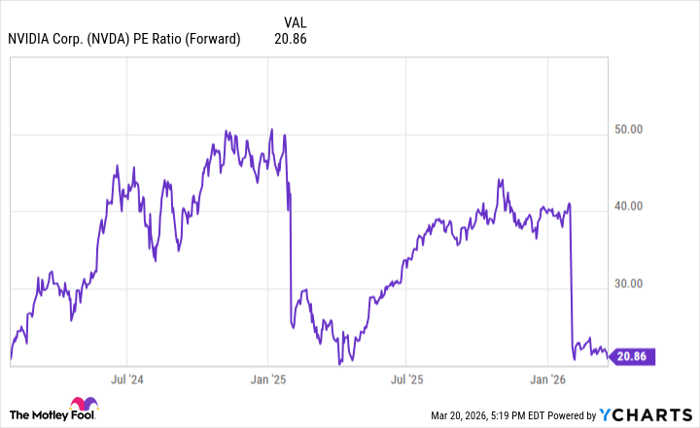
NVDA PE Ratio (Forward) data by YCharts.
Don't get bogged down by Meta's infrastructure surge
Meta is embedding AI directly into some of the world's most popular social media channels -- Facebook, Instagram, and WhatsApp. Through advancements in machine learning, Meta is using AI to supercharge user engagement, increase advertising efficiency, and enhance the user experience.
These efforts are already having positive impacts on Meta's business. Advertising revenue is rising at a healthy clip, reflecting AI-driven efficiencies in both customer targeting and creative campaign generation. The important takeaway here is that Meta's AI models are well beyond the experimental phase.
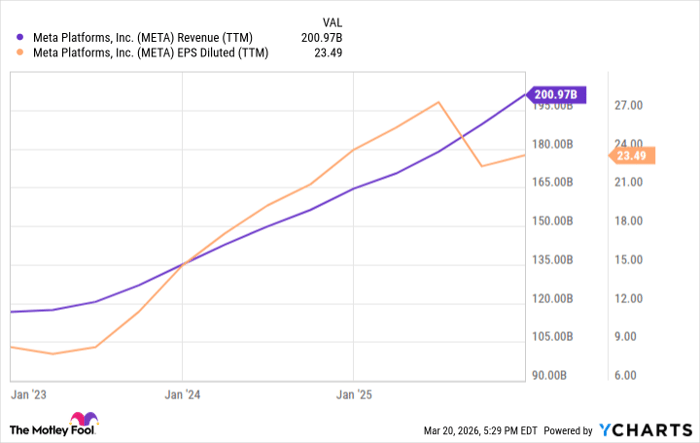
META Revenue (TTM) data by YCharts.
Despite the company's progress on the top and bottom lines, the stock has been under pressure as of late. One big driver of the sell-off is likely the company's capital expenditure plan. Meta has told investors that it intends to spend up to $135 billion on AI infrastructure in 2026 -- nearly double what it spent on it last year.
To me, this strategy makes perfect sense. Meta has an unmatched treasure trove of real-world consumer data with which to train its AI models. By spending today, the company seeks to secure the inference scale it will require to evolve its AI ecosystem.
Over time, this approach should help Meta unlock new revenue streams in commerce, entertainment, and enterprise tools -- all while lowering overhead costs. In light of its heavy spending, though, Meta hovers at a forward P/E ratio of about 20, compared to its three-year average of around 23.
The bottom line: Buy the dips in Nvidia and Meta right now
In my opinion, the market is beginning to cautiously price the durability of Nvidia's leadership position in the AI landscape instead of assigning it a premium based on the ongoing acceleration of its underlying business.
Similarly, investors appear to be increasingly viewing Meta as a steadily profitable value play, which is why it trades at multiples that understate the long-term potential value it could accrue from AI-driven efficiencies.
These compressions in their valuations are not signals of weakness, and the real opportunities lie in recognizing that neither business is truly maturing at this stage.
For this reason, now looks like a great time to buy the dip in both Nvidia and Meta, as they remain positioned to be enduring compounders in the AI era.
Should you buy stock in Nvidia right now?
Before you buy stock in Nvidia, consider this:
The Motley Fool Stock Advisor analyst team just identified what they believe are the 10 best stocks for investors to buy now… and Nvidia wasn’t one of them. The 10 stocks that made the cut could produce monster returns in the coming years.
Consider when Netflix made this list on December 17, 2004... if you invested $1,000 at the time of our recommendation, you’d have $490,325!* Or when Nvidia made this list on April 15, 2005... if you invested $1,000 at the time of our recommendation, you’d have $1,074,070!*
Now, it’s worth noting Stock Advisor’s total average return is 900% — a market-crushing outperformance compared to 184% for the S&P 500. Don't miss the latest top 10 list, available with Stock Advisor, and join an investing community built by individual investors for individual investors.
See the 10 stocks »
*Stock Advisor returns as of March 25, 2026.
Adam Spatacco has positions in Meta Platforms and Nvidia. The Motley Fool has positions in and recommends Advanced Micro Devices, Meta Platforms, and Nvidia. The Motley Fool recommends Broadcom. The Motley Fool has a disclosure policy.
Recommended Articles


