


Gold Suffers Epic Plunge, March Cumulative Decline Exceeds 20%. Has Gold Become a Risk Asset?

 Trending Articles
- Breaking: Gold falls below $5,000 as oil-driven inflation fears weigh
- $180 Oil Prices Imminent? Saudi Arabia Warns: Crisis to Last Until Late April, Oil Prices Will Break Historic Highs
- Gold tumbles below $4,650 as inflation fears and liquidity squeeze weigh
- Gold falls below $4,850 as Fed holds rates steady
- WTI rises above $95.00 as Iran's attacks on facilities fuel supply fears
- Surging Over 20%. Ethereum Crushing Bitcoin, What Does This Really Mean?
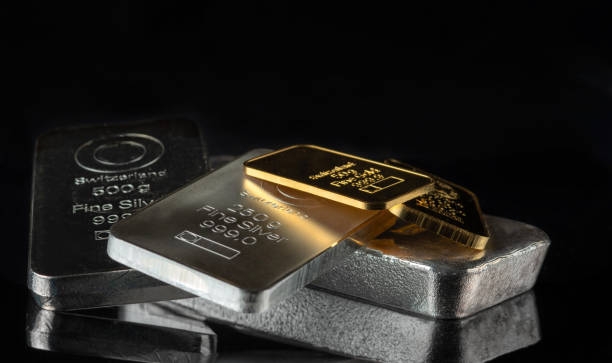
TradingKey - At 3:21 AM Beijing time during the Asian trading session, Spot gold (XAUUSD) fell nearly 9% intraday, at one point dropping below the $4,100 per ounce mark. This not only erased all gains for the year 2026 but also marked the largest single-month decline of the 21st century. Since March, spot gold prices have plunged by more than $1,000. Meanwhile, spot silver (XAGUSD) simultaneously dropped to $61 per ounce, falling 10% intraday.
Based on recent price movements, gold appears to have become a high-beta risk asset similar to Bitcoin, running counter to traditional safe-haven logic.
Why is the current volatility in gold so significant?
The magnitude of gold's current price swings is truly exceptional and remains relatively rare from a historical perspective.
First, from a market structure standpoint, gold's investment vehicles have evolved from traditional physical holdings into a multi-tiered financial system centered on gold ETFs, futures, options, and over-the-counter derivatives. Against the backdrop of highly diversified financial instruments, the "tradability" and "leverageability" of gold have increased significantly, making its price not only reflective of fundamental expectations but also highly sensitive to capital flows and position adjustments.
Second, the introduction of leverage mechanisms has amplified price elasticity. In futures and derivatives markets, the widespread application of margin trading and algorithmic trading strategies makes gold prices more susceptible to amplification when trends form; during trend reversal phases, concentrated stop-loss orders or forced liquidations can trigger an accelerated decline, creating a typical "pro-cyclical amplification effect."
Third, changes in the structure of market participants are also a key factor. With the large-scale participation of global macro hedge funds, CTA strategies, and cross-asset allocation funds, gold has transformed from a standalone safe-haven asset into a "macro trading tool."
In the current environment, its price is not only influenced by inflation expectations and real interest rates but also highly correlated with the US Dollar Index, real yields, and the performance of risk assets. This multi-factor driving mechanism significantly increases the complexity of its volatility.
Furthermore, marginal changes in sentiment and liquidity cannot be ignored. During periods of rising uncertainty, gold often benefits from safe-haven demand and moves up rapidly; however, when the market enters a "liquidity first" phase, capital may instead be withdrawn from gold to supplement cash or cover losses in other assets, leading to sharp price reversals in a short period.
Has gold turned from a safe-haven asset into a risk asset?
From a macro perspective, global instability does indeed drive the strengthening of safe-haven assets. However, the US dollar, as the global currency, appears to possess greater potential as a safe-haven asset. Although the continuous expansion of US debt has significantly weakened the credibility of the dollar, historical global development suggests that the greenback remains the asset with the strongest safe-haven consensus.
Meanwhile, the US Dollar Index has fallen to recent lows, and the conflict in the Middle East has driven up global energy prices, leading to higher inflation expectations. As market expectations for interest rate cuts by major central banks diminish, the attractiveness of holding gold has declined, with capital still favoring yield-bearing currency assets over gold.
It should be noted that, given the excessive gains in gold during 2025 and liquidity requirements, some institutions had previously chosen to reduce their gold holdings. Asian institutions, which had previously increased their gold positions significantly, have also seen a substantial slowdown in their accumulation pace.
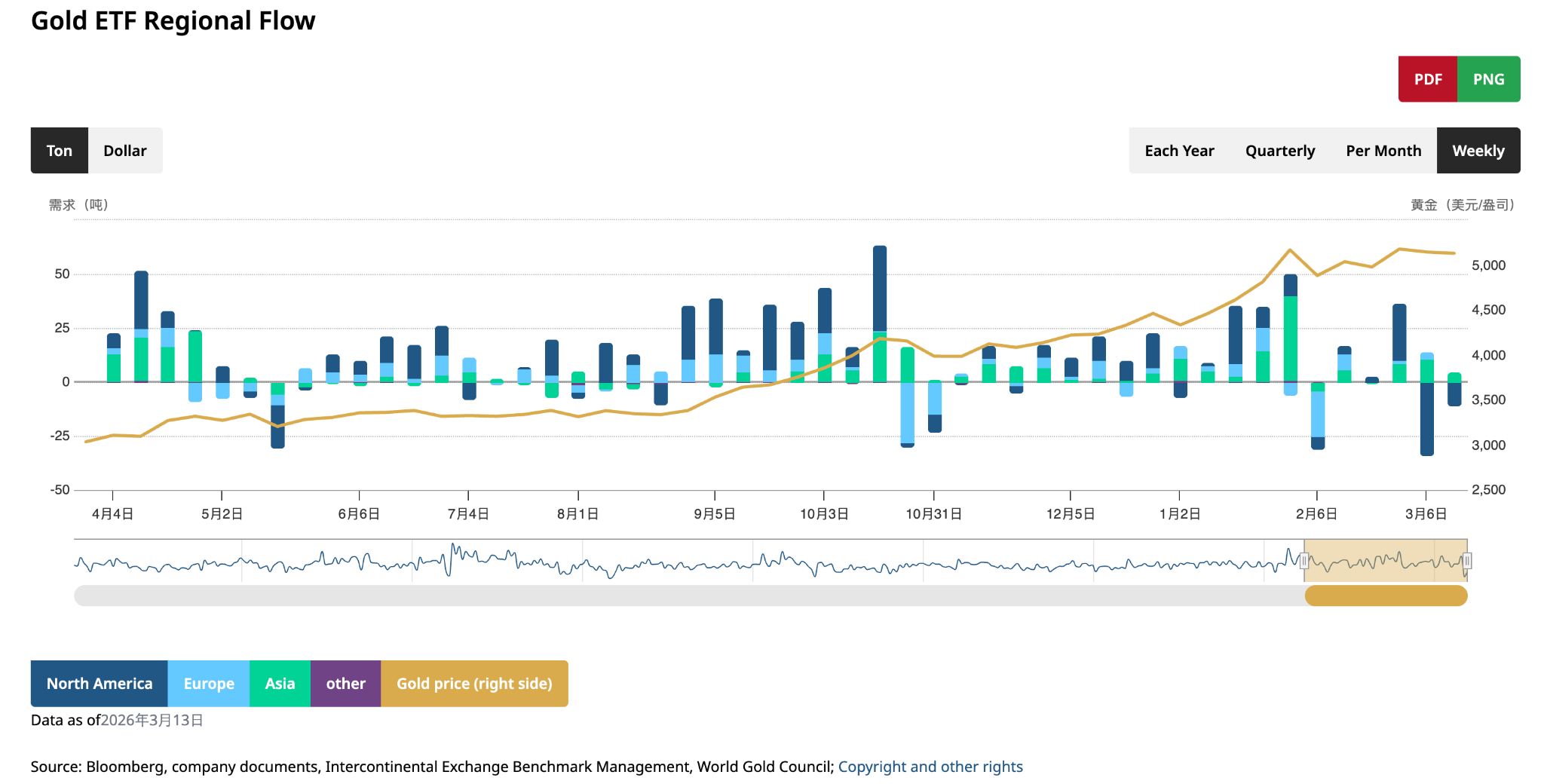
According to gold ETF flow data, the amount of holdings reduced in March was the largest of the year, primarily reflected in selling by institutions in South America.
At the same time, the Central Bank of Russia sold 300,000 ounces of gold in January alone, marking one of the largest single-month official gold reductions in recent years.
Federal Reserve Chair Jerome Powell previously emphasized that it is still unclear how much the rise in oil prices will affect consumption, and the Fed has to adopt a wait-and-see approach. He also signaled to the market that swift action will be taken to curb inflationary pressures if necessary. Tightening monetary policy by various central banks will support the dollar and dampen investor demand for precious metals such as gold and silver.
Despite the numerous short-term headwinds facing gold prices, some market analysts remain optimistic about its long-term prospects.
Adrian Day, president of Adrian Day Asset Management in the US, believes that the reasons investors have bought gold over the past few years have not disappeared, and the fundamental monetary and fiscal issues driving the gold bull market will continue to manifest once conflicts end or the situation stabilizes.
Given that gold's fundamentals have not undergone a fundamental reversal and there is a lack of assets in the market capable of replacing its credit-hedging properties over the long term, the underlying logic of gold as a safe-haven asset remains unchanged. However, at this stage, its price is increasingly dominated by the liquidity environment, interest rate paths, and capital behavior, exhibiting stronger characteristics of "risk assetization" in the short term.
In other words, gold's intrinsic properties have not changed, but its trading logic is undergoing a phase shift—from a "value anchor" to a "流动性锚" (liquidity anchor). This also means that until macro uncertainties subside, its volatility is likely to remain at elevated levels.
Read more
* The content presented above, whether from a third party or not, is considered as general advice only. This article should not be construed as containing investment advice, investment recommendations, an offer of or solicitation for any transactions in financial instruments.


