


How This Mid Cap ETF Contributes to a Balanced Portfolio
Key Points
The outperformance of the S&P 500 over the past few years has left many parts of the U.S. equity market ignored.
Historically, mid-caps have outperformed large-caps and small-caps over time.
As the current rotation away from tech deepens, mid-caps provide an excellent balance between growth and value.
- 10 stocks we like better than Vanguard Mid-Cap ETF ›
When discussing U.S. stocks, most people refer to the S&P 500 (SNPINDEX: ^GSPC) as "the market." Even when talking more broadly, the argument is usually large-caps versus small-caps.
Why do mid-caps frequently get left out of the discussion? In theory, they could provide the best of both worlds -- higher growth potential relative to more mature large companies but more established and durable than smaller ones.
Where to invest $1,000 right now? Our analyst team just revealed what they believe are the 10 best stocks to buy right now, when you join Stock Advisor. See the stocks »
It turns out, that theory is backed up by data. Going back more than 30 years, the S&P 400 Mid Cap (SNPINDEX: ^MID) index has beaten both the S&P 500 and the S&P 600 Small Cap index by a fairly sizable margin.
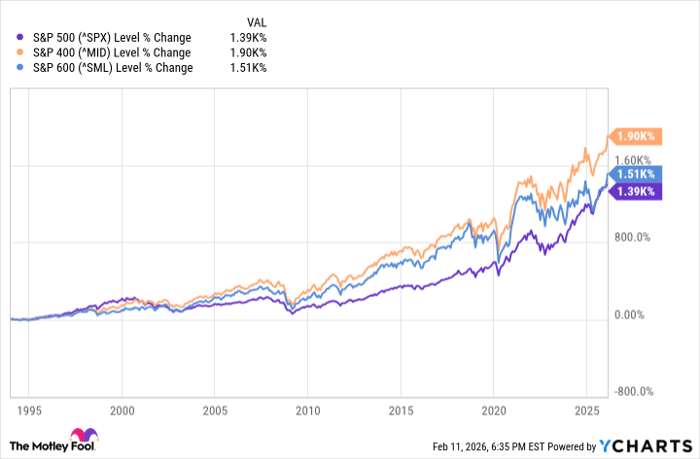
^SPX data by YCharts
In other words, mid-caps shouldn't be ignored in a broader portfolio. They've demonstrated an ability to enhance returns and provide exposure to a segment of the market that looks much different than that of the S&P 500.
My favorite pick in this space is the Vanguard Mid-Cap ETF (NYSEMKT: VO). Not only does it come with the cost advantage of many Vanguard ETFs, it's constructed in a way that I believe is more advantageous for investors.

Image source: Getty Images.
What is the Vanguard Mid-Cap ETF?
This ETF tracks the CRSP U.S. Mid Cap Index. This is important to note right away because it defines mid-cap stocks differently than the methodology used for the S&P 400 index mentioned above.
It measures the performance of companies ranked within the cumulative 70%-85% market capitalization range of the investable market. That means there's no set number of companies that need to be included or any special criteria applied. It's essentially including all companies that fall within this market cap range.
The S&P 400 differs in a few ways:
- Index components are selected by a committee. Some companies could meet market cap requirements, but get left out of the index.
- It targets 400 components for the index. More specifically, these companies would be No. 501-900 by market cap rank.
- The S&P indices apply a profitability screen. To be included, companies must have positive reported earnings in the most recent quarter and over the last four quarters. The CRSP indices have no such requirement.
This means that the portfolios of these seemingly similar "mid-cap ETFs" can actually look quite different. I prefer the Vanguard Mid-Cap ETF's more comprehensive coverage in this space.
Mid-caps have a much different sector composition than the S&P 500
Most people already know that the S&P 500 has a very high allocation to tech and the Magnificent Seven stocks. The mid-cap market tends to be 1. spread out more diversely across multiple market sectors and 2. is more exposed to cyclically sensitive areas of the market.
The Vanguard Mid-Cap ETF's top sector holdings include Industrials (19.7%), Consumer Discretionary (15.5%), Financials (13.8%), Technology (13.3%), and Utilities (8.9%). This is a much different mix than we see in the S&P 500, which has nearly 35% of its index tied to tech stocks alone.
It's also likely to be more closely tied to the health of the U.S. economy and interest rates. This is the case with tech as well, but tech, as we've seen over the past year, can be heavily influenced by the emergence of the next big technological advance. The artificial intelligence (AI) boom has pushed tech stock prices higher on hope as much as results.
Industrials, Financials, and Consumer Discretionary tend to be more closely linked to manufacturing, consumers' willingness to borrow and/or spend money, and the direction of interest rates. It's a different set of influences that actually help boost the case for mid-caps as a diversifier.
Plus, mid-caps are generally less expensive than large-caps. The Vanguard Mid-Cap ETF price/earnings ratio is about 23 compared to 28 for the Vanguard S&P 500 ETF.
Don't forget about mid-caps in your portfolio
Mid-caps have delivered demonstrably better performance over history compared to large-caps, but that's not the whole story.
Mid-cap stocks offer a different risk/return profile, sector composition, and level of value. That's what you should look for when constructing a balanced portfolio. Assets that act, perform, and look differently. Assets that are able to reduce overall risk when paired together.
The Vanguard Mid-Cap ETF does that for equity investors. Given how the market has shifted in 2026, that might be exactly what they need.
Should you buy stock in Vanguard Mid-Cap ETF right now?
Before you buy stock in Vanguard Mid-Cap ETF, consider this:
The Motley Fool Stock Advisor analyst team just identified what they believe are the 10 best stocks for investors to buy now… and Vanguard Mid-Cap ETF wasn’t one of them. The 10 stocks that made the cut could produce monster returns in the coming years.
Consider when Netflix made this list on December 17, 2004... if you invested $1,000 at the time of our recommendation, you’d have $414,554!* Or when Nvidia made this list on April 15, 2005... if you invested $1,000 at the time of our recommendation, you’d have $1,120,663!*
Now, it’s worth noting Stock Advisor’s total average return is 884% — a market-crushing outperformance compared to 193% for the S&P 500. Don't miss the latest top 10 list, available with Stock Advisor, and join an investing community built by individual investors for individual investors.
See the 10 stocks »
*Stock Advisor returns as of February 17, 2026.
David Dierking has no position in any of the stocks mentioned. The Motley Fool has positions in and recommends Tesla, Vanguard Mid-Cap ETF, and Vanguard S&P 500 ETF. The Motley Fool has a disclosure policy.
Recommended Articles


