


A Once-in-a-Decade Investment Opportunity: 1 Magnificent Artificial Intelligence (AI) Software Stock to Buy Hand Over Fist Right Now
Key Points
Amazon plans to spend $200 billion on artificial intelligence (AI) infrastructure in 2026.
While rising capital expenditures may decelerate Amazon's free cash flow in the near term, the company's long-term gains look compelling.
Amazon is seeing robust growth in its cloud segment for the first time in over three years thanks to advances in AI.
- 10 stocks we like better than Amazon ›
It's been an odd year for Amazon (NASDAQ: AMZN) investors so far. In early January, the stock popped roughly 7% to $247 per share -- just inches away from notching a new all-time high. But over the last month, Amazon stock has been sliding -- now down about 14% on the year as software stocks continue to plummet.
Let's dig into the driving forces behind Amazon's sell-off. From there, I'll detail why smart investors view this dip as a generational buying opportunity.
Where to invest $1,000 right now? Our analyst team just revealed what they believe are the 10 best stocks to buy right now, when you join Stock Advisor. See the stocks »

Image source: Amazon.
Why Amazon's $200 billion AI budget is worth it
Prior to Amazon's fourth-quarter earnings call on Feb. 5, Wall Street was expecting management to guide for capital expenditures of about $150 billion for this year. Spoiler alert: Amazon plans to spend $200 billion, far more than investors were expecting.
As Amazon continues to pour money into procuring GPUs from Nvidia, designing its own custom silicon, and building AI data centers, the company's free cash flow generation will decelerate. The combination of accelerating infrastructure spend and diminishing cash flow is what's causing investors to dump Amazon stock right now.
Here's what investors are missing: During the fourth quarter, Amazon Web Services (AWS) generated $35.6 billion in revenue -- representing 24% growth year over year. This is the highest growth from AWS in 13 quarters, and data suggests the ride is just getting started. Backlog from AWS sits at a whopping $244 billion -- up 40% year over year and an impressive 22% from the third quarter.
Importantly, AWS is a high-margin business for Amazon. While the company's profitability in the e-commerce division can experience pronounced swings due to seasonality and fluctuations in consumer buying patterns, AWS remains more resilient -- often generating operating margins in the mid-30% range.
The consistency of AWS's profit margins is what fuels robust cash flow for Amazon -- providing the company with a high degree of financial flexibility to reinvest in the business, as it's doing now.
Beyond LLMs: How Anthropic is turning Amazon into an AI ecosystem
One of the biggest contributors to the AWS renaissance is Amazon's relationship with Anthropic. Anthropic's Claude model is heavily integrated throughout the AWS ecosystem, particularly in a product called Amazon Bedrock.
Moreover, Anthropic is also leveraging Amazon's custom Trainium and Inferentia chips. By partnering closely with a leading enterprise AI system and designing its own infrastructure, Amazon is quietly building a cost-efficient, vertically integrated AI stack.
This strategy helps Amazon move beyond the world of basic chatbots and win over sophisticated, data-heavy enterprise workflows.
Is Amazon's pullback a buying opportunity?
I think most investors are overlooking the fact that Amazon is already bearing fruit from its AI-related investments. In my eyes, it makes complete sense for the company to double down and increase its infrastructure spend.
While there may be a lag between the initial capital outlay and a meaningful return on investment for these buildouts, the evidence is already clear: AWS is becoming more than a capacity service, and the combination of Anthropic and custom silicon serves as strategic assets for Amazon's AI ecosystem.
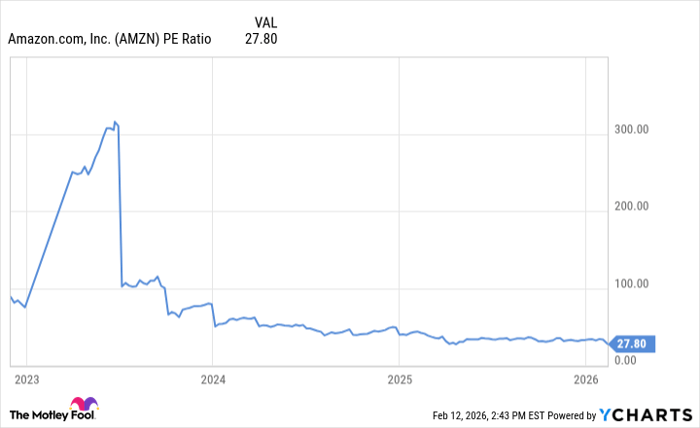
AMZN PE Ratio data by YCharts
Nevertheless, the software bear market has brought Amazon stock to its cheapest levels during the entire AI revolution based on price-to-earnings (P/E) trends.
I think Amazon is a no-brainer buy at this price point. The stock is heavily discounted relative to the company's upside potential, making it a compelling opportunity to buy and hold as the AI movement continues to benefit the hyperscaler.
Should you buy stock in Amazon right now?
Before you buy stock in Amazon, consider this:
The Motley Fool Stock Advisor analyst team just identified what they believe are the 10 best stocks for investors to buy now… and Amazon wasn’t one of them. The 10 stocks that made the cut could produce monster returns in the coming years.
Consider when Netflix made this list on December 17, 2004... if you invested $1,000 at the time of our recommendation, you’d have $414,554!* Or when Nvidia made this list on April 15, 2005... if you invested $1,000 at the time of our recommendation, you’d have $1,120,663!*
Now, it’s worth noting Stock Advisor’s total average return is 884% — a market-crushing outperformance compared to 193% for the S&P 500. Don't miss the latest top 10 list, available with Stock Advisor, and join an investing community built by individual investors for individual investors.
See the 10 stocks »
*Stock Advisor returns as of February 16, 2026.
Adam Spatacco has positions in Amazon and Nvidia. The Motley Fool has positions in and recommends Amazon and Nvidia. The Motley Fool has a disclosure policy.
Recommended Articles


