


This Super Software Stock Is the Cheapest It Has Ever Been. Time to Swoop in and Buy?
Key Points
Atlassian offers a portfolio of software products designed to help organizations improve productivity.
The company has infused artificial intelligence (AI) into its core products, which is driving increased spending from its customers.
Atlassian stock is trading at the cheapest price-to-sales ratio in its history, and it could be a solid long-term buy.
- 10 stocks we like better than Atlassian ›
We're a little over a month into 2026, and the S&P North American Technology Software Index is already down 20%. Investors are panicking about the potential impacts of artificial intelligence (AI), which could render many enterprise software tools obsolete because it allows businesses to rapidly build their own internally.
Atlassian (NASDAQ: TEAM) sells a portfolio of software products designed to help organizations improve productivity by facilitating collaboration between employees, and by streamlining workflows. The company's stock is faring even worse than many of its peers, with a staggering 39% decline in 2026 already. If that isn't bad enough, it's now down 80% from its 2021 record high.
Will AI create the world's first trillionaire? Our team just released a report on the one little-known company, called an "Indispensable Monopoly" providing the critical technology Nvidia and Intel both need. Continue »
However, Atlassian's annualized revenue just hit a record high, which suggests the recent hysteria might be overblown. In fact, the company continues to launch its own AI products, which its customers are adopting at a rapid pace. With Atlassian stock now at the cheapest level since it went public in 2015, could this be a great long-term buying opportunity?

Image source: Getty Images.
AI is transforming Atlassian's products
Jira and Confluence are Atlassian's main products. Jira was designed to help software development teams track their projects, quickly troubleshoot bugs, and ship upgrades, but it's increasingly used by non-technical departments like human resources to track general tasks. Confluence, on the other hand, is like a digital town square where employees across an entire organization can share information, important documents, and more.
Atlassian launched an AI platform called Rovo in 2024, which enhances tools like Jira and Confluence. It offers a powerful search function that can instantly track down information from across the entire organization, whether it's stored in an Atlassian software product or in a third-party app like Alphabet's Google Drive.
Rovo can also collaborate with employees through its chat function, helping them achieve their goals more quickly. Plus, workers can create custom AI agents for specific tasks, whether it's analyzing incoming tickets in Jira or creating a research report for a future project.
At the end of Atlassian's fiscal 2026 second quarter (ended Dec. 31), Rovo had over 5 million monthly active users, which is an incredible accomplishment for a product that is barely two years old.
Revenue growth is accelerating
Atlassian generated $1.6 billion in total revenue during its fiscal 2026 second quarter, which was a 23% increase from the year-ago period. That was the fastest quarterly growth rate in almost two years (since the fiscal 2024 third quarter), although the company did benefit from a one-off accounting adjustment to its data center business, which boosted its overall revenue.
Atlassian's annual run rate revenue also surpassed $6 billion for the first time during the second quarter, and it appears AI has been a major tailwind, rather than a threat. The company's cloud business achieved a net revenue retention rate of 120% during the quarter, which ticked higher for the third straight period. It means existing customers were spending 20% more money with Atlassian than they were in the same quarter a year ago, and management says the expanding use of its AI platform is the reason.
Moreover, the number of deals Atlassian signed worth more than $1 million in annual revenue doubled year over year during the second quarter, suggesting there is still significant demand for its software platforms among large organizations.
Atlassian stock is the cheapest it has ever been
Since Atlassian's consistent revenue growth has been accompanied by an 80% decline in its peak stock price from 2021, its price-to-sales (P/S) ratio is now just 4.3. That is the cheapest level since the company went public more than a decade ago:
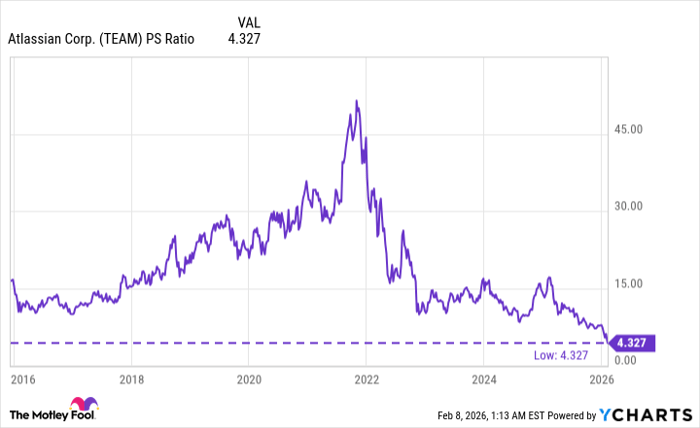
TEAM PS Ratio data by YCharts
Atlassian values its addressable market at $67 billion, and it says that figure is growing by around 13% annually. In other words, the company doesn't believe AI is about to derail its opportunity -- in fact, this new technology seems to be adding value instead.
On the flip side, that could change as AI-powered development tools like Anthropic's Claude Code become even more proficient at building sophisticated software projects. But I think large organizations will still prefer using experienced vendors that deliver more than just software -- Atlassian, for example, also provides security, data center infrastructure, and technical support, which aren't as easy to replicate, and cost significant amounts of money.
Atlassian stock is offering up a great price right now, so I think investors who are willing to buy it now and hold on for the next three to five years could do well.
Should you buy stock in Atlassian right now?
Before you buy stock in Atlassian, consider this:
The Motley Fool Stock Advisor analyst team just identified what they believe are the 10 best stocks for investors to buy now… and Atlassian wasn’t one of them. The 10 stocks that made the cut could produce monster returns in the coming years.
Consider when Netflix made this list on December 17, 2004... if you invested $1,000 at the time of our recommendation, you’d have $443,353!* Or when Nvidia made this list on April 15, 2005... if you invested $1,000 at the time of our recommendation, you’d have $1,155,789!*
Now, it’s worth noting Stock Advisor’s total average return is 920% — a market-crushing outperformance compared to 196% for the S&P 500. Don't miss the latest top 10 list, available with Stock Advisor, and join an investing community built by individual investors for individual investors.
See the 10 stocks »
*Stock Advisor returns as of February 12, 2026.
Anthony Di Pizio has no position in any of the stocks mentioned. The Motley Fool has positions in and recommends Alphabet and Atlassian. The Motley Fool has a disclosure policy.
Recommended Articles


