


Is SaaS Dead? The Truth Behind the Software Meltdown, the Missing Floor, and the Peak That’s Not Coming Back
Over the past few weeks, you’ve probably seen the same refrain everywhere: “SaaS has crashed this much, valuations must have bottomed, time to buy the dip.”
On the surface, that sounds tempting. A lot of software names really have round-tripped back to valuation levels we haven’t seen in years. But lower prices don’t automatically mean lower risk. In public markets, cheap is often just a layover on the way to even cheaper. To make sense of this software bloodbath, we need to walk the timeline and unpack the logic underneath it step by step.
What Just Happened? A Trillion-Dollar AI-Triggered Selloff
Let’s start with the numbers. By early February, the IGV ETF, which tracks North American software, was down almost 20% year to date and close to 30% off its September peak. The sector’s forward P/E has collapsed from roughly 35x at the end of 2025 to around 20x today, back to levels the market hasn’t really seen since 2014.
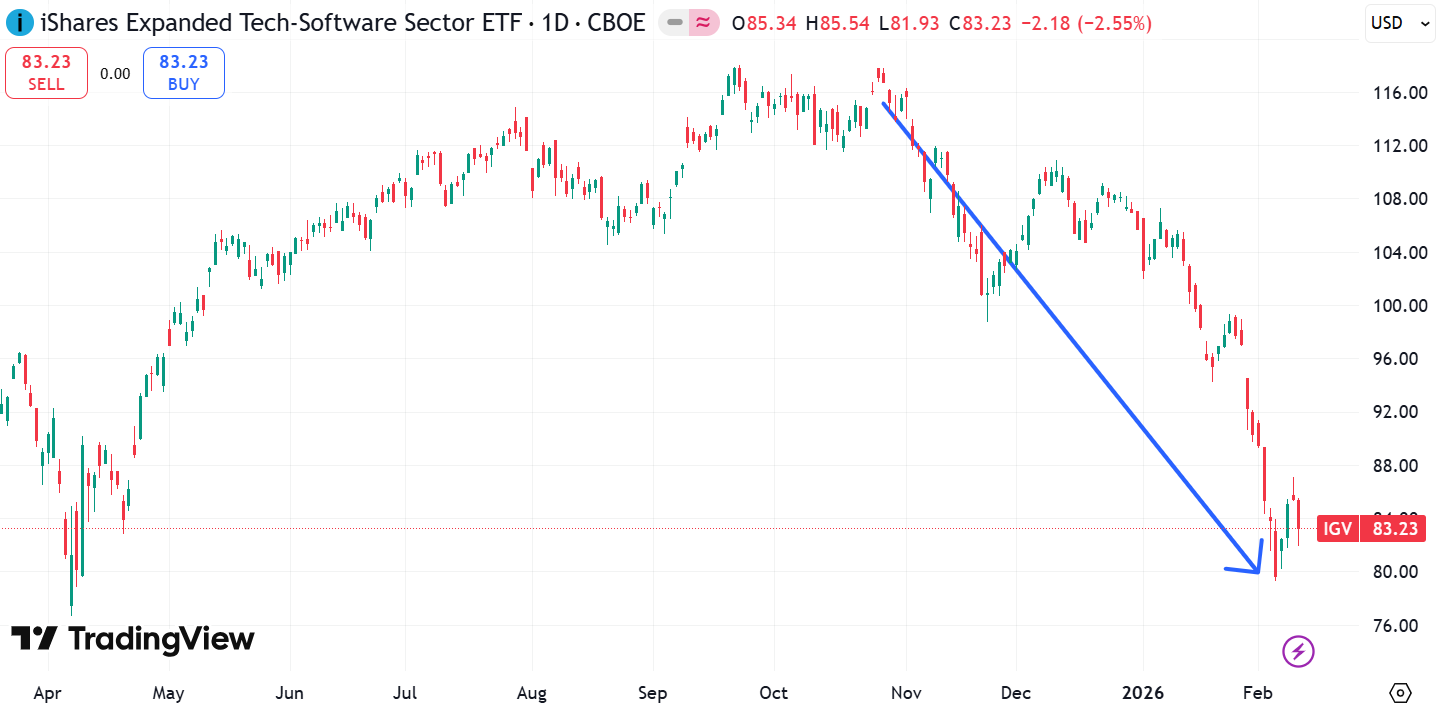
Source: TradingView
None of this was caused by a sudden macro shock or a blow-up at some mega-cap. The trigger was much smaller and more technical: a new wave of AI product launches, starting with Anthropic’s Claude Cowork and its follow‑on upgrades.
On January 12, Anthropic released Claude Cowork, a desktop AI agent that lets non‑technical knowledge workers offload complex, enterprise‑grade tasks to AI. Shortly after, Cowork gained industry‑specific plugins for finance, legal, consulting, and more. Then came Claude Opus 4.6, showing it could orchestrate entire teams of AI agents working together on multi‑step workflows.
That’s when a scary question snapped into focus in investors’ minds:
“If AI can sit at the center and route work directly to underlying tools, how much mindshare and budget do all these SaaS subscriptions really deserve?”
Capital voted with its feet. First, application software names were hit. Then the pain spilled over into asset managers, insurers, and business‑service platforms whose economics are tightly linked to software spend, and finally into alternative-asset firms that hold software-heavy portfolios. No macro black swan, no liquidity shock—just a wholesale repricing of what software is worth in an AI-first world.
A lot of people instinctively react: “It’s just another AI feature—how bad can it be?” To answer that, it helps to zoom into the most familiar territory: Excel, and see why Claude's performance in Excel exacerbates market concerns about Microsoft and the entire office software ecosystem during the Copilot era. Claude’s Excel plugin quietly did what Microsoft’s own Copilot should have nailed first—and didn’t.
On one side is the first-party, native Microsoft Copilot, and on the other is the third-party Claude, piggybacking on Excel; the result is that the latter completely crushes the former in terms of user experience. Specific differences:
- Responsiveness: Claude typically returns answers in 1–2 seconds; Copilot often spins for several seconds before responding.
- Solution quality: Claude offers multiple formula options for the same problem; Copilot frequently suggests a single formula and gives up quickly on complex tasks.
- Capability scope: Claude doesn’t just help you import data, it can draft and refine fairly complex data‑cleaning steps end‑to‑end. Copilot is still mostly confined to basic imports and simple operations.
- Context handling: Claude can reason across entire workbooks and multiple sheets to find relationships. Copilot tends to demand a neatly pre‑modeled table before it becomes truly useful.
Anyone in finance who has tried Claude for Excel will tell you: many financial modeling tasks that used to require analysts can now be handled directly by the plugin. From reading financial statements and building model frameworks to writing formulas and generating sensitivity analyses, it completes the entire process in one go, and the results are quite good. The only problem is that tokens are consumed rapidly, and computing power costs are visibly increasing, essentially turning it into a new variable that benefits computing power.
As Claude Code and Cowork spread, AI isn’t just nibbling around the edges in support or dev‑tool niches anymore. It’s starting to seep into high‑value white‑collar work in finance, law, consulting, insurance, and more. The total addressable market for agents is likely much larger than for models alone.
Any workflow that can be decomposed into “read documents → understand → generate output → write back into a system” is fair game for agents. That just happens to be where SaaS has lived for the past decade.
From “AI Will Help SaaS” To “AI Might Replace SaaS”
In 2024 and the first half of 2025, the dominant story was that AI would augment existing enterprises, making them stronger. Every software company talked about embedding AI and boosting user productivity.
By late 2025 and early 2026, that story quietly flipped. The reality on the ground was that the pace at which incumbents were adding AI lagged the pace at which native AI tools were beginning to replace them.
You still hear plenty of jokes about AI hallucinating and making silly mistakes. But there’s been a very visible shift that’s easy to miss if you don’t look closely. ByteDance’s Seedance 2.0 is a perfect example: its latest model has pushed AI video from “obviously fake” to “hard for a normal viewer to distinguish from real footage.” A year ago, most people could instantly spot an AI‑generated clip. Today, a huge share of short‑form videos and ads would be extremely hard for non‑experts to flag as synthetic unless they’re told in advance.
Software is going through the same kind of transition. A year ago, code generated by Claude Code was riddled with bugs and felt like a toy. Now it can reliably ship medium‑complexity projects with far less human scaffolding. Once people realize Claude Code can build bespoke tools that mirror their exact business workflows, those generic, look‑alike SaaS interfaces—just a few buttons on top of data—naturally get re‑evaluated.
There are still plenty of real‑world gaps: stability, security, enterprise deployment, auditability, compliance. None of that is trivial, and none of it goes away just because a demo looks slick. But if you look back at how far AI has come in the last 12 months, it’s hard not to imagine that many of today’s “not ready yet” objections could be gone 12 months from now.
That, fundamentally, is what the market is trading on. It isn’t trading today’s earnings (which, ironically, still look pretty good—sector profit margins are near 20‑year highs). It’s trading the world three years from now.
Salesforce: How AI Agents Eat a CRM Empire
If you need a textbook case of who’s in the firing line, Salesforce is about as clean a specimen as you can get.
As one of the largest SaaS companies on the planet, Salesforce’s stock began to underperform last year, then accelerated to the downside during the February AI panic. Year to date, it’s down close to 30%, and the company has just quietly cut nearly 1,000 roles in a fresh round of layoffs. The irony, of course, is that Salesforce is aggressively pushing its own AI agent platform, Agentforce, at the same time. Salesforce’s story perfectly captures the core tension of this selloff: legacy software giants are both victims and would‑be beneficiaries of AI. The market simply doesn’t believe they can reinvent themselves faster than AI can erode their old business models.
Look at what AI agents can already do inside the CRM stack:
- Customer service: Where a human agent might handle 50–60 tickets a day, an AI agent can chew through that volume in under an hour, cutting service‑desk costs by 30% or more in early deployments.
- Sales prep: Firms like RBC Wealth Management have rolled out agents to thousands of advisers; meeting prep that once took an hour now takes minutes, with automatic client digests and agendas replacing junior staff.
- Lead qualification: Virtual SDRs (sales development reps) can run 24/7, automatically scoring leads, sending outreach, tracking replies, and booking meetings.
Here’s the crux: Salesforce and peers have historically charged per seat—one license per person. But the person doing the work isn’t necessarily human anymore. It’s an AI agent that can replace multiple junior reps. In theory, Salesforce can bill separately for the agent. In practice, once a CFO discovers that “one agent + a small human team” can achieve the same output as an entire legacy team, the natural next step is to cut headcount licenses and only pay for the minimum number of humans plus a handful of agent seats.
That’s the self‑destruct paradox confronting SaaS: the more successful your AI is, the less valuable your per‑seat pricing model becomes.
If Seat‑Based SaaS Is Getting Hit, Who Actually Has a Shot at Surviving?
This is the single most important lens for understanding the current selloff: business model shapes destiny.
What we’re witnessing is a brutal reshuffling of pricing power. One simple way to see who AI is rewarding and who it’s punishing is to lay out software names by how they charge:
Pricing model | Example companies | How AI changes things | Near term setup |
Per seat | Salesforce, Asana, Atlassian, Figma, Microsoft, Zoom, HubSpot | AI boosts productivity → fewer humans needed → seats shrink, revenue under direct pressure | Facing both multiple compression and earnings risk |
Usage / consumption | Snowflake, MongoDB, Datadog, Twilio | More agents → more queries, more API calls, more logs | Natural AI beneficiaries; better insulated |
Data / infra linked | Rubrik (data under protection), Procore (construction volume), Nutanix (environments / workloads) | Not tied to headcount; AI doesn’t remove data or infra, it amplifies both | Fundamentals more stable; sentiment still weighs |
This is why the usage‑based cohort is more likely to climb out of the hole first. As agents proliferate, they don’t just replace humans—they generate far more activity: API calls, database queries, logs, storage, and compute cycles. Usage‑based vendors effectively collect a tax on AI prosperity.
MongoDB is a textbook example of this AI tax collector. AI apps still need to read/write real‑time data, manage state, and support interactive workloads. Those needs don’t go away; they intensify as AI usage explodes. Anthropic itself (Claude’s parent company) is a MongoDB customer. The market has started to separate MongoDB from the generic SaaS bucket: year to date it’s down less than 20%, noticeably better than the broader software group, which suggests investors are already treating it differently.
The same logic spills over into non seat‑driven vertical and security platforms:
- Data security and resilience (Rubrik): Rubrik charges based on data under management and sells “data security + backup + recovery” as a foundational capability. The more AI spreads, the more data enterprises accumulate, and the larger the blast radius when things go wrong. Spend on backup, recovery, and cyber resilience tends to rise with AI adoption, not fall. Its current decline is more of a collateral damage caused by dragging down industry sentiment.
- Vertical infrastructure (Procore): Procore serves construction, one of the least digitized industries. It charges on construction volume, not seats. Its platform is becoming the digital substrate for the whole sector. AI is more likely to accelerate the shift onto Procore than to displace it.
On the flip side, if a SaaS product is essentially “a UI with a couple of buttons” and its main job is letting humans shuttle data around (write emails, reformat text, stitch together reports), then it’s squarely in the blast zone. Text‑to‑speech, text‑to‑image, and other generative workflows let AI handle these transformations at a scale and speed that traditional software simply cannot match.
One big caveat: even the relatively insulated good businesses will trade inside the same sector ETF for a while. When the entire basket gets thrown into the AI disruption bucket and sold, the market tends not to discriminate on fundamentals in the short run.
What a Stock Price Really Is And Why “Cheap” Doesn’t Mean “Buy”
Seeing software down 30% tempts a lot of people into the same mental shortcut: Valuation reset → mean reversion → time for a bounce. The danger is treating this like an ordinary pullback when the market is actually rewriting the equation.
At the simplest level:
Stock price = discounted value of future cash flows.
Right now, the market is doing two things at once:
- Raising the discount rate: Perceived structural risk is higher, so required returns (and therefore implied discount rates) go up.
- Haircutting cash‑flow expectations: Investors are marking down future margins and growth across the sector.
That’s how you end up in a situation where a stock is down a lot and still not obviously cheap. Pre‑AI, the market might have baked in 15–20% forward revenue growth for a quality SaaS name. Today, implied growth for many of these businesses is far closer to mid‑single‑ or low‑double‑digits.
In other words, the market no longer believes that the average software company can sustain today’s growth and margin levels three to five years from now. If sentiment continues to move negatively, there’s room for estimates, and therefore prices, to fall further.
History offers some grim parallels. When newspapers faced internet disruption in the early 2000s, the group lost about 95% of its value between 2002 and 2009, and only stabilized once forward earnings expectations had fully reset to the new reality.
For software stocks to find a durable floor, earnings expectations have to stabilize first. The problem today is that AI capabilities are leaping forward every few months, and every new model or agent product launch triggers another round of “what if” scenarios that hit future estimates.
The real inflection point will come when you see: consensus estimates stop getting cut quarter after quarter or even start getting revised up. That’s when “cheap” stops being a value trap and starts being a genuine margin of safety.
So What Now? Don’t Pinch Your Nose and Buy the Old Stories
If your goal is to participate in the long‑term upside of this AI cycle, not just scalp a technical bounce in bombed‑out legacy names, then the playbook has to look different.
You don’t need to time the exact bottom. You need to decide which stories still deserve to exist in an agent‑dominated world.
A more sensible two‑step approach looks like this:
- Start with the foundations that AI can’t route around. Not every legacy software company is getting kicked out of the stack. The platforms that control core data, govern approvals and compliance, secure and recover systems, or sit deeply embedded in vertical processes will still matter. These are the ones AI has to stand on, not route around. In the short term, they’ll drown in the same sector‑wide pessimism as everything else, and they require patience. But over time, they combine real‑world cash flows with incremental AI‑driven demand—a rare mix in this market.
- Wait for the next generation of AI‑native software to go public. Over the next year or two, we’re likely to see a wave of AI‑native companies go public: on one side, model and agent orchestration players like OpenAI and Anthropic; on the other, data and application platforms built from day one around AI workflows. These businesses are “AI + data + cloud” fused together—building models, operating platforms, and then spawning vertical apps for specific industries. That’s the circle of companies closest to the new productivity frontier.
Look back at previous cycles in US equities and you always see the same pattern: new and old productivity regimes swapping places. During the dot‑com bubble, Yahoo was the internet front door, worth over 120 billion dollars at its peak and acting as the era’s traffic hub. Google was just the little search engine that powered Yahoo’s search box. Two decades later, the scoreboard looks very different. Yahoo’s core assets were sold to Verizon in 2017 for under 5 billion dollars, while Google—off the back of search, then advertising, cloud, and now AI—has grown into a multi‑trillion‑dollar platform. That’s the difference between an old‑story “portal” and a new‑story “platform that rewrites the whole stack”: one clings to its legacy entry point; the other uses new technology to rebuild the entire workflow.
In that light, it makes less sense to hold your nose and fund a software story that the market increasingly sees as structurally sidelined. You’re almost always better off aligning yourself with the players that are actually expanding their role in the system, not defending it.
Conclusion
From this vantage point, the real question about this selloff isn’t “How far have we fallen?” It’s: “Exactly which software stories is the market repricing—and why?”
If you chalk up the software crash to a simple valuation bubble bursting, you miss the point. What we’re seeing is an AI‑accelerated, sector‑wide reset of what software is allowed to be worth.
Every major model upgrade, every new agent product like Claude Cowork, is forcing investors to ask, again and again: “In a world where AI agents run the workflow, which software is still worth paying an annual subscription for?”
Until the market finds a new consensus answer to that question, “down a lot” is a very weak standalone thesis for “time to buy.”
If you believe in AI’s long‑term potential, a more coherent path is to hunt for the companies that got dragged down by sector‑wide panic but still sit in structurally critical positions in an AI world—and be patient. At the same time, keep an eye on the hottest, soon‑to‑list AI names and watch closely who actually manages to stitch models, data, and applications into real, defensible business systems.
What doesn’t make much sense is bottom‑fishing purely because something looks cheap, scraping a bit of reflexive rebound out of yesterday’s stories, and then watching the real long‑term AI winners run away without you.
Disclaimer: This article reflects personal opinions for discussion only and does not constitute investment advice or a recommendation to buy or sell any security. Investing involves risk, including the possible loss of principal. Any companies or stocks mentioned are used purely as illustrative examples.
Recommended Articles


