

Walmart vs. Costco: What's the Better Retail Stock to Buy Right Now?
Key Points
Walmart and Costco have been growing at similar rates over the past couple of years.
Their strong stock performances have pushed them to fairly high valuations.
Both companies possess some exciting growth opportunities.
- 10 stocks we like better than Walmart ›
Two of the biggest behemoths in retail are Walmart (NYSE: WMT) and Costco Wholesale (NASDAQ: COST). They both offer essential day-to-day products, including groceries, and a diverse mix of discretionary items. Their businesses have also been resilient over the years, even as other retailers have struggled due to challenging economic conditions.
Over the past five years, both of these stocks have more than doubled in value. But in the process, that has also made them much more expensive buys.
Where to invest $1,000 right now? Our analyst team just revealed what they believe are the 10 best stocks to buy right now, when you join Stock Advisor. See the stocks »
Which retail stock is the better buy today?

Image source: Getty Images.
Comparing their growth rates and future prospects
Both of these companies have been generating solid, dependable growth in recent years. The big difference is that when consumer spending was strong a few years ago, Costco benefited from a much bigger boost to its top line. More recently, its growth rate has fallen back down to single digits and is now much more comparable to Walmart's growth.
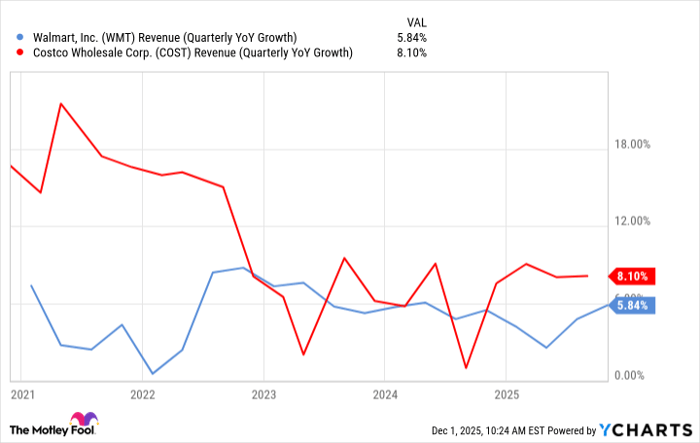
WMT Revenue (Quarterly YoY Growth) data by YCharts
Looking ahead, Costco still makes for a compelling growth play as it has been expanding into China and other parts of the world. Its business is heavily centered around North America, and as it grows in more markets, that could ensure its growth remains strong for the foreseeable future.
In the near future, Walmart is planning to expand domestically. Last year, the company announced that it would be opening or expanding as many as 150 stores in the U.S. over the course of the next five years. It also completed its acquisition of TV-maker Vizio, which will open up opportunities in its ad business.
A look at their valuations
It's always important to consider how one stock is valued in relation to another when making an investment decision. After all, even though a business may be doing well, if it is trading at a high earnings multiple, then a lot of that growth may already be priced in; buying a stock at elevated levels could mean minimal returns, and even losses, for investors.
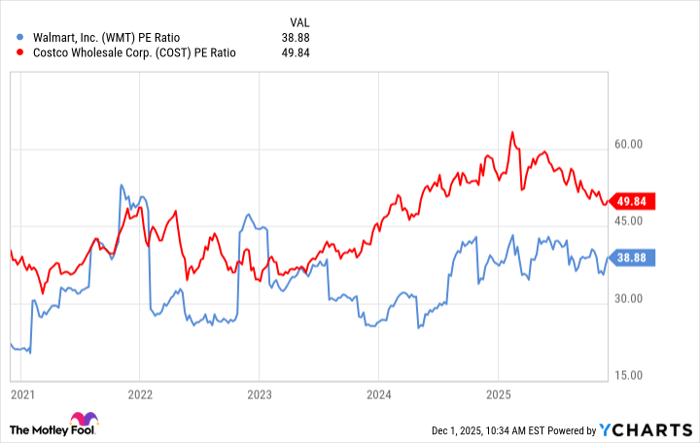
WMT PE Ratio data by YCharts
Historically, Costco has been trading at a higher price-to-earnings multiple than Walmart, and that gap has grown of late. The big question investors have to ask themselves is whether it's worth it. You can point to the company's strong brand, its potential to dominate when discretionary spending is high, and its plentiful growth opportunities as possible reasons why it may be justifiable to pay more for the stock.
Walmart is no slouch in those areas, but many retail investors may see Costco as being the superior brand overall. However, paying around 50 times earnings for a retail stock is still incredibly expensive, especially with its growth rate being in single digits. The average S&P 500 stock trades at a multiple of just 25.
Why I'd go with Walmart
While both of these businesses look solid, Walmart is the stock I'd buy today, largely due to its more reasonable valuation. Costco's significant premium can leave investors vulnerable to a steep correction in the future.
Although Costco is no longer trading at more than $1,000, there's no denying this remains an extremely expensive stock to own and that it's effectively priced for perfection. That means the bar is going to be high for the company to continue performing well. Otherwise, more of a decline could be coming.
Walmart is by no means a dirt cheap stock to own, either, but its growth rate is in the same ballpark as Costco's, its growth opportunities are also encouraging, and at a lower earnings multiple, it gives investors a better margin of safety.
Should you invest $1,000 in Walmart right now?
Before you buy stock in Walmart, consider this:
The Motley Fool Stock Advisor analyst team just identified what they believe are the 10 best stocks for investors to buy now… and Walmart wasn’t one of them. The 10 stocks that made the cut could produce monster returns in the coming years.
Consider when Netflix made this list on December 17, 2004... if you invested $1,000 at the time of our recommendation, you’d have $589,717!* Or when Nvidia made this list on April 15, 2005... if you invested $1,000 at the time of our recommendation, you’d have $1,111,405!*
Now, it’s worth noting Stock Advisor’s total average return is 1,018% — a market-crushing outperformance compared to 194% for the S&P 500. Don’t miss out on the latest top 10 list, available when you join Stock Advisor.
See the 10 stocks »
*Stock Advisor returns as of December 1, 2025
David Jagielski, CPA has no position in any of the stocks mentioned. The Motley Fool has positions in and recommends Costco Wholesale and Walmart. The Motley Fool has a disclosure policy.
Recommended Articles


