


US April PCE Rises to 3.8% YoY, Core Monthly Rate Cools But Inflation Pressures Remain High
TradingKey - U.S. April PCE data shows that inflationary pressures remain sticky; although the core monthly rate was lower than expected, it is unlikely to shift the Federal Reserve's cautious stance.
On Thursday ET, data released by the Bureau of Economic Analysis (BEA) of the U.S. Department of Commerce showed that the U.S. PCE price index rose 0.4% month-on-month in April, a significant slowdown from the 0.7% increase in March; it rose 3.8% year-on-year, indicating that overall inflation remains elevated. The Core PCE price index, which the Fed follows more closely, rose 0.2% month-on-month, lower than the market consensus of 0.3% and the previous value of 0.3%; it rose 3.3% year-on-year, still significantly above the Fed's 2% inflation target.
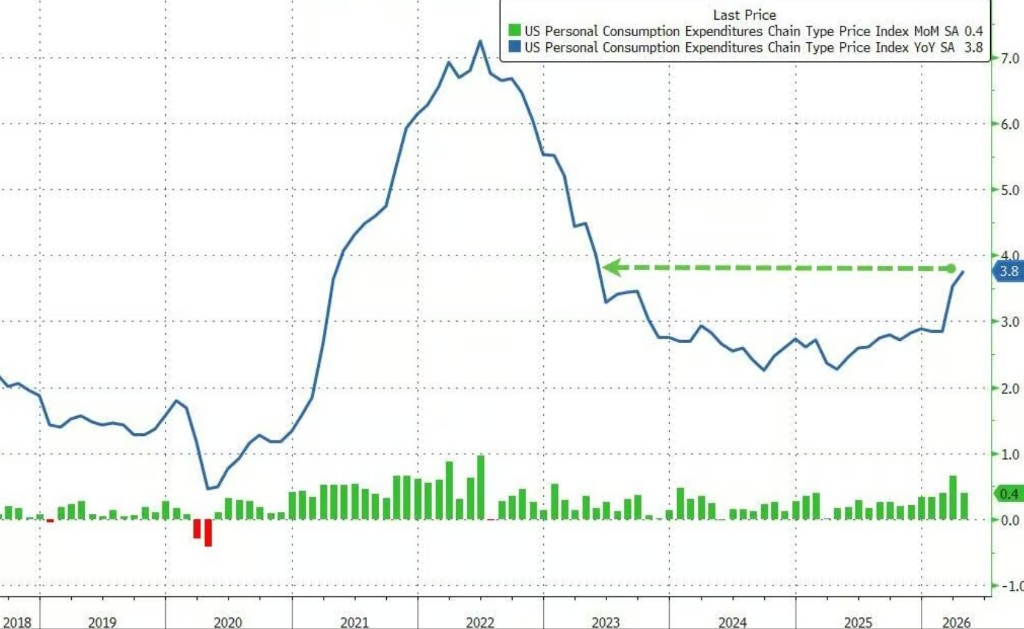
Source: Wallstreetcn
Analysis suggests that the slowdown in the month-on-month core PCE has eased some investors' concerns about inflation continuing to spiral out of control, but the 3.8% year-on-year increase in headline PCE means that price pressures from energy, services, and consumption have not yet fully subsided. For the Federal Reserve, this report is not enough to support a rapid pivot to easing, and policymakers are likely to maintain their cautious stance.
Looking at the income and consumption side, U.S. personal income in April was basically flat compared to the previous month, with a real change of less than 0.1%; disposable personal income fell by 0.1%. Meanwhile, personal consumption expenditures increased by $111.1 billion, a month-on-month growth of 0.5%, with service spending increasing by $67.2 billion and goods spending by $44.0 billion. After adjusting for price factors, real personal consumption expenditures grew by only 0.1%, indicating that while nominal consumer spending continues to grow, improvements in real purchasing power remain limited.
The savings side also released cautious signals. BEA data showed that U.S. personal savings in April totaled $611.7 billion, with a personal savings rate of 2.6%. Against a backdrop of still-high inflation and declining disposable income, the savings rate remained at a low level, suggesting that while U.S. household consumption resilience persists, the room for further expansion may be constrained.
Analysts believe that the lower-than-expected month-on-month core PCE helps ease upward pressure on Treasury yields and the U.S. dollar, providing short-term support for interest-rate sensitive assets such as tech stocks. However, year-on-year inflation remains significantly above the target, and with recent oil prices rebounding due to geopolitical tensions, market concerns about a secondary flare-up in inflation have not yet been dispelled.
Overall, the U.S. April PCE data shows that inflation remains quite sticky. If subsequent employment and consumption data continue to weaken, the Fed may face a policy dilemma where cooling growth coexists with elevated inflation. In the short term, market focus will shift to speeches by Fed officials, energy price trends, and May inflation data to determine whether there is still room for rate cut expectations for the year to heat up again.
Recommended Articles


