


US House passes bill making data centers face more of their grid costs
The H.R. 9340, which was dubbed the Ratepayer Protection Act, has been passed by the US House of Representatives with a vote of 417-3 on Wednesday.
This is the first bill passed by the House that deals with the economic implications of the expansion of data centers. It requires state utility regulators to consider whether those that consume large amounts of electricity should cover the incremental infrastructure costs created by their demand.
Hyperscalers and AI companies vying for compute resources will suffer from more than just utility costs. If more states require that large-load customers pay for the infrastructure expansion they cause, the economics of operating data centers in the United States will shift.
Energy availability, transmission speed, and capital costs are becoming as important as chips and capital in determining where AI infrastructure gets built.
A federal standard states must consider, but need not adopt
The legislation would create a federal standard that mandates fetching “full incremental cost” from large-load consumers for the generation, transmission, or distribution improvements necessary for serving them. The law will require companies to provide financial guarantees before utility providers make those investments. Large-load consumers are companies that consume at least 100 megawatts of energy at a single location.
State authorities will have to adopt the regulation but they still reserve the right to reject it. Experts state that this approach makes the framework overly weak; however, supporters of the initiative think that it will provide a federal benchmark without overriding state ratemaking authority.
The bill does not cap anyone’s power bill
The Act does not create a restriction on electricity prices nor does it influence households’ bills. The real priority of the act is identification of the entity that pays for the provision of services to huge energy consumers.
Rep. Frank Pallone (D-N.J.), the ranking Democrat on the House Energy and Commerce Committee, called the measure “imperfect” and said it addressed only part of the problem, according to Politico. The bill now moves to the Senate.
The legislation follows President Donald Trump’s March 4 Ratepayer Protection Pledge. Brookings notes that Amazon, Google, Meta, Microsoft, OpenAI, Oracle and xAI committed to secure new power and cover delivery-infrastructure upgrades associated with their data centers. Turning those commitments into enforceable protection, however, still depends heavily on states, utilities and regulators.
Record demand meets a strained grid
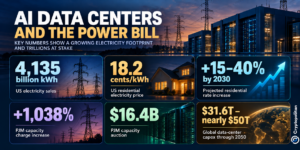
The pressure is already observable. According to EIA projections, electricity sales will be at an all-time high of 4,135 billion kilowatt-hours in 2026, backed to a degree by data centers and industrial production, while residential prices will reach 18.2 cents per kilowatt-hour. An analysis conducted by ICF, published in Brookings, suggested that residential tariffs could surge by 15% to 40% by 2030, and some of them may double by 2050.
A study carried out by the University of California calculates that data centers may account for 11.8% of the total electricity consumption in the US by 2030 within the acceptable limits. Meanwhile, FERC instructed six regional grid operators to justify or reform large-load tariffs, including measures aimed at preventing cost shifting and speeding interconnection.
As was previously reported by Cryptopolitan, PJM capacity costs surged by about 1,038% compared to the rates effective in 2024, while an Ohio brickmaker’s monthly capacity fee increased from $1,600 to $12,000. Data centers have become responsible for roughly 40% of PJM’s unprecedented capacity auction worth $16.4 billion.
 AI data-center power boom: US electricity costs, PJM charges and global capex
Where trillions in compute capital may land
The stakes extend beyond the US. PwC, using Oxford Economics modeling, estimates global data-center capex could reach $31.6 trillion through 2050, with a plausible upside near $50 trillion. PwC says power availability will be decisive in determining where that investment goes.
The IEA identifies electricity supply and grid access as central constraints on AI expansion, while BCG says geography, financing and compute costs are increasingly shaping AI economics.
Making large-load customers absorb more infrastructure costs could reduce cost shifting to households and businesses while raising the upfront cost of some projects. Regions with abundant power, faster connections and lower financing costs may therefore gain an edge in attracting the next wave of AI infrastructure.
Don’t just read crypto news. Understand it. Subscribe to our newsletter. It's free.
Recommended Articles


