


RWA market passes $38 billion, but liquidity is the next challenge
The amount of tokenized real-world assets (RWAs) has surpassed $38 billion on-chain, however, that number is less significant than what’s coming next. In a report released on Monday, September 14, 2026, Castle Labs argued that the future of the industry relies on whether tokenized assets are able to move between exchanges, serve as loan collateral, and trade against deep liquidity rather than their number of listings.
This distinction is of utmost importance for institutions that are looking into tokenization as well as DeFi protocols in order to obtain collateral with returns. It will impact whether tokenized assets will be capable of generating meaningful value or remain as nothing more than digital wrappers in traditional finance systems.
Treasuries anchor a $38 billion base
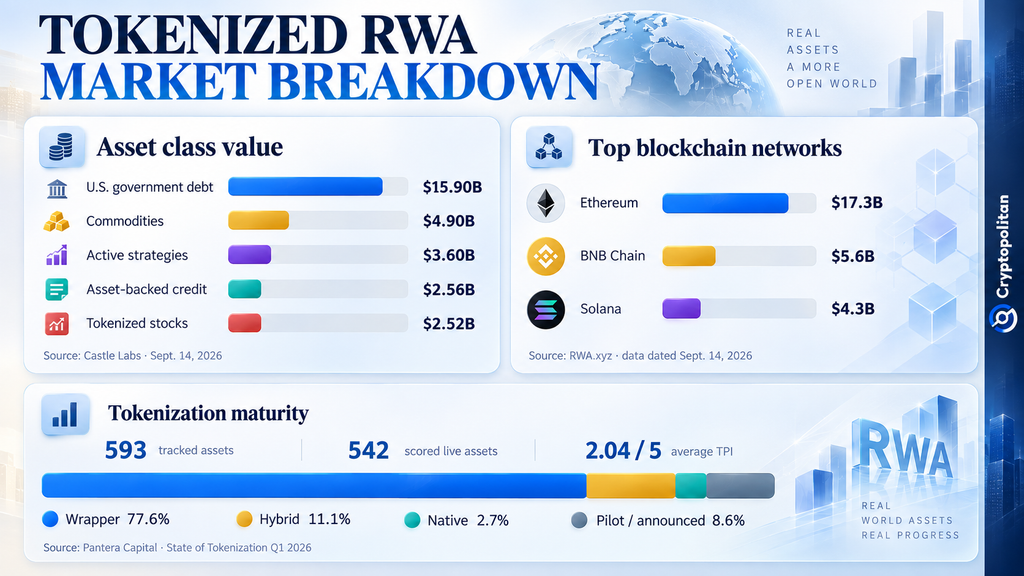
As of September 15, 2026, RWA.xyz reported a distributed asset value of $38.86 billion, an increase of 1.00% over 30 days, and about 4.24 million holders. According to Castle Labs, the US government debt totals more than $15.9 billion. The other types include: commodities worth $4.9 billion, active strategies worth $3.6 billion, asset-backed credit worth $2.56 billion and tokenized stocks worth $2.52 billion.
The market is also divided by the blockchain where the transactions take place. According to the league table of RWA.xyz which is dated September 14, the top three networks are Ethereum with $17.3 billion, BNB Chain with $5.6 billion and Solana with $4.3 billion. The information provided indicates the ongoing problem of tokenized assets being spread out across different blockchains, leading to liquidity issues.
According to CoinGecko’s 2026 report, tokenized RWAs exceeded $19.3 billion by the end of the first quarter after an increase of more than three times from January 2025.
Listing assets is now the easy part
Castle Labs claims that supply is not the issue anymore. Companies like Kraken, Robinhood, Ondo, Securitize, Franklin Templeton, and BlackRock can already provide tokenized access one way or the other.
The bigger question is what holders can actually do with their assets. Castle Labs splits utility into two categories: accessibility and composability. Tokenization has given a boost to access to trading venues, but the assets become useful only when they can move across different venues, trade against deep liquidity, be used as collateral, and effectively interact with on-chain transactions.
This has become increasingly relevant as everyday trading hours are being extended, conveniently relieving traditional markets of crypto’s advantage of round-the-clock access for the past several years.
Regulation and institutions move in
The sector has found favorable government policies to underpin its long-term growth. According to TRM Labs, stablecoin regulations have progressed in more than 70% of 30 jurisdictions in 2025, while approximately 80% of financial institutions have made announcements regarding their digital asset initiatives.
The consequences for the banking sector take place on structural level. In a note published by the IMF in April 2026, economist Tobias Adrian pointed out that tokenization can help achieve atomic settlement, continuous liquidity management, and embedded compliance. However, if there is absence of the right legal framework and safe settlement assets, tokenization may intensify instability by speeding up banking processes and increasing concentration and fragmentation.
The May report by BCG stated that today’s digital RWAs are small in scope; however, in the upcoming decade, digital RWAs are likely to have the highest level of structural importance in banking.
Why the liquidity still lags
In its first-quarter report, Pantera Capital observed a total of 593 assets out of which 542 were live. The average Tokenization Progress Index was just 2.04 out of 5 for the quarter. According to Pantera, out of the tracked assets, 77.6% were classified under the “Wrapper” level, 11.1% were classified as Hybrid while only 2.7% were classified as Native.
Pantera compared the RWA market with the early “newspaper-on-a-website” phase of the internet: meaning that known products have moved to a different technological platform, even though the majority of products have not yet been able to exploit their potential capabilities. In practice, many tokenized assets still behave much like their traditional counterparts, which helps explain why liquidity and market infrastructure have struggled to keep pace.
The OECD came to the same conclusion, identifying thin liquidity, lack of payment networks, custody gaps, uncertainties in legislation, and lack of interoperability as factors preventing progress towards wider acceptance.
Cryptopolitan also pointed out that just having the tokenization in place is not enough for liquidity to occur, and that market makers, two-sided order flow and the reliable price discovery process will still be needed.
The future of tokenization will no longer be only about how much value becomes tokenized, but rather whether this value can really move and be utilized in a financial context.
Don’t just read crypto news. Understand it. Subscribe to our newsletter. It's free.
Recommended Articles


