


Bitcoin On Morgan Stanley’s Balance Sheet? The Answer Is Getting Interesting
Morgan Stanley’s Amy Oldenburg said a future move by major banks to put Bitcoin on their balance sheets is “not totally out of the question,” pointing to regulatory progress while warning that capital rules and global supervisory alignment still matter.
Speaking during a Bitcoin 2026 conference panel, Oldenburg was asked what it would take for a bank like Morgan Stanley, or another regulated financial institution, to make the leap from offering Bitcoin exposure to actually holding Bitcoin as a treasury asset.
“Bitcoin on the balance sheet,” she said, pausing on the premise. “You know, I think if we continue to see the progress that we’ve made over the last 16 months or so in regulatory, that that’s something that you may see going forward. It’s not totally out of the question.”
Morgan Stanley And Bitcoin?
That answer is notable less because it signals an imminent move and more because it frames the idea as procedurally possible. For years, the bank balance sheet question has sat on the far end of institutional Bitcoin adoption: beyond ETFs, beyond custody, beyond client access, and into the realm of prudential capital, examiner expectations, accounting, liquidity planning and board-level risk appetite.
Oldenburg’s caveat was that the constraint is not a single rule. She pointed first to SAB 121, the SEC accounting guidance that had made it more difficult for banks to custody crypto assets at scale before its rollback changed part of the equation. But she immediately widened the lens.
“I think the other thing too is we were talking about SAB 121 rolling back on the capital treatment, but it’s not just that that holds us back,” she said. “It’s Fed guidance, it’s Basel guidance. When you’re a large G-sub bank, it’s not just one agency that you report to.”
That is the core of the issue for a firm like Morgan Stanley. A global systemically important bank does not evaluate Bitcoin only through a market-risk lens. It has to satisfy multiple regulators, capital frameworks and jurisdictional expectations at once. Oldenburg said large banks have “many oversight groups” to attend to and need “a little bit more alignment across the board with some of those agencies.”
The Backdrop
The Basel point is especially important. The Basel Committee’s cryptoasset standard places the most conservative treatment on unbacked crypto assets such as Bitcoin, and industry advocates have argued that the 1,250% risk-weight treatment effectively makes direct bank balance-sheet exposure uneconomic. The Basel Committee said in February 2026 that it had expedited a targeted review of its prudential standard for banks’ cryptoasset exposures, with an update expected later in the year.
The Bitcoin Policy Institute has been trying to push that debate into the US implementation process. In March, the group said it planned to review and comment on the Federal Reserve’s coming Basel proposal, arguing that the current treatment discourages banks from holding or servicing Bitcoin because of the punitive risk weight.
The US side has also been moving, though not in a straight line toward bank-owned Bitcoin. In April 2025, the Federal Reserve withdrew earlier guidance tied to banks’ crypto-asset and dollar-token activities, saying the move would keep expectations aligned with evolving risks and support innovation in the banking system. The FDIC and OCC also moved away from prior-approval style frameworks for permissible crypto activity, while maintaining that banks still need sound risk management.
More recently, US banking agencies clarified that eligible tokenized securities should generally receive the same capital treatment as their non-tokenized equivalents, describing the capital rule as technology neutral. That clarification does not solve Bitcoin’s balance-sheet treatment, because Bitcoin is not a tokenized version of a traditional security. But it does show regulators separating blockchain rails from asset risk, rather than treating every digital-asset exposure as the same category.
That distinction helps explain Oldenburg’s answer. The path for a bank to hold Bitcoin is not simply “regulators become more pro-crypto.” The first point is Basel: if Bitcoin remains subject to the most punitive capital treatment, a G-SIB has little economic incentive to warehouse it as a treasury asset, even if client demand is clear.
The second point is Federal Reserve supervision: even after recent rollbacks, large banks still need a coherent examiner framework that tells them how Bitcoin exposure will be judged across safety and soundness, liquidity, operational risk and capital planning.
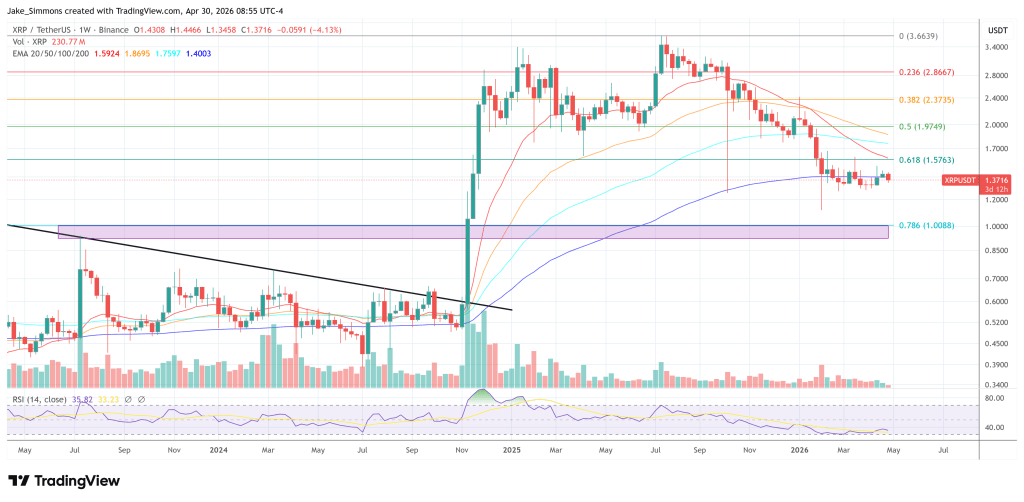
At press time, BTC traded at $1.3716.
Recommended Articles


