

BlackRock’s Bitcoin ETF Now Rivals Binance, Doubling Coinbase in Daily Volume

Source Beincrypto

BlackRock’s iShares Bitcoin Trust (IBIT) now processes between $16 billion and $18 billion in daily trading volume, positioning the regulated fund as a direct competitor to the world’s largest crypto exchanges.

The data, reported by analytics firm Kaiko, signals that institutional-grade products are pulling liquidity away from crypto-native platforms at a pace few anticipated.

A Regulated Giant Takes on Crypto Exchanges

IBIT’s daily turnover now more than doubles the $6 billion to $8 billion that Coinbase processes on its spot market.

The figure also approaches Binance’s spot trading activity, long considered the benchmark for global crypto liquidity.

The shift suggests regulated financial products are becoming competitive alternatives to traditional cryptocurrency exchanges. For an ETF that launched in January 2024, the speed at which IBIT has scaled is striking.

BlackRock’s fund commands roughly 70% market share by volume among U.S. spot Bitcoin (BTC) ETFs.

That dominance has only grown as institutional allocators increase their exposure through listed products rather than direct exchange access.
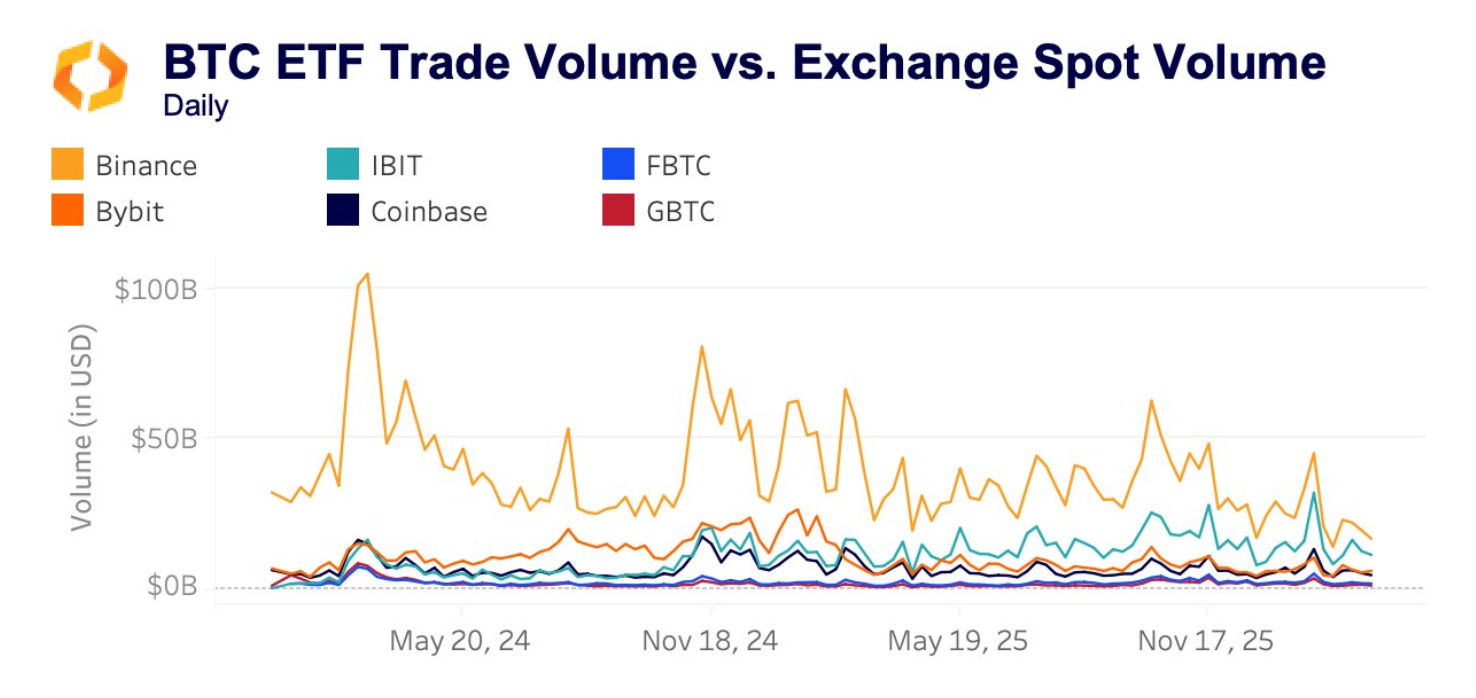
IBIT daily trading volume vs. Coinbase and Binance spot volumes, Source: Kaiko on X

Q1 2026 Tested ETF Conviction

Despite IBIT’s trading volume surge, broader ETF flows told a more complicated story during the first quarter.

Spot Bitcoin ETFs saw $496.5 million in net outflows during Q1, with $1.8 billion leaving in the first two months.

Bitcoin fell 23.8% in Q1 2026, its worst first-quarter performance since 2018. The selloff, compounded by geopolitical tensions in the Middle East and the Federal Reserve’s cautious policy, triggered heavy redemptions in January and February.

However, figures from SoSoValue show that the funds added $1.32 billion in March and ended a dry spell that had lasted since October 2025. March’s reversal marked the first monthly gain for spot BTC ETFs in 2026.

On April 2, U.S. spot Bitcoin ETFs recorded a modest $8.99 million in total net inflows, led by Fidelity’s FBTC with $7.29 million.
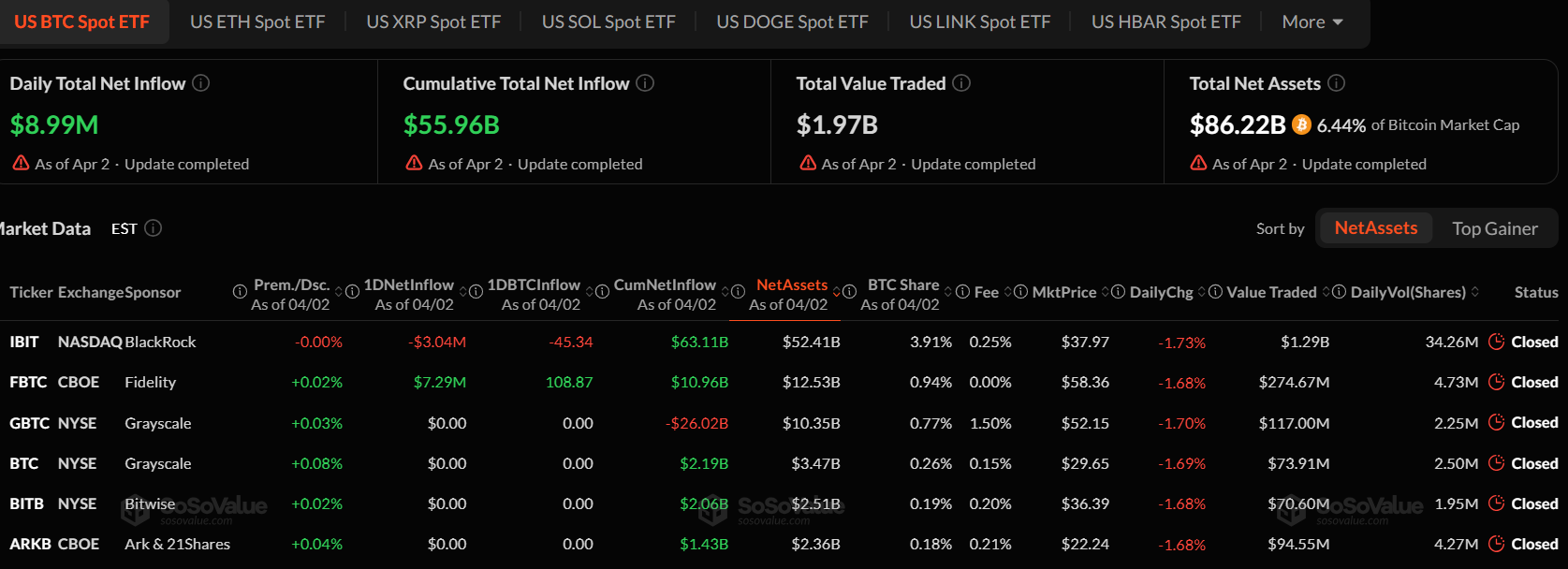
Spot Bitcoin ETF Flows on April 2Spot Bitcoin ETF Flows on April 2. Source: SoSoValue

Spot Ethereum ETFs, meanwhile, posted $71.17 million in net outflows, with BlackRock’s ETHA seeing the largest single-day withdrawal at $46.66 million.
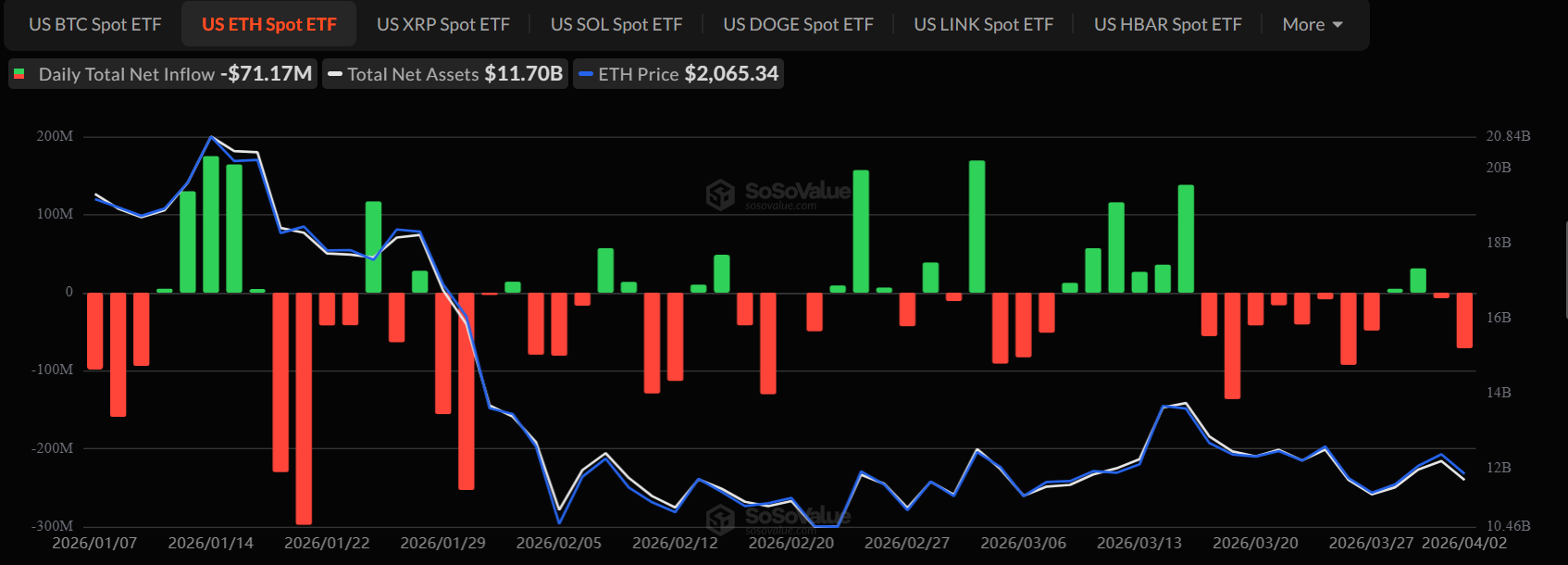
Spot Ethereum FlowsSpot Ethereum Flows. Source: SoSoValue

What Comes Next for ETF Flows

The contrast between IBIT’s surging volume and the broader category’s uneven flows raises an important question.

  • Trading activity does not always equal fresh capital entering the market.
  • High volumes can also reflect hedging, rebalancing, or short-term positioning.

Spot Bitcoin ETFs closed Q1 as their second-worst quarterly performance since launch, only behind Q4 2025’s $1.15 billion in cumulative outflows.

Whether April sustains March’s momentum or reverts to the pattern seen earlier in the quarter will likely depend on macroeconomic signals and BTC price stability.

In the meantime, IBIT’s ability to match crypto-native exchange volumes confirms that the line between TradFi and digital asset markets continues to blur.

Disclaimer: For information purposes only. Past performance is not indicative of future results.
placeholder
Bitcoin To Anchor America Party—’Fiat Is Hopeless,’ Says Elon MuskMusk Pitches Bitcoin As Pillar Of America Party
Author  Bitcoinist
Jul 07, 2025
Musk Pitches Bitcoin As Pillar Of America Party
placeholder
Bitcoin briefly loses 2025 gains as crypto plunges over the weekend.Bitcoin experienced a sharp decline this weekend, briefly erasing its 2025 gains and dipping below its year-opening value of $93,507. The cryptocurrency fell to a low of $93,029 on Sunday, representing a 25% drop from its all-time high in October. Although it has rebounded slightly to around $94,209, the pressures on the market remain significant. The downturn occurred despite the reopening of the U.S. government on Thursday, which many had hoped would provide essential support for crypto markets. This year initially appeared promising for cryptocurrencies, particularly after the inauguration of President Donald Trump, who has established the most pro-crypto administration thus far. However, ongoing political tensions—including Trump's tariff strategies and the recent government shutdown, lasting a historic 43 days—have contributed to several rapid price pullbacks for Bitcoin throughout the year. Market dynamics are also being influenced by Bitcoin whales—investors holding large amounts of Bitcoin—who have been offloading portions of their assets, consequently stalling price rallies even as positive regulatory developments emerge. Despite these sell-offs, analysts from Glassnode argue that this behavior aligns with typical patterns seen among long-term investors during the concluding stages of bull markets, suggesting it is not indicative of a mass exodus. Notably, Bitcoin is not alone in its struggles, as Ethereum and Solana have also recorded declines of 7.95% and 28.3%, respectively, since the start of the year, while numerous altcoins have faced even steeper losses. Looking ahead, questions linger regarding the viability of the four-year cycle thesis, particularly given the increasing institutional support and regulatory frameworks now in place in the crypto landscape. Matt Hougan, chief investment officer at Bitwise, remains optimistic, suggesting a potential Bitcoin resurgence in 2026 driven by the “debasement trade” thesis and a broader trend toward increased adoption of stablecoins, tokenization, and decentralized finance. Hougan emphasized the soundness of the underlying fundamentals, pointing to a positive outlook for the sector in the longer term.
Author  Mitrade
Nov 17, 2025
Bitcoin experienced a sharp decline this weekend, briefly erasing its 2025 gains and dipping below its year-opening value of $93,507. The cryptocurrency fell to a low of $93,029 on Sunday, representing a 25% drop from its all-time high in October. Although it has rebounded slightly to around $94,209, the pressures on the market remain significant. The downturn occurred despite the reopening of the U.S. government on Thursday, which many had hoped would provide essential support for crypto markets. This year initially appeared promising for cryptocurrencies, particularly after the inauguration of President Donald Trump, who has established the most pro-crypto administration thus far. However, ongoing political tensions—including Trump's tariff strategies and the recent government shutdown, lasting a historic 43 days—have contributed to several rapid price pullbacks for Bitcoin throughout the year. Market dynamics are also being influenced by Bitcoin whales—investors holding large amounts of Bitcoin—who have been offloading portions of their assets, consequently stalling price rallies even as positive regulatory developments emerge. Despite these sell-offs, analysts from Glassnode argue that this behavior aligns with typical patterns seen among long-term investors during the concluding stages of bull markets, suggesting it is not indicative of a mass exodus. Notably, Bitcoin is not alone in its struggles, as Ethereum and Solana have also recorded declines of 7.95% and 28.3%, respectively, since the start of the year, while numerous altcoins have faced even steeper losses. Looking ahead, questions linger regarding the viability of the four-year cycle thesis, particularly given the increasing institutional support and regulatory frameworks now in place in the crypto landscape. Matt Hougan, chief investment officer at Bitwise, remains optimistic, suggesting a potential Bitcoin resurgence in 2026 driven by the “debasement trade” thesis and a broader trend toward increased adoption of stablecoins, tokenization, and decentralized finance. Hougan emphasized the soundness of the underlying fundamentals, pointing to a positive outlook for the sector in the longer term.
placeholder
Gold rises on softer US Dollar, traders await Trump's address on Iran warGold price (XAU/USD) extends the rally to near $4,775 during the early Asian session on Thursday. The precious metal surges amid a weakening US Dollar (USD) and cooling geopolitical tensions in the Middle East.
Author  FXStreet
Yesterday 01: 20
Gold price (XAU/USD) extends the rally to near $4,775 during the early Asian session on Thursday. The precious metal surges amid a weakening US Dollar (USD) and cooling geopolitical tensions in the Middle East.
placeholder
Silver Price Forecast: XAG/USD falls to near $72.00 amid fading safe-haven demandSilver price (XAG/USD) continues to lose ground after registering tiny losses in the previous day, trading around $72.90 during the Asian hours on Thursday. The safe-haven demand for the precious metal fades amid rising optimism over Middle East peace.
Author  FXStreet
Yesterday 08: 19
Silver price (XAG/USD) continues to lose ground after registering tiny losses in the previous day, trading around $72.90 during the Asian hours on Thursday. The safe-haven demand for the precious metal fades amid rising optimism over Middle East peace.
placeholder
Gold retreats sharply from two-week top/$4,800 as Trump’s Iran comments boost USDGold (XAU/USD) witnessed an intraday turnaround from the $4,800 mark, or a fresh two-week high set earlier this Thursday, and for now, seems to have snapped a four-day winning streak amid resurgent US Dollar (USD) demand.
Author  FXStreet
Yesterday 07: 03
Gold (XAU/USD) witnessed an intraday turnaround from the $4,800 mark, or a fresh two-week high set earlier this Thursday, and for now, seems to have snapped a four-day winning streak amid resurgent US Dollar (USD) demand.
goTop
quote