


The U.S. and China are seemingly chasing different robotics strategies
The United States and China are two countries most closely watched in the emerging robotics race, even though Japan is a larger market than America in terms of its operational stock of industrial robots. It’s not really surprising though, when you look at the broader AI race.
The competition, talents, and funding on AI models have overwhelmingly centered on the U.S. and China. But in this terrain, the U.S. clearly dominates China.
America attracted $109.1 billion in private AI funding two years ago, against $9.3 billion in China, although Beijing partly makes up for the low private funding with government-led initiatives. Epoch Capabilities Index showed Chinese AI models have lagged behind U.S. models since 2023 by an average of seven months.
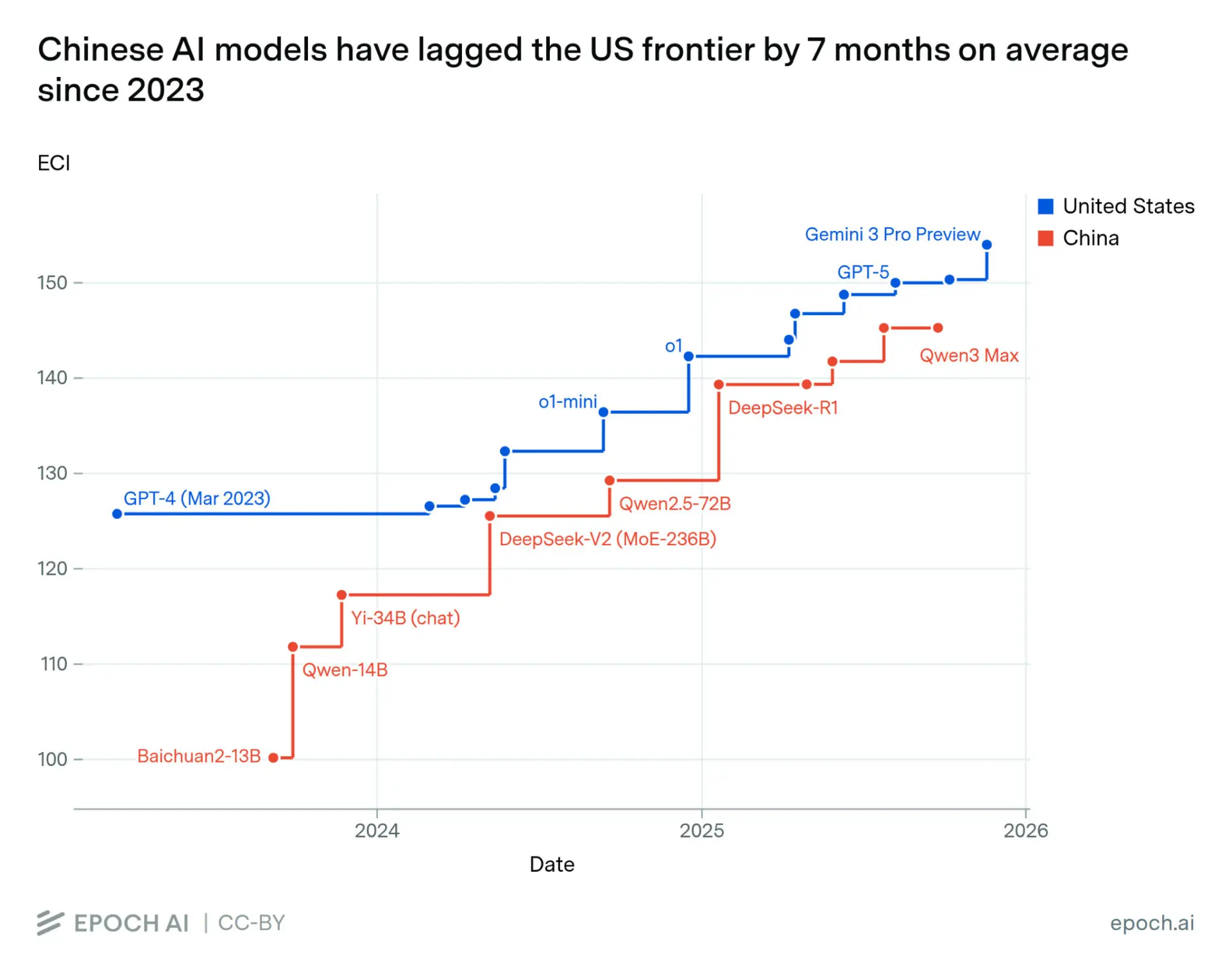
U.S. AI founders have been vocal about it. But it’s a different story when it comes to physical AI. Both techno-nations are racing to lead the global robotics industry, but it would seem the goal lines are different for each country.
It’s premature to choose winners, however, China is already doing more numbers than the U.S. in terms of working industrial robots. It makes sense quickly when you look at what goes on in the Chinese robotics ecosystem.
The state of the Chinese robotics ecosystem
China installed nearly 10x more robots in its factories last year, compared to the U.S. The Chinese are rapidly expanding and making so many cheap robots that U.S. robotics companies, including South Koreans, had to push for tariffs to level the playing field for local makers.
An insight by Chang Che, a writer covering Chinese politics, society, and technology, tells why China is running at this pace.
The takeaway is that Beijing is keen on pursuing robotics, or “embodied intelligence” as described in Chinese policy documents, even down to the provincial level.
Interest in robots ballooned in China right after the government began introducing embodied AI in its paper – still did in its most recent “Five-Year Plan (2026–2030),” reviewed by the National People’s Congress earlier this month. Professors turned to robot entrepreneurs, Che wrote. Students and VCs wanted consultations. Even officials were equally eager to bring robotics down to their localities.
It became a competition sort of among the local governments, with officials propping up local companies for their personal interest, given that career advancement within the Communist Party is heavily tied to economic performance metrics, like GDP, investments, and industrial output, among other things.
In one case, Che mentioned Viktor Wang, co-founder of PsiBot, who had gotten unsolicited offers from municipal governments to help him set up teleoperation centers to train robots. The collective result of the competition among the governments adds, if not solely responsible, for the fast-paced robotics development we see today in China.
But why is China all-in on robotics?
Two reasons immediately come to mind, even cited in government papers. One is a labor shortage, and the second is industrial automation.
China faces one of the fastest-aging populations in history. On top of that, its population keeps dropping. Reuters reported a third consecutive drop in the population in 2024, all-round meaning fewer workers and consumers. The country is expected to face a shortage of 50 million blue-collar workers. So, it’s looking at industrial and humanoid robots to fill roles where young people no longer want to work.
The demographic crisis is closely tied to why China is also pursuing industrial automation, which is where Chinese robots are finding the most application – 295,000 robots were installed in Chinese factories last year, the highest annual total on record, per the International Federation of Robotics.
China makes more useful industrial robots than it does for other purposes, and there is a reason behind it. The focus for Beijing is to make commercial robots that can find practicality in the real world. Remember, there are reasons in the first place why the government is heavily pushing for robotics.
Che wrote that there are commercialization requirements attached to those fundings provided to Chinese robot makers. So, they cannot afford to chase frivolities, so to speak. And that is where China diverges from the U.S. in the global robotics war.
The U.S. and China have different goal lines
For China, the focus is on making commercializable robots that fit into the real economy. The Chinese manufacturers are mostly building humanoids and industrial robots that can perform one specific task very well, whether it’s installing and handling car parts, sorting items, welding, or assembling parts.
The U.S., however, is racing towards general-purpose robots, humanoids that can compete with humans, with a focus on homes and manufacturing. Figure 03, the humanoid robot that accompanied the U.S. first lady, Melania Trump, to a White House event, is one example.
Figure 03 is built by Figure AI. The Chicago-based robotics firm introduced the robot, its 3rd generation humanoid, in October for use in home environments and handling high-volume manufacturing. Tesla’s Optimus takes on a similar direction, although the primary focus will be on the factory. Elon Musk said Optimus’s home use will follow factory success.
I’ve been working on my figure pic.twitter.com/u7trMda7eM
— Tesla Optimus (@Tesla_Optimus) September 6, 2025
There are a lot of promises with Optimus. Musk said in February that Optimus will be the “biggest product ever” and make up 80% of Tesla. He went on to say that the solar-powered Optimus+PV would become the first real-world version of sci-fi robots capable of replicating itself with materials from space.
Whilst the Chinese are already deep into deployments, the U.S. is only warming up to commercial production. Figure AI launched a high-volume manufacturing facility, BotQ, last year, with a capacity to make up to 12,000 humanoids per year. Tesla is preparing for the first line of production later this summer. It targets making 1 million robots per year when large-scale production begins in 2027.
It also seems most of the big-name U.S. companies are mostly pushing humanoids as their flagship products. Aside from Figure 03 and Optimus, there are humanoids like Digit by Agility Robotics and Apollo by Apptronik. Boston Dynamics also now has Atlas. Earlier this year, OpenAI was reported to have built its humanoid lab.
It’s left to see how well the U.S. does pursuing general-purpose humanoids, but fellows like Mark Cuban are not particularly optimistic. Cuban said during a livestream with TBPN that he thinks humanoids “might have a 5-year lifespan, and then they’ll fail miserably. Maybe 10.”
If you're reading this, you’re already ahead. Stay there with our newsletter.
Recommended Articles


