

Bitcoin And The 2026 Fed Shift: Expert Says Markets Aren’t Ready
Macro strategist Alex Krüger is tying Bitcoin’s next macro chapter directly to the coming reshuffle at the Federal Reserve, warning that investors are underpricing how far US rates could fall under a Trump-aligned central bank.
In a long X post titled “2026: The Year of the Fed’s Regime Change,” he argues that “the Federal Reserve as we know it ends in 2026” and that the most important driver of asset returns will be a new, much more dovish Fed led by Kevin Hassett. His base case is that this shift becomes a key driver for risk assets broadly and Bitcoin in particular in 2026, even if crypto markets are currently trading as if nothing fundamental has changed.
Why The Federal Reserve Will Dramatically Change
Krüger’s scenario is anchored in personnel. He notes that prediction platform Kalshi put the odds of Hassett becoming chair at 70% as of 2 December, and describes him as a supply-side loyalist who “champions a ‘growth-first’ philosophy, arguing that with the inflation war largely won, maintaining high real rates is an act of political obstinacy rather than economic prudence.”
A few hours after Krüger’s thread, Trump himself added fuel, telling reporters at the White House that he would announce his Fed pick “early next year” and explicitly teasing National Economic Council Director Kevin Hassett as a possible choice, after saying the search had been narrowed down to one candidate.
To explain how this would translate into policy, Krüger reconstructs Hassett’s stance from his own 2024 comments. On 21 November, Hassett said “the only way to explain a Fed decision not to cut in December would be due to anti-Trump partisanship.” Earlier he argued, “If I’m at the FOMC, I’m more likely to move to cut rates, while Powell is less likely,” adding, “I agree with Trump that rates can be a lot lower.” Across the year he endorsed expected rate cuts as merely “a start,” called for the Fed to “keep cutting rates aggressively,” and supported “much lower rates,” leading Krüger to place him at 2 on a 1–10 dove–hawk scale, with 1 being the most dovish.
Institutionally, Krüger maps a concrete path: Hassett would first be nominated as a Fed governor to replace Stephen Miran when his short term expires in January, then elevated to chair when Powell’s term ends in May 2026. Powell, he assumes, follows precedent by resigning his remaining Board seat after pre-announcing his departure, opening a slot for Kevin Warsh, whom Krüger treats not as a rival but as a like-minded ally who has been “campaigning” for a structural overhaul and arguing that an AI-driven productivity boom is inherently disinflationary. In that configuration, Hassett, Warsh, Christopher Waller and Michelle Bowman form a solidly dovish core, with six other officials seen as movable votes and only two clear hawks on the committee.
The main institutional tail risk, in Krüger’s view, is that Powell does not resign his governor seat. He warns that this would be “extremely bearish,” because it would prevent Warsh’s appointment and leave Powell as a “shadow chair,” a rival focal point for FOMC loyalty outside Hassett’s inner circle. He also stresses that the Fed chair has no formal tie-breaking vote; repeated 7–5 splits on 50-basis-point cuts would look “institutionally corrosive,” while a 6–6 tie or a 4–8 vote against cuts “would be a catastrophe,” turning the publication of FOMC minutes into an even more potent market event.
On rates, Krüger argues that both the official dot plot and market pricing understate how far policy could be pushed lower. The September median projection of 3.4% for December 2026 is, he says, “a mirage,” because it includes non-voting hawks; by re-labeling dots based on public statements, he estimates the true voters’ median closer to 3.1%. Substituting Hassett and Warsh for Powell and Miran, and using Miran and Waller as proxies for an aggressive-cuts stance, he finds a bimodal distribution with a dovish cluster around 2.6%, where he “anchors” the new leadership, while noting that Miran’s preferred “appropriate rate” of 2.0%–2.5% suggests an even lower bias.
As of 2 December, Krüger notes, futures price December 2026 fed funds at about 3.02%, implying roughly 40 basis points of additional downside if his path is realized. If Hassett’s supply-side view is right and AI-driven productivity pushes inflation below consensus forecasts, Krüger expects pressure for deeper cuts to avoid “passive tightening” as real rates rise. He frames the likely outcome as a “reflationary steepening”: front-end yields collapsing as aggressive easing is priced in, while the long end stays elevated on higher nominal growth and lingering inflation risk.
What This Means For Bitcoin
That mix, he argues, is explosive for risk assets like Bitcoin. Hassett “would crush the real discount rate,” fueling a multiple-expansion “melt-up” in growth equities, at the cost of a possible bond-market revolt if long yields spike in protest. A politically aligned Fed that explicitly prioritizes growth over inflation targeting is, in Krüger’s words, textbook bullish for hard assets such as gold, which he expects to outperform Treasuries as investors hedge the risk of a 1970s-style policy error.
Bitcoin, in Krüger’s telling, should be the cleanest expression of this shift but is currently trapped in its own psychology. Since what he calls the “10/10 shock,” he says Bitcoin has developed “a brutal downside skew,” fading macro rallies and crashing on bad news amid “4-year cycle” top fears and an “identity crisis.” Even so, he concludes that the combination of a Hassett-led Fed and Trump’s deregulation agenda would “override the dominant self-fulfilling bearish psychology, in 2026” — a macro repricing he insists “markets aren’t ready” for yet.
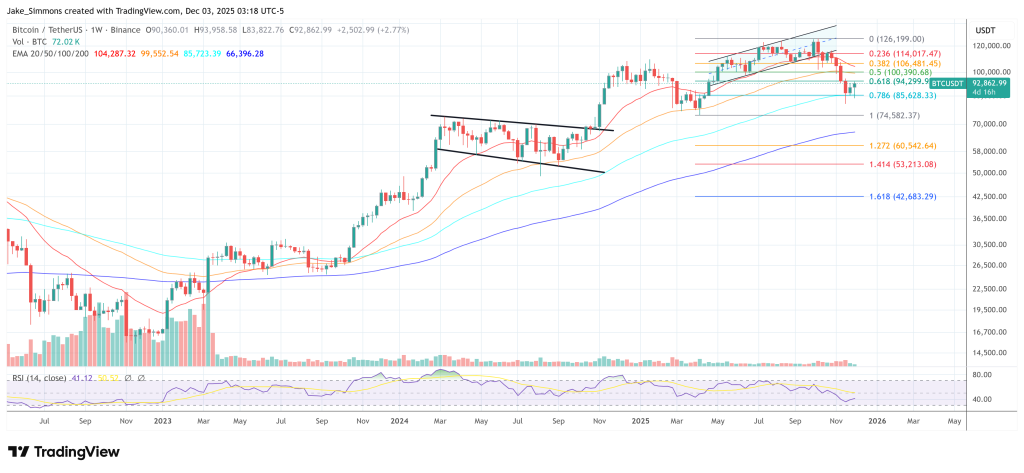
At press time, Bitcoin traded at $92,862
Recommended Articles


