


Silver Prices Are Falling, Institutions Warn: Industrial Demand Peaking, Recovery Hopes Are Slim
TradingKey - Current silver ( XAGUSD) prices are hovering below $74 per ounce, as the market lacks upside momentum.
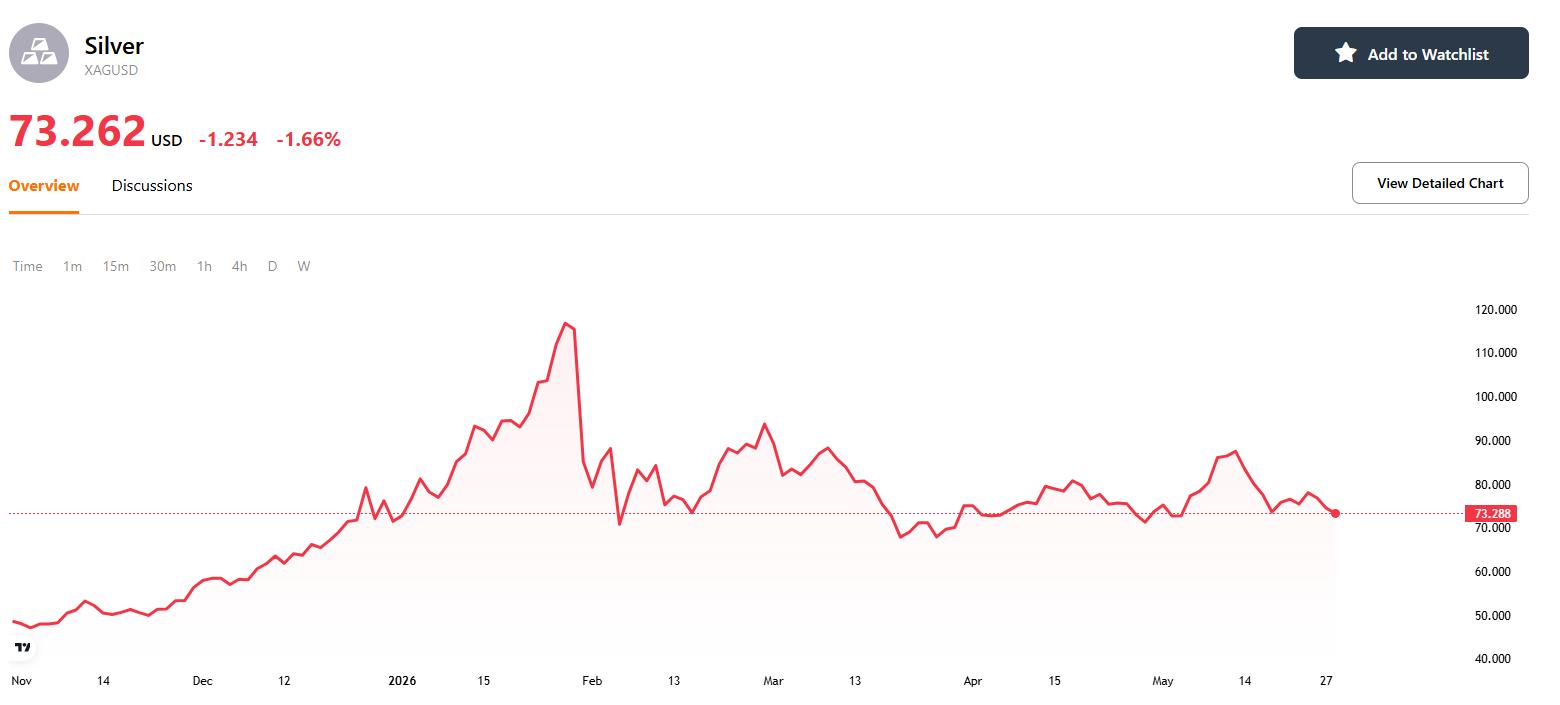
Bank of America ( BAC) commodities team provided a 'rise-then-fall' assessment in its latest research report—the bank's analysis team, led by Head of Metals Research Michael Widmer, believes silver prices are poised to hit $100 per ounce in the fourth quarter of 2026.
However, BofA also issued a warning, noting that this rally is not sustainable; silver prices are expected to retreat to around $75 per ounce by the second quarter of 2027 as industrial demand enters a structural decline.
Furthermore, UBS ( UBS) previously released a research report lowering its silver price target for the end of the second quarter of 2026 from $100 to $85, its year-end target from $85 to $80, and its March 2027 forward target to $75.
From a positioning perspective, silver ETF holdings continue to contract, and the willingness of bulls in the futures market to increase positions remains weak. This lack of active capital support has resulted in poor stability for silver price trends.
Silver "De-silverization": Industrial Demand Peaks
In Bank of America's view, the greatest structural headwind for silver stems from the "de-silverization" trend in the industrial sector. "While a gold rally might push silver above $100/oz again in the coming months, we don't believe silver will consistently outperform gold due to weakening fundamental demand."
The bank further noted that elevated prices are forcing manufacturers in key industrial sectors—particularly the solar photovoltaic (PV) industry—to proactively reduce silver usage or even switch to lower-cost alternatives like copper.
As the largest industrial demand source for silver, photovoltaic (PV) applications are projected to account for 35% of total global industrial silver consumption in 2025. However, as the penetration rate of N-type high-efficiency cells like TOPCon and HJT rapidly climbs to 70%, silver consumption per watt has surged significantly, with silver paste costs now exceeding 50% of the non-silicon costs for some high-efficiency modules. High silver prices are clearly squeezing the margins of PV manufacturers, forcing companies to accelerate the "de-silverization" process.
Bank of America analysts stated, "We believe industrial silver demand peaked last year due to a confluence of factors, including a strong desire among manufacturers to thrift silver in their processes. The leveling off of China's solar PV capacity growth and a potential decline in global solar installations this year have further intensified these headwinds."
Impacted by corporate efforts to reduce silver usage and contracting demand, the silver supply-demand deficit is expected to narrow by 90% this year.
UBS strategists also pointed out that the silver supply-demand landscape will undergo a fundamental shift by 2026. This year's supply deficit is projected to shrink dramatically from an original estimate of 300 million ounces to just 60 to 70 million ounces. This "cliff-like" contraction is the root cause for the fading upward momentum in silver prices.
A previous report from the Silver Institute corroborated this trend, projecting a global silver market deficit of approximately 67 million ounces in 2026. While marking the sixth consecutive year of shortage, the scale of the deficit has significantly narrowed.
Amid this structural shift, Bank of America believes silver's pricing dynamics are changing, moving closer to the logic of a precious metal rather than a pure industrial commodity. "Investor demand will likely be the key to future price movements," the report emphasized.
UBS believes that current investment returns are insufficient to compensate for the volatility investors face; therefore, it remains an "unattractive" investment choice for investors.
Silver prices are also facing short-term pressure.
In addition to the medium-to-long-term structural bearish factor of "thrifting," the silver market also faces multiple short-term uncertainties.
Market expectations for a Federal Reserve rate hike this year continue to intensify, with the estimated probability of a single hike by 2026 now exceeding 50%. New Fed Chair Kevin Warsh was appointed by Trump, but the market fears that against a backdrop of higher-than-expected inflation, his first official remarks may lean hawkish, thereby pressuring non-yielding assets like precious metals.
Traders are closely monitoring the upcoming U.S. Personal Consumption Expenditures (PCE) price index data for April, scheduled for release on Thursday, for further clues regarding the interest rate path.
Meanwhile, geopolitical tensions are rattling the market. The U.S. military launched "self-defense strikes" in southern Iran on Monday, targeting missile launch sites and Iranian vessels attempting to lay mines. Iran announced it had shot down a U.S. drone and opened fire to drive off warplanes; analysts view the exchange of fire during a ceasefire as a "maximum pressure" tactic in a negotiation game.
Iranian state television recently stated that under a framework agreement with the U.S., the country will restore shipping in the Strait of Hormuz to pre-war levels within a month; the agreement also includes provisions for the withdrawal of U.S. troops from areas surrounding Iran.
If the agreement is implemented and the strait reopens, a pullback in oil prices would help alleviate inflationary pressure, providing silver with some breathing room; conversely, an escalation of geopolitical risks would exacerbate an already complex macroeconomic situation.
NAFTA negotiations are also viewed as a potential "black swan"; Canada and Mexico are the largest silver suppliers to the U.S. Trade policy uncertainty has prompted market participants to maintain exceptionally high inventories within the U.S., tightening global circulating supply. This lack of liquidity could further amplify price volatility.
In the short term, developments in the Iran situation and Federal Reserve policy signals will continue to dominate silver price trends, with whether gold prices can provide an effective lead also serving as a key variable.
In the medium to long term, the industrial demand substitution effect triggered by high silver prices may fundamentally reshape silver's pricing logic. As BofA noted, photovoltaics will remain a core pillar of silver demand, but the trend toward "thrifting" has become irreversible—this could mean that even if silver prices return to the $100 mark in the future, its foundation is already quietly eroding.
Recommended Articles


