


EUR/USD Price Forecast: Surrenders early gains amid caution ahead of US inflation data
- EUR/USD edges down to near 1.1190 ahead of the US CPI data for September.
- Fed policymakers have indicated that the US inflation risks remain elevated.
- The ECB is unlikely to hike policy rates in the meeting later this month.
The Euro (EUR) trades marginally lower at around 1.1190 against the US Dollar (USD) during the European trade on Wednesday after retreating from its day’s high of 1.1211. The major currency pair ticks down as the US Dollar claws back its early losses, with investors turning cautious ahead of the United States (US) Consumer Price Index (CPI) data for September releasing at 12:30 GMT.
As of writing, the US Dollar Index (DXY), which tracks the Greenback’s value against six major currencies, is marginally higher to near 102.24.
Analysts at Danske Bank expect a modest firming in the September data, forecasting “headline inflation at 0.5% m/m SA, 3.6% y/y (prior: 0.6% m/m, 3.4% y/y) and core inflation at 0.2% m/m SA, 2.5% y/y (prior: 0.3% m/m, 2.4% y/y), with energy prices being the main driver of the expected pickup in headline inflation.”
The inflation data is expected to influence Federal Reserve’s (Fed) interest rate expectations significantly, as officials have indicated several times that they highly concerned about heightened inflation risks.
Later in the day, investors will also focus on Fed’s Beige Book, which will be published at 18:00 GMT.
On the Euro front, financial markets seem increasingly confident that the European Central Bank (ECB) will not hike interest rates in the policy meeting later this month.
According to a Reuters poll conducted October 5-8, 70 of 73 economists expect the ECB to hold its deposit rate at 2.50% on October 29.
EUR/USD Technical Analysis
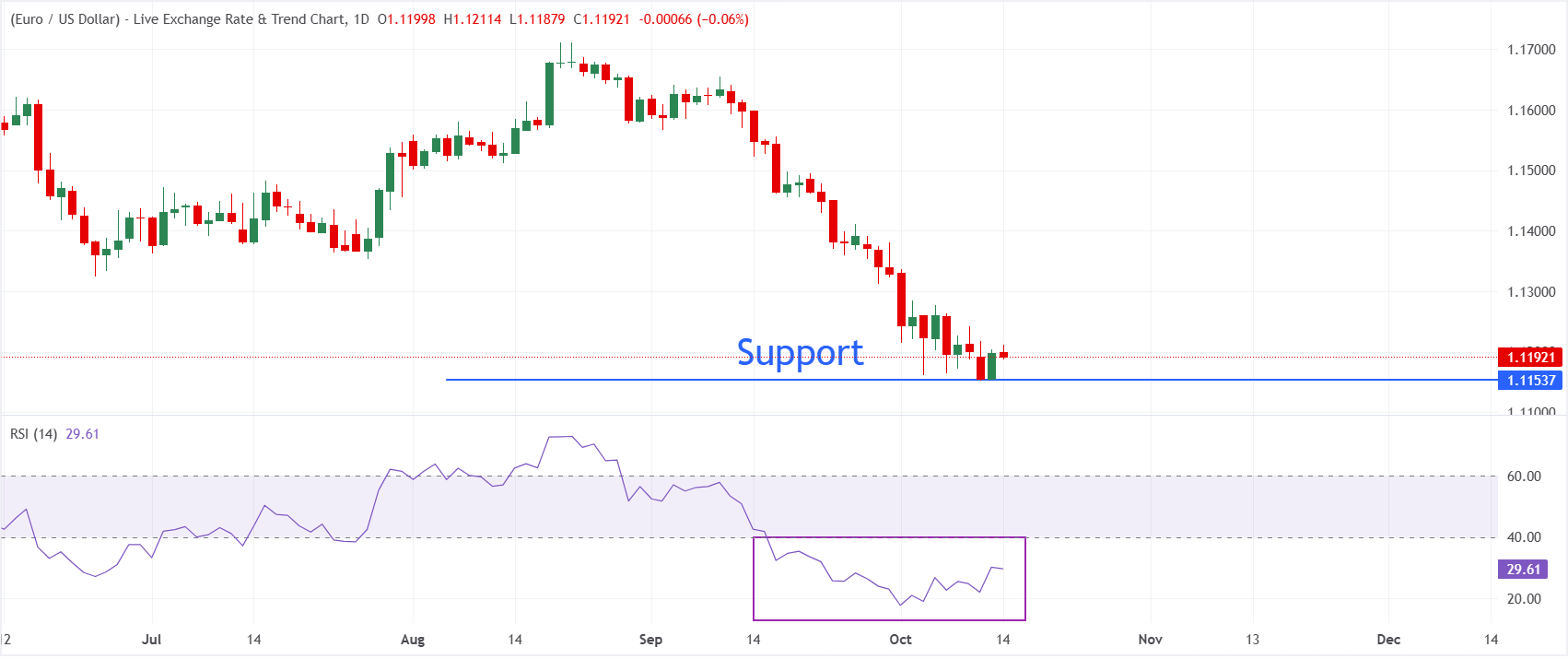
In the daily chart, EUR/USD trades at 1.1192. The pair remains under clear bearish pressure, with price extending its decline from recent highs and pressing toward fresh lows in this sequence. The Relative Strength Index (14) at 29.62 sits just below the oversold threshold, hinting that bearish momentum is stretched but still dominant in the near term.
On the downside, the October 12 low at 1.1153 is the key support level. Looking up, the October 6 high at 1.1277 would act as major barrier.
(The technical analysis of this story was written with the help of an AI tool. Know more.)
Economic Indicator
Consumer Price Index ex Food & Energy (YoY)
Inflationary or deflationary tendencies are measured by periodically summing the prices of a basket of representative goods and services and presenting the data as the Consumer Price Index (CPI). CPI data is compiled on a monthly basis and released by the US Department of Labor Statistics. The YoY reading compares the prices of goods in the reference month to the same month a year earlier. The CPI Ex Food & Energy excludes the so-called more volatile food and energy components to give a more accurate measurement of price pressures. Generally speaking, a high reading is bullish for the US Dollar (USD), while a low reading is seen as bearish.
Read more.Next release: Wed Oct 14, 2026 12:30
Frequency: Monthly
Consensus: 2.5%
Previous: 2.4%
Source: US Bureau of Labor Statistics
The US Federal Reserve has a dual mandate of maintaining price stability and maximum employment. According to such mandate, inflation should be at around 2% YoY and has become the weakest pillar of the central bank’s directive ever since the world suffered a pandemic, which extends to these days. Price pressures keep rising amid supply-chain issues and bottlenecks, with the Consumer Price Index (CPI) hanging at multi-decade highs. The Fed has already taken measures to tame inflation and is expected to maintain an aggressive stance in the foreseeable future.
Recommended Articles


