


BoE expected to hold interest rate at 3.75
- The Bank of England is expected to keep its policy rate at 3.75%.
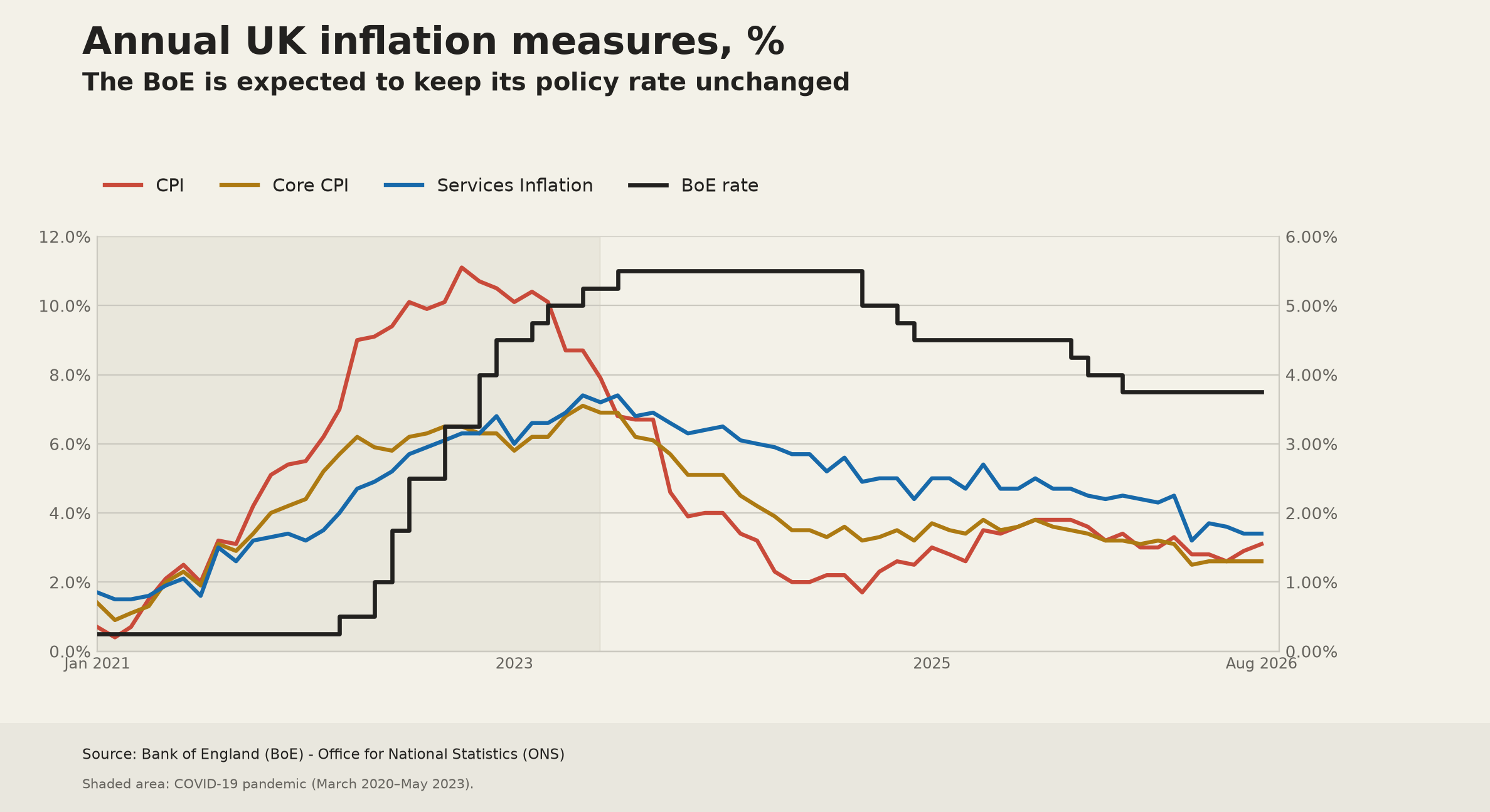
- UK inflation figures remain well above the BoE’s target.
- GBP/USD remains below the 1.3500 mark, close to its key 200-day SMA.
The Bank of England (BoE) is set to reveal its latest monetary policy decision on Thursday, coinciding with its sixth rate-setting meeting of 2026.
Market analysts expect the central bank to keep its benchmark interest rate steady at 3.75%, which should be its sixth hold in a row following December’s 25-bps rate cut.
The Monetary Policy Committee’s (MPC) decision will be followed by the release of Meeting Minutes, which will detail the internal discussions that shaped the outcome.
The central bank maintained interest rates at 3.75% in July, despite a surprisingly hawkish 6-3 vote from the MPC that indicated increased anxiety about the inflationary effect of the Iran conflict. In addition, Governor Andrew Bailey said there was no sign of second-round consequences yet, but that continued conflict and wider pricing pressures would likely require higher interest rates.
Attention remains broadly on inflation and geopolitics
At the latest Treasury Select Committee hearings on September 8, policymakers have sought to push back against the idea that a rate hike is inevitable, while acknowledging that the inflation outlook remains highly sensitive to geopolitical and energy-market developments.
That said, Governor Andrew Bailey argued the increase in market-implied rates partly reflected a risk premium linked to the possibility of further energy-price rises, rather than the BoE’s most likely policy path.
The MPC’s internal debate nevertheless remains finely balanced: Deputy Governor Dave Ramsden described domestically generated inflation pressures as “relatively benign” amid softer labour-market conditions, while Alan Taylor argued that keeping rates at restrictive levels offered insurance against external inflation risks. Megan Greene, who voted to raise the Bank rate from 3.75% to 4.00% in July, struck a more hawkish tone, warning that a prolonged oil-price shock could become embedded in inflation expectations.
How will the BoE interest rate decision impact GBP/USD?
Despite being a close call, market participants appear to lean toward another steady hand by the BoE on Thursday at 11:00 GMT.
Other than the rate decision per se, attention will also focus on the vote split among MPC members, which might be a market mover for the British Pound if it indicates an unusual outcome.
In the run-up to the meeting, GBP/USD navigates the lower end of the current multi-week range in the mid-1.3400s, confronting at the same time its critical 200-day SMA.
"Cable came under fresh downside pressure in the last few days, exclusively following US Dollar dynamics. Further weakness could see the provisional 100-day SMA around 1.3440 retested in the short-term horizon," said Pablo Piovano, Senior Analyst at FXStreet. Further south, there are no support levels of note until the late-July trough at 1.3273 (July 28).
On the upside, Piovano identified the monthly high at 1.3567 (September 9) as the first level to watch, followed by the August ceiling at 1.3675 (August 21).
“Momentum indicators seem to favour extra losses, as the Relative Strength Index (RSI) declines toward the 40 zone, while the Average Directional Index (ADX) around 21 is indicative of a fairly firm trend,” he concludes.
BoE FAQs
The Bank of England (BoE) decides monetary policy for the United Kingdom. Its primary goal is to achieve ‘price stability’, or a steady inflation rate of 2%. Its tool for achieving this is via the adjustment of base lending rates. The BoE sets the rate at which it lends to commercial banks and banks lend to each other, determining the level of interest rates in the economy overall. This also impacts the value of the Pound Sterling (GBP).
When inflation is above the Bank of England’s target it responds by raising interest rates, making it more expensive for people and businesses to access credit. This is positive for the Pound Sterling because higher interest rates make the UK a more attractive place for global investors to park their money. When inflation falls below target, it is a sign economic growth is slowing, and the BoE will consider lowering interest rates to cheapen credit in the hope businesses will borrow to invest in growth-generating projects – a negative for the Pound Sterling.
In extreme situations, the Bank of England can enact a policy called Quantitative Easing (QE). QE is the process by which the BoE substantially increases the flow of credit in a stuck financial system. QE is a last resort policy when lowering interest rates will not achieve the necessary result. The process of QE involves the BoE printing money to buy assets – usually government or AAA-rated corporate bonds – from banks and other financial institutions. QE usually results in a weaker Pound Sterling.
Quantitative tightening (QT) is the reverse of QE, enacted when the economy is strengthening and inflation starts rising. Whilst in QE the Bank of England (BoE) purchases government and corporate bonds from financial institutions to encourage them to lend; in QT, the BoE stops buying more bonds, and stops reinvesting the principal maturing on the bonds it already holds. It is usually positive for the Pound Sterling.
Economic Indicator
BoE's Governor Bailey speech
Andrew Bailey is the Bank of England's Governor. He took office on March 16th, 2020, at the end of Mark Carney's term. Bailey was serving as the Chief Executive of the Financial Conduct Authority before being designated. This British central banker was also the Deputy Governor of the Bank of England from April 2013 to July 2016 and the Chief Cashier of the Bank of England from January 2004 until April 2011.
Read more.Next release: Thu Nov 05, 2026 12:30
Frequency: Irregular
Consensus: -
Previous: -
Source: Bank of England
Recommended Articles


