




Nvidia Has Returned $46 Billion to Shareholders This Year, and Another Major Dividend Hike Could Be Coming
Key Points
The AI boom has been an unprecedented catalyst for Nvidia's business.
Nvidia increased its quarterly dividend this year from $0.01 per share in the first quarter to $0.25 per share in the second.
Nvidia is currently sitting on nearly $100 billion in cash, cash equivalents, and short-term securities.
- 10 stocks we like better than Nvidia ›
Nvidia (NASDAQ: NVDA) is currently the world's most valuable company, with a market cap of over $5.1 trillion as of Sept. 15. As the central chip designer of the AI boom, Nvidia's business has seen unprecedented demand, and as a result, huge amounts of cash keep rolling in. Now, it's beginning to ramp up shareholder returns instead of focusing solely on reinvesting for growth.
Through the first two quarters of its current fiscal year, Nvidia has returned around $46 billion to shareholders through dividends and stock buybacks, and much more is likely on the way.
Missed AI’s "Act 1"? Act 2 Could Be 15x Bigger. Most investors think they missed the AI boat because they didn't buy Nvidia in 2005. But according to our analysts, we’re only at the end of "Act 1"—the R&D phase. "Act 2" is the global rollout. Continue »
Why Nvidia gave its dividend a major boost
Nvidia first began paying a dividend in November 2012. After its 4-for-1 (2021) and 10-for-1 (2024) stock splits, the initial dividend was $0.001875 per share quarterly. Nearly 14 years later, Nvidia's quarterly dividend is $0.25 per share after it gave the payout a 2,400% boost in June from the $0.01 per share it previously paid.
The reason for the huge dividend boost was simple: Nvidia is making tons of money. In just the past three years, its revenue and net income have increased by 431% and 546%, respectively. It now also has $99.4 billion in cash, cash equivalents, and short-term securities on its books.
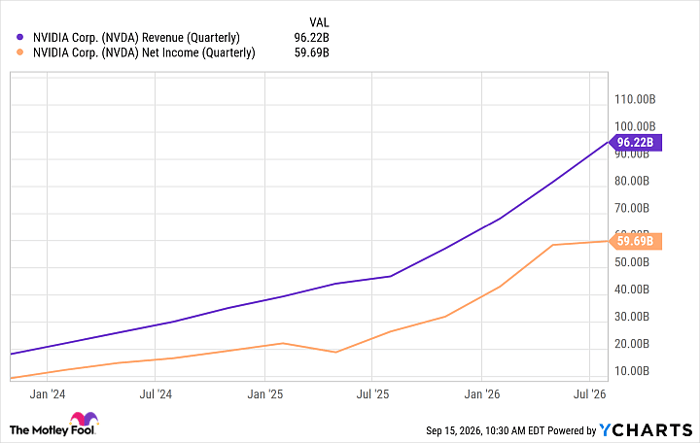
NVDA Revenue (Quarterly) data by YCharts.
With Nvidia rolling in cash, it was getting harder and harder to justify paying out a dividend of a penny per quarter.
Why another hike might be coming
Nvidia's business still has plenty of runway. Even if (or when, rather) its growth rate slows down from its current rapid pace, it has a chance to remain one of the faster-growing tech stocks in the world. So it's at a point where it can aggressively reinvest in its business and also reward shareholders more handsomely.
Image source: The Motley Fool.
Much of the $46 billion Nvidia has returned to shareholders has come through stock buybacks -- it spend $20 billion and $19.7 billion on them in the first and second quarter, respectively -- but a dividend hike lets Nvidia reward investors directly. It still has $99 billion in buybacks planned under its current authorization, but it's unclear how it will execute them.
Another dividend hike could also put Nvidia on the same tier as more mature big tech dividend payers like Microsoft and Apple. Neither has a yield that would get most to consider them as income stocks, but their payouts have been reliable and growing consistently over the years.
No matter how big Nvidia's next dividend hike is, the stock is a growth stock at heart. The dividend is simply a nice-to-have perk that should continue to compound over time.
Should you buy stock in Nvidia right now?
Before you buy stock in Nvidia, consider this:
The Motley Fool Stock Advisor analyst team just identified what they believe are the 10 best stocks for investors to buy now… and Nvidia wasn’t one of them. The 10 stocks that made the cut could produce monster returns in the coming years.
Consider when Netflix made this list on December 17, 2004... if you invested $1,000 at the time of our recommendation, you’d have $420,109!* Or when Nvidia made this list on April 15, 2005... if you invested $1,000 at the time of our recommendation, you’d have $1,303,689!*
Now, it’s worth noting Stock Advisor’s total average return is 938% — a market-crushing outperformance compared to 211% for the S&P 500. Don't miss the latest top 10 list, available with Stock Advisor, and join an investing community built by individual investors for individual investors.
See the 10 stocks »
*Stock Advisor returns as of September 17, 2026.
Stefon Walters has positions in Apple and Microsoft. The Motley Fool has positions in and recommends Apple, Microsoft, and Nvidia. The Motley Fool has a disclosure policy.
Recommended Articles


