




Bank of America Stock Breaks Trendline as Q3 Banking Warning Puts $58.90 in Focus
TradingKey - Bank of America reports a September 14 detailed closing price of $59.47, a 5.14% decrease from the previous day. The stock traded at an intraday low of $58.92. The stock dipped below the rising trendline and moved through the moving average zone of $61.85-$62.08, with CEO Brian Moynihan suggesting at least a 10% decline in Q3 investment-banking fees and relatively unchanged Q3 trading revenues from last year's level. This shows a reset in Wall Street revenues and should not be interpreted as a negative signal regarding BAC's consumer, credit and deposit franchises.
Q3 Investment Banking Guidance Triggered the Selloff
The league tables suggest that Wall Street is redefining how it values Bank of America. Moynihan said at the Barclays Global Financial Services Conference that the bank is targeting $1.6 billion to $1.8 billion in Q3 investment-banking fees, versus $2 billion for the previous year’s quarter. That suggests a decline of at least 10 percent and potentially closer to 20 percent at the low end.
Sales and trading revenues are expected to be in the range of $5.4 billion for Q3, roughly flat compared with Q3 2025. That is below Q2 2026 sales and trading revenue of $7.1 billion, which had risen 33% year over year.
Still, Moynihan said the deal pipeline is strong. Therefore, the current trading trends look more like a normalizing and timing adjustment to today’s sales levels.
Q2 Shows the Core Franchise Is Still Strong
The reported results for the previous quarter balance the weaker outlook for Q3 capital markets. Bank of America reported total revenue of $31.6 billion, up by 15 percent, and total net income of $9.1 billion, up by 27 percent, and total diluted EPS of $1.21, up by 34 percent.
The group reported net interest income of $16 billion, which represented an increase of 9%. Average loans were $1.22 trillion, while average deposits were $2.02 trillion. Return on Tangible Common Equity was 17%.
The strength of this report is how broad it is. BAC was growing net interest income and loans, while also growing deposits and wealth management fees, trading and investment banking. While today's warning weakens one part of the earnings equation, it doesn't weaken the diversification of the earnings engines.
Net Interest Income Remains the Main Fundamental Support
The strength of the story that BAC offers continues to be it's Net Interest Income. The bank is growing its loans, deposits, and is starting to see the benefit of the repricing of some of their lower yielding, fixed income assets.
The context in which that growth is happening is important. The US 10 year Treasury has moved above 5 percent. The market is also pricing in a Fed rate hike on September 16. The initial impact of more rate hiking is likely to boost asset yield and the income from reinvestment.
However, the impact of such a change is likely to reduce the demand for new loans and weaken the credit quality. Increased credit costs with weaker housing is also likely. Moynihan also conceded that increasing interest rates would likely reduce loan activity. Therefore, in the context of the rate changes, I would say the current environment is short-term net-interest income positive, and loan growth negative and credit-risk negative over the long run.
Consumer and Credit Trends Remain Healthy
Bank of America’s core consumer division is still healthy with little to no stress. Q2 revenue for consumers was up 5%, and they added more than 160,000 net new consumer checking accounts. Combined spending on consumer debit and credit cards was also up 9% from last year.
Credit quality remains healthy. Net charge-offs for Q2 fell to $1.41 billion, while the net charge-off ratio improved to 0.47% from 0.55% a year earlier. Provision for credit losses also declined to $1.37 billion from $1.59 billion.
Moynihan said on September 14 that consumer spending remains solid, and that quality of credit has been as good as he has ever seen it. For me, that is the reason to ignore yesterday’s drop as snap bank selling.
Wealth Management and Capital Returns Add Resilience
Global Wealth and Investment Management had revenue of $6.9 billion for Q2, a 16% increase year over year. Fees for Asset Management went up 19% as well and client balances hit $4.9 trillion. Bank of America also returned capital the shareholders for $8 billion, in which $6 billion was returned through share buyback and $2 billion was returned for common dividend. The quarterly dividend was raised to $0.32 a share, a 14% increase from the prior quarter. Capital return helps value of the stock when capital market revenue is low.
Valuation Is More Reasonable After the Drop
Tangible book value at $29.37 per share is not indicative of distressed valuation territory, but it is more defendable if Bank of America can sustain strong NII, healthy credit and double-digit ROTCE. The main valuation question is centered around the Q3 investment banking slowdown and the extent to which it is likely to be temporary. Should strength in NII and credit hold and stabilize while the capital markets revenue line continues to be affected by the recent slowdown, the 5% decline may have been more of an expectation gap closing rather than a significant nond School event.
Bank of America Technical Analysis: $58.92 Is the Immediate Decision Level
BAC closed on September 14 at $59.47, matching the chart reference exactly, after breaking below the rising trendline and the $61.85-$62.08 moving average zone. The breakdown cutting through the $60.82 and $59.76 levels with very little upside response confirms a meaningful short-term breakdown.
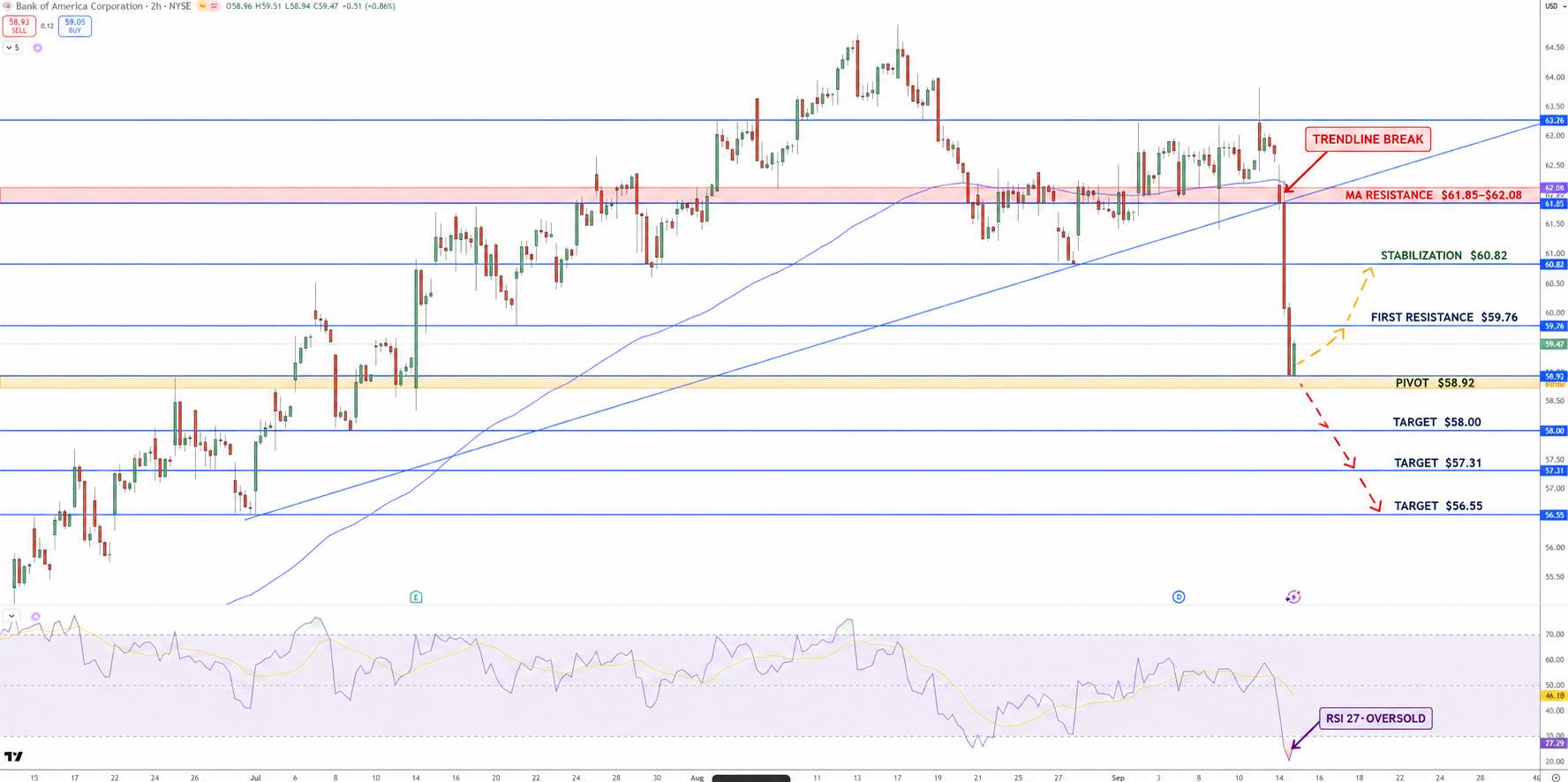
Bank of America Stock Price Chart - Source: Tradingview
The RSI is currently at 27 and is below the 30 oversold level and well below the signal line around 46. This confirms downside momentum, but also makes a short-term relief bounce possible.
The immediate pivot is at $58.92 and also matched Monday’s intraday low. A move above this price could trigger a short-term move higher toward $59.76 and $60.82. To consider the longer-term technical picture healed, bulls would need to move above the $61.85-$62.08 range.
If $58.92 is breached, the next support is identified at $58.00. $57.31 and $56.55 are the next downside targets.
Key Levels
· Latest completed close: $59.47
· Immediate support: $58.92
· First downside target: $58.00
· Secondary support: $57.31
· Deeper support: $56.55
· First recovery level: $59.76
· Stabilization trigger: $60.82
· Major recovery zone: $61.85-$62.08
· RSI: Around 27, firmly oversold
Why is Bank of America stock in focus now?
BAC fell 5.14% after Brian Moynihan indicated that Q3 investment banking fees would drop by at least 10% and trading revenue would be roughly flat year over year. While the selloff reset expectations for Wall Street businesses, consumer spending, credit quality, loans, deposits, and NII remain strong.
What level confirms a BAC recovery?
Signs of early stabilization would be reclaiming $59.76, while BAC trading above $60.82 would be favorable for the short term. Overall, technical damage would continue to exist until BAC reclaims $61.85-$62.08.
Bottom Line
Bank of America's setup for September 15 appears to be more technically challenging than fundamentally sound. The Q3 investment banking cautionary note is a legitimate earnings headwind. The selling the day following the strength of the Q2 capital markets is justified, but the core business remains healthy and robust. NII is increasing, and loan growth is 8%. $2 trillion plus deposits are a credit positive, and credit metrics are strong. Liquidity and capital returns are sound. On a technical basis, I remain bearish while BAC is below $59.76. The RSI is at oversold levels of 27, and a relief bounce is expected. A breakdown of $58.92 would bring $58.00 and $57.31 into focus. Conversely, $60.82 would be a good first sign of stabilization.
Recommended Articles


