




NVIDIA Stock Breaks Rising Trendline as $207 Support Becomes the Next Test
TradingKey - NVIDIA enters September 15 with the latest completed close at $210.96 on September 14, down 3.36%, slightly above the supplied $210.86 chart reference. The stock had broken its long-standing uptrend after getting rejected at the $228.91 area, and buyers had not been able to reclaim $212.65. What's most concerning is price disassociating from fundamentals. The sell-off has been driven by AI-safety concerns, the rising yield environment (with 5%+ Treasuries) and multiple contraction. However, NVIDIA is projecting $108B for Q3 revenue and near 70% growth for FY 2028, all while the supply situation has yet to improve.
AI-Safety Fears Hit the Stock, Not the Order Book
Market sentiment for the latest sell-off was driven by AI concerns. Many leading executives of AI firms have called for a slowdown to some aspects of frontier model build-out, emerging safety and regulatory concerns. That triggered a sharp sell-off in semiconductors on September 14, with NVIDIA down 3.36%.
I'd caution against drawing conclusions of models driven down because of demand. There is a large difference between slowing the build-out of the ever more dangerous models and slowing the deployment of AI. If the demand shift is towards enterprise deployment with a focus more on inference and agentic AI, demand for powerful compute would shift but remain significant.
For now, NVIDIA's reported numbers show no significant demand shift.
Q2 Growth and Q3 Guidance Remain Exceptional
NVIDIA reported $96.2B in revenue for fiscal Q2 2027, which was an increase of 106% YoY and 18% higher compared to the previous quarter. Data Center revenue was at $89.0B, rising 117% and retaining gross margin of 75%.
For the third quarter of this fiscal year, management forecasts revenue to be in the range of $108 billion, minus or plus 2 percent, and this forecast is significant based on their assumption there is no Data Center compute revenue from China.
The highest of the bull points is the preliminary FY2028 revenue growth of approximately 70 percent. What NVIDIA is really saying here is that they expect to see rapid growth while supply is constrained.
Vera Rubin Is Becoming the Next Growth Engine
Challenging the classic cycle of supply and demand within the semiconductor industry, Vera Rubin is now in full production and is forecasted to contribute roughly 20 percent of total Data Center revenue for the quarter. Customers will not cease sales to wait for the next architecture.
Traditional risks related to supply and demand cycles will be negated by this continuous production of the next architecture. Now NVIDIA will have to execute cleanly to manage the demands of the previous architecture (Blackwell) and satisfying the demand of the new (Rubin) while managing constraints related to memory, networking, and systems.
SB Energy Investment Shows NVIDIA Is Funding the AI Buildout
NVIDIA has made a $1.5 billion investment commitment to SB Energy, a SoftBank-backed data-center and power-infrastructure developer.
This helps us understand a constraint that has certainly shifted. NVIDIA's supply chain issues aren't just GPU supply anymore. They have to worry about power, land, cooling, and of course, supply chain issues with data centers and connectivity.
This is how the company balances risk to create future GPU supply. The issue here is that NVIDIA is taking on more direct exposure to the ecosystem that supports the spending that will drive future GPU growth.
This investment with Anthropic has more implications. Separately, NVIDIA is also in talks to invest in Anthropic’s planned IPO.
Anthropic Talks Add Another Capital-Intensity Question
According to reports, NVIDIA is in talks to become an anchor investor in Anthropic’s expected IPO, with a potential investment of up to $10 billion.
Anthropic is one of the largest AI compute users in the world, so this partnership makes sense, however, I find this new development concerning because it drives the question that I have been watching. How much capital will NVIDIA have to invest in customers and infrastructure in order to support the artificial intelligence industry?
While this is not an automatic bear case, investors should differentiate the demand for chips from the demand for chip services.
Margins Remain the Main Company-Specific Risk
NVIDIA’s Q2 margin was 75.0%, but management mentioned that advanced memory pricing remains a large negative in the overall cost environment. The cost of HBM and related components has been increasing.
This matters because, while NVIDIA’s revenue continues to grow, the rate at which NVIDIA’s profit grows can start to slow, and profits can begin to erode, if the effects of cost inflation diminish NVIDIA’s profits faster than NVIDIA can control through their pricing and mix strategies.
For NVIDIA’s next earnings report, I will be analyzing two primary metrics: gross margin and Rubin mix.
Macro Pressure Is Making Valuation Harder
NVIDIA has less favorable economic conditions. Higher Treasury yieldsput upward pressure on the rates. Oil prices remain high. The U.S. 10-year Treasury yield moved above 5% on September 15, while markets priced a high probability of another Fed rate increase.
Earnings estimates for NVIDIA may not change. However, investors can still choose to employ lower valuation multiples. This can result in high-duration/high-growth stocks losing value. This may be one of the reasons NVIDIA's stock can trade listlessly while the fundamental business performance can be strong.
NVIDIA Technical Analysis: $207.01 Is the Key Breakdown Level
NVDA closed at around $210.96 on September 14, which is in the range of the $210.86 provided in the chart reference. The 2 hr structure has deteriorated, as price broke below the long-standing rising trend line and failed to take out the $212.65 resistance zone.
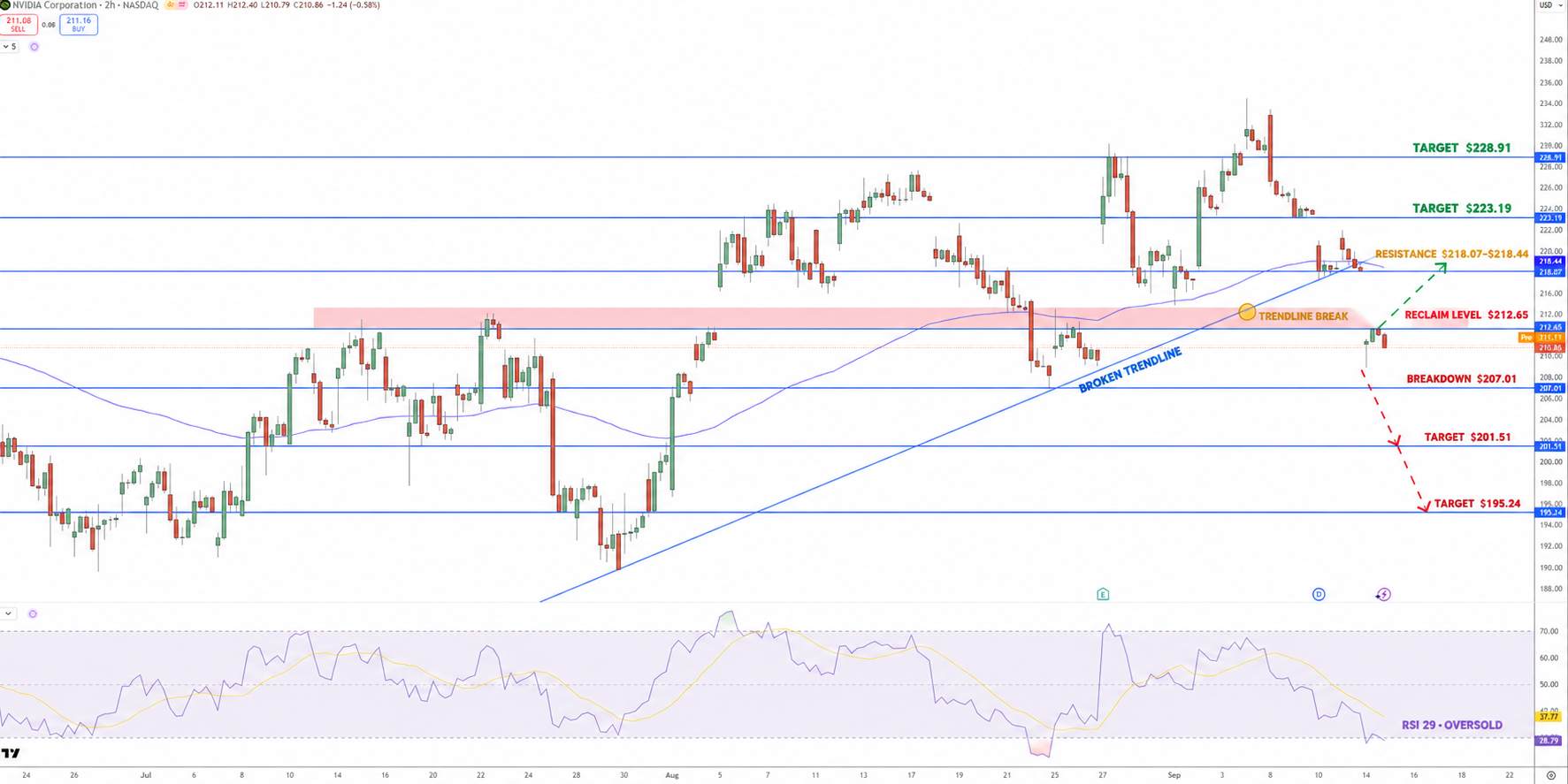
NVIDIA Stock Price Chart - Source: Tradingview
RSI is at a level of 29 and is below the signal line of 38 and the 30 oversold zone. This means a probable short term relief bounce, but it does not negate the bearish structure.
The first recovery level may come at $212.65. Beyond that we may see $218.07 -$218.44. Should price take out this zone, we should expect $223.19 and $228.91 to be reached.
In the event price breaks below $207.01, we can expect $201.51 and $195.24 to be reached.
Key Levels
· Recent Closed Price: Around $210.96
· Immediate Resistance: $212.65
· Recovery Zone: $218.07-$218.44
· Higher Resistance: $223.19
· Major Resistance: $228.91
· Key Support: $207.01
· First Downside Target: $201.51
· Deeper Support: $195.24
· RSI: Around 29, oversold
Why is NVIDIA stock in focus now?
AI safety, 5%+ Treasury yields and falling valuations all have a negative impact on semiconductor sentiment, and consequently NVIDIA. Operating fundamentals continue to perform well with 106% year over year revenue growth and 117% year over year growth in Data Center, $108 billion revenue outlook for Q3, and Vera Rubin already in full production.
What level confirms an NVDA recovery?
Recovery bounce would be confirmed at $212.65. A sustained reclaim of $212.65 would be the first recovery signal. A break above $218.07-$218.44 would change the structure and expose $223.19 and $228.91. A break of $207.01 would lead to $201.51 and $195.24.
Bottom Line
NVIDIA’s September 15 outlook shows selling pressure growing faster than the operating story. The stock is below the trendline and RSI is oversold, but there are no clear signals to indicate falling GPU demand. The main risks are valuation, 5% + Treasury yields, AI safety, memory, and the increasing amount of capital NVIDIA is allocating to its ecosystem. Below $212.65, I am Still bearish. $212.65 is immediate resistance, not support. The key downside support is $207.01; a break below it would favor $201.51 and possibly $195.24, while reclaiming $212.65 would support a recovery toward $218.07-$218.44.
Recommended Articles


