




This Is the First Oil Dividend Stock I'd Buy in September
Key Points
Chevron’s scale and diversification make it a reliable long-term investment.
It has plenty of room to raise its dividend, and it will eventually become a Dividend King.
- 10 stocks we like better than Chevron ›
Income-oriented investors often buy oil stocks to earn steady dividends. However, many of those stocks are also tightly tethered to volatile oil prices. When oil prices surge, these companies generate plenty of cash to cover their dividends. But when oil prices pull back, the less diversified companies with weaker balance sheets will likely reduce those payments.
That said, there's still one resilient oil stock I'd be comfortable buying in September, even though it's historically the weakest month for the stock market. That stock is Chevron (NYSE: CVX), one of the world's largest integrated energy companies.
Missed Nvidia in 2009? This Rare Signal Is Flashing Again. In 2009, a "Double Down" signal flashed for a little-known chipmaker called Nvidia. For the first time in years, that same "Total Conviction" signal is flashing for a company 1/100th the size of Nvidia. Continue »
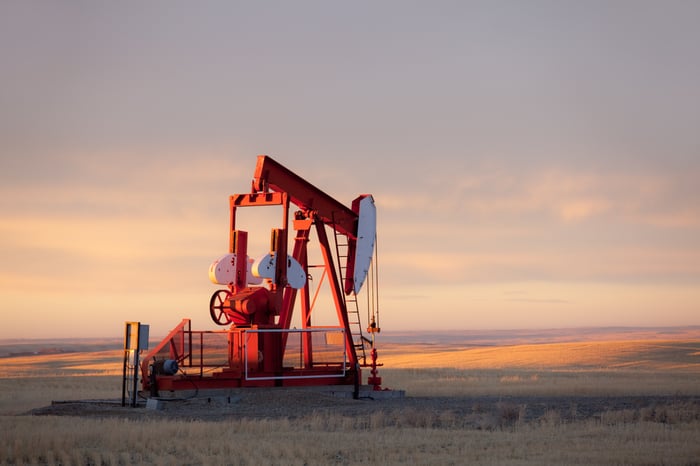
Image source: Getty Images.
Why is Chevron more resilient than other oil companies?
Chevron owns upstream, midstream, and downstream businesses. Upstream companies, which extract oil, typically benefit most from rising oil prices because their revenues increase faster than their expenses. Midstream companies, which build the infrastructure to transport those resources, can grow as long as gas and oil keep flowing through their pipelines.
Downstream companies that operate refineries and chemical production plants generally fare better when crude oil prices are lower, since their input costs are pegged to the spread between crude oil costs and retail fuel prices. Chevron's diversification across all three industries helps it better withstand market downturns than smaller companies that focus on a single market.
Chevron still generates most of its profits from its upstream business, so it's benefited from the conflict-driven spike in oil prices over the past six months. However, it only needs the price of Brent crude oil -- which recently rose above $100 per barrel -- to remain above its breakeven price of about $50 per barrel to comfortably cover its capex and dividends.
Chevron has a presence in 180 countries, but it gets most of its oil and natural gas from the U.S., Kazakhstan, and Australia. It's also less dependent on the Middle East than most of its industry peers, including ExxonMobil (NYSE: XOM) and BP (NYSE: BP).
At the end of the second quarter, Chevron had $8.53 billion in cash and equivalents with a low net debt ratio of 13.1%. That fortress balance sheet should shield it from the next market crash.
Chevron expects to increase its oil and gas production by 2%-3% annually through 2030. That growth should be supported by its Tengiz Field in Kazakhstan, its main Permian Basin field in the U.S., its deepwater projects across the Gulf of Mexico, new natural gas projects in Australia, and its growth in Guyana -- one of the fastest-growing oil regions in the world.
It also aims to reduce its structural costs by up to $4 billion by the end of 2026, increase its synergies from Hess (which it acquired last July) to $1.5 billion, and buy back up to $20 billion in shares every year -- as long as the price of Brent crude oil stays at about $60-$80 per barrel.
Why is Chevron a rock-solid dividend investment?
Chevron currently pays a forward yield of 3.4%. It's raised its dividend annually for 39 consecutive years, even as the U.S. endured four recessions. If it maintains that streak for 50 years in a row, it will become a Dividend King. Over the past 12 months, Chevron spent just 51% of its free cash flow (FCF) on its dividends, leaving it plenty of room for future hikes.
Over the past 20 years, Chevron delivered a total return of 618% with reinvested dividends. It didn't outperform the S&P 500's (SNPINDEX: ^GSPC) total return of 755%, but it easily beat ExxonMobil and BP's total returns of 391% and 100%, respectively.
From 2025 to 2028, analysts expect Chevron's revenue and EPS to grow at CAGRs of 4% and 24%, respectively. Those are robust growth rates for a stock that trades at 16 times next year's earnings. By comparison, the S&P 500 is trading at 20 times forward earnings. So if you're looking for a cheap oil dividend stock to buy this month, Chevron checks all the right boxes.
Should you buy stock in Chevron right now?
Before you buy stock in Chevron, consider this:
The Motley Fool Stock Advisor analyst team just identified what they believe are the 10 best stocks for investors to buy now… and Chevron wasn’t one of them. The 10 stocks that made the cut could produce monster returns in the coming years.
Consider when Netflix made this list on December 17, 2004... if you invested $1,000 at the time of our recommendation, you’d have $410,024!* Or when Nvidia made this list on April 15, 2005... if you invested $1,000 at the time of our recommendation, you’d have $1,372,815!*
Now, it’s worth noting Stock Advisor’s total average return is 950% — a market-crushing outperformance compared to 211% for the S&P 500. Don't miss the latest top 10 list, available with Stock Advisor, and join an investing community built by individual investors for individual investors.
See the 10 stocks »
*Stock Advisor returns as of September 10, 2026.
Leo Sun has no position in any of the stocks mentioned. The Motley Fool has positions in and recommends Chevron. The Motley Fool recommends BP. The Motley Fool has a disclosure policy.
Recommended Articles


