




The Dow Hit 50,000. Here's What History Says Happens Next.
Key Points
Major milestones usually aren't market tops.
The history of the Dow continuing its momentum after hitting a big round number could repeat itself.
Investors should be prepared regardless of what happens next with the stock market.
- 10 stocks we like better than Dow Jones Industrial Average ›
Investors tend to get excited by big round numbers. They partied like it was 1999 when the Dow Jones Industrial Average (DJINDICES: ^DJI) reached 10,000 back in... 1999. The major index topping 30,000 in 2020 during the huge rebound after the COVID-19 sell-off was a time to celebrate.
And now the Dow has broken another big round-number barrier. It blew past 50,000 on Friday, Feb. 8, 2026. Here's what history says could happen next.
Where to invest $1,000 right now? Our analyst team just revealed what they believe are the 10 best stocks to buy right now, when you join Stock Advisor. See the stocks »
Milestones usually aren't market tops
You might think a letdown is in order after a stock market index hits a psychological milestone. However, that has typically not been the case in the past.
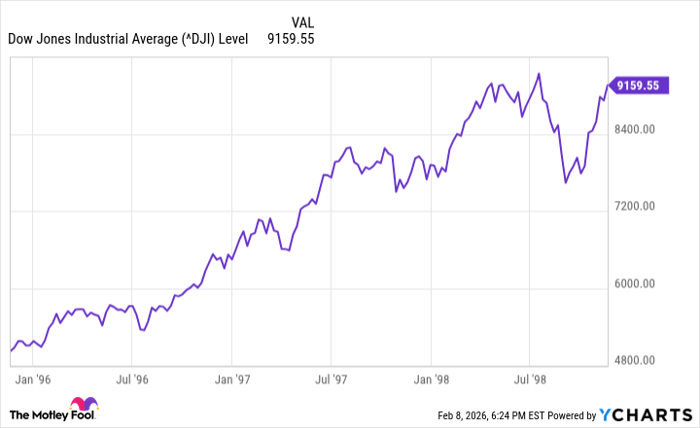
For example, the Dow Jones Industrial Average reached 5,000 on Nov. 21, 1995. Fast-forward one year: The index had jumped another 28%. Three years after topping 5,000, the Dow had soared 82%.
^DJI data by YCharts
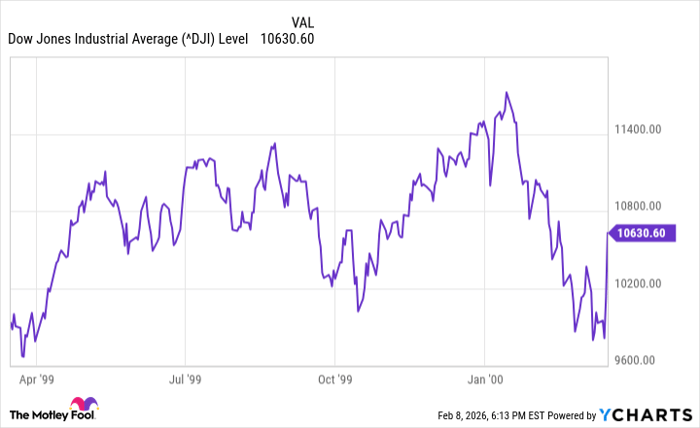
The Dow first traded above 10,000 on March 16, 1999. One year later, the index was up another 7%. Sure, the dot-com bubble burst shortly afterward, erasing those gains. But the Dow's momentum didn't end suddenly after reaching five digits.
^DJI data by YCharts
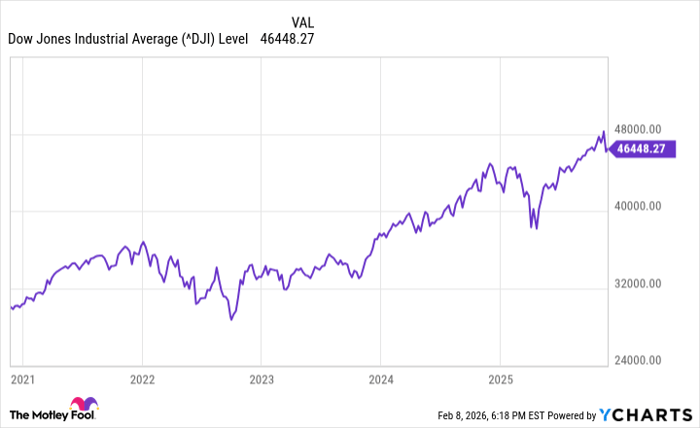
The outcome was even better after the Dow Jones Industrial Average hit 30,000 on Nov. 24, 2020. A year later, the index had risen 19%. After five years, the Dow had gained 54% after reaching the 30,000 milestone.
^DJI data by YCharts
To be sure, the post-milestone momentum hasn't always lasted. For example, the Dow declined 13% a year after hitting 1,000 on Nov. 14, 1972. The index was still down 16% five years later, amid high inflation and a sluggish economy. However, history is clear that big round numbers more often lead to greater gains for the Dow than a sell-off.
Why history could repeat itself
There's a simple reason the stock market tends to keep rising after reaching a significant milestone: the factors that drove it to that level remain in place. I think that's the main reason why history could repeat itself with the Dow hitting 50,000.
Corporate earnings are the most critical driver of stock prices. So far, earnings reported by companies in the Dow Jones Industrial Average have continued to grow. If this trend continues, the Dow will almost certainly keep rising.
Of course, macroeconomic factors such as inflation, interest rates, and GDP growth are also important. At this point, there's no reason to expect dramatic negative swings for any of these economic metrics.
What about the possibility that an artificial intelligence (AI) stock bubble bursts? It could happen. We have seen the share prices of some AI giants, including Amazon (NASDAQ: AMZN) and Microsoft (NASDAQ: MSFT), fall recently, in large part because analysts were nervous about their increased AI infrastructure spending.
However, the Dow Jones Industrial Average isn't loaded with tech stocks. Yes, the index includes Amazon, Microsoft, and Nvidia (NASDAQ: NVDA). But Goldman Sachs (NYSE: GS) and Caterpillar (NYSE: CAT) rank as the top two stocks in the Dow. Microsoft is the only AI stock in the index's top 10 components.
Preparing for Dow 60,000
Perhaps the Dow Jones Industrial Average's momentum could stall and even evaporate over the next 12 to 24 months. Consumers could eventually feel the full brunt of tariffs, leading them to reduce spending so much that corporate earnings take a hit. Inflation might resurge. The aforementioned AI bubble could burst, as some predict.
However, I suspect the most likely scenario over the near term is more of what we have now. In particular, I wouldn't bet the farm that an AI bubble will burst anytime soon. The demand for AI appears to be growing rather than slowing.
Investors should be prepared if the Dow and the broader stock market stumble. It's always good to have a diversified portfolio and some cash available. On the other hand, investors should also be prepared for the good times to keep rolling. Dow 60,000 might not be too far away.
Should you buy stock in Dow Jones Industrial Average right now?
Before you buy stock in Dow Jones Industrial Average, consider this:
The Motley Fool Stock Advisor analyst team just identified what they believe are the 10 best stocks for investors to buy now… and Dow Jones Industrial Average wasn’t one of them. The 10 stocks that made the cut could produce monster returns in the coming years.
Consider when Netflix made this list on December 17, 2004... if you invested $1,000 at the time of our recommendation, you’d have $443,299!* Or when Nvidia made this list on April 15, 2005... if you invested $1,000 at the time of our recommendation, you’d have $1,136,601!*
Now, it’s worth noting Stock Advisor’s total average return is 914% — a market-crushing outperformance compared to 195% for the S&P 500. Don't miss the latest top 10 list, available with Stock Advisor, and join an investing community built by individual investors for individual investors.
See the 10 stocks »
*Stock Advisor returns as of February 9, 2026.
Keith Speights has positions in Amazon and Microsoft. The Motley Fool has positions in and recommends Amazon, Caterpillar, Goldman Sachs Group, Microsoft, and Nvidia. The Motley Fool has a disclosure policy.
Recommended Articles


