




Is Sandisk the Next Micron?
Key Points
Micron isn't the only company benefiting from the healthy demand for memory chips used in data centers and other applications.
Sandisk saw remarkable growth in revenue and earnings in recent quarters and is poised to overtake Micron's earnings.
Sandisk's growth potential suggests it could see a significant jump in its stock price going forward.
- 10 stocks we like better than Sandisk ›
Micron Technology (NASDAQ: MU) has been one of the hottest stocks on the market in the past year. Shares of the memory specialist jumped an incredible 339% in the past year. This isn't surprising, given its accelerating revenue and earnings growth, driven by robust demand and constrained supply of memory chips.
The good news is that Micron stock seems poised to deliver more upside, thanks to the stunning earnings growth that the company is poised to deliver in the future. But what's worth noting is that Micron isn't the only memory-industry participant capitalizing on the booming memory demand.
Where to invest $1,000 right now? Our analyst team just revealed what they believe are the 10 best stocks to buy right now, when you join Stock Advisor. See the stocks »
Sandisk (NASDAQ: SNDK), which manufactures data storage solutions using NAND flash technology for personal computers (PCs), smartphones, gaming consoles, data centers, and other applications, saw its share price jump by a phenomenal 1,840% in the past year. Sandisk's gains significantly outpaced Micron during this period.
Let's see why that's been the case and check if Sandisk has the potential to become the next big player in the memory market, like Micron.

Image source: Getty Images
Sandisk is enjoying incredible earnings growth, just like Micron
The terrific demand for both storage and compute memory chips has been a massive catalyst for Micron in recent quarters. The company's bottom line is anticipated to quadruple in the current fiscal year, primarily due to a shortage of dynamic random access memory (DRAM) and NAND flash chips.
These memory chips are in high demand in data centers, where the proliferation of artificial intelligence (AI) workloads has driven the need for massive computing power and storage. Micron gets 80% of its revenue from selling DRAM chips, which are being designed into AI accelerators to help move massive datasets at incredible speeds. It's worth noting that the company has sold out its 2026 memory capacity due to robust end-market demand.
Sandisk, on the other hand, is a specialist in NAND flash technology. It was the fifth-largest player in the global NAND flash market in June last year with a 12% share -- slightly lower than Micron's 13% -- according to Counterpoint Research. However, Sandisk is taking share from Micron in NAND flash.
Sandisk's revenue shot up by 61% year over year in the second quarter of fiscal 2026 (which ended on Jan. 2, 2026) to just over $3 billion. That was almost triple the jump in Micron's NAND revenue in the previous quarter. Sandisk reported impressive growth across the data center, consumer, and edge business segments.
What's more, the company's non-GAAP earnings shot up by more than 5x during the quarter to $6.20 per share. That's not surprising, as the demand for Sandisk's flash memory products is outpacing supply. The NAND flash shortage is expected to continue in 2026, as AI data centers have been loading up on flash-based storage solutions, leading to a stunning increase in prices.
Phison Electronics, a Taiwan-based NAND flash-memory chip company, estimates that the NAND flash shortage could persist over the next decade, propelled by AI-driven demand. There's a good chance that Sandisk will sustain healthy growth for years to come.
Sandisk pointed out just over a year ago that it sees NAND demand increasing at an annual rate in the high teens through 2028. However, its latest quarterly performance and guidance suggest that it's on track to clock much stronger growth.
Sandisk expects $4.6 billion in revenue in the current quarter, a potential increase of 172% from the prior year. It expects its bottom line to land at $13 per share, a massive improvement over the non-GAAP loss of $0.30 per share in the year-ago period.
Consensus estimates project a jump of more than 10x in Sandisk's earnings in the current fiscal year to $39.45 per share. This is well above the anticipated increase in Micron's earnings, followed by another terrific increase next year.
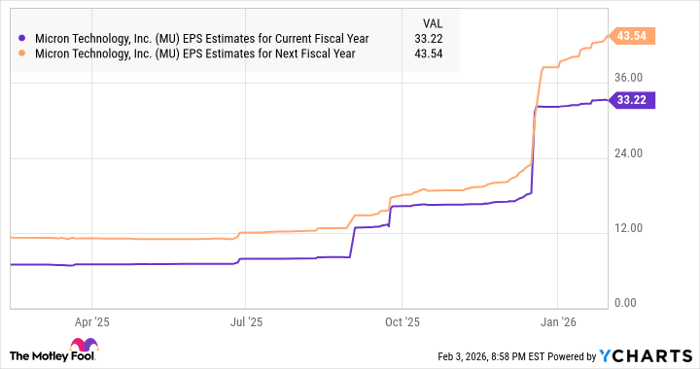
Data by YCharts.
The stock has a lot of room to run higher
We have seen that Sandisk is leaving Micron in the dust when it comes to earnings growth. This explains the stellar returns that Sandisk has clocked in the past year. Of course, Sandisk's forward earnings multiple of 44 is higher than Micron's reading of 13, but the premium can be justified by the much stronger growth that the former is delivering.
As it turns out, Sandisk's earnings are poised to become much bigger than Micron's by next year.
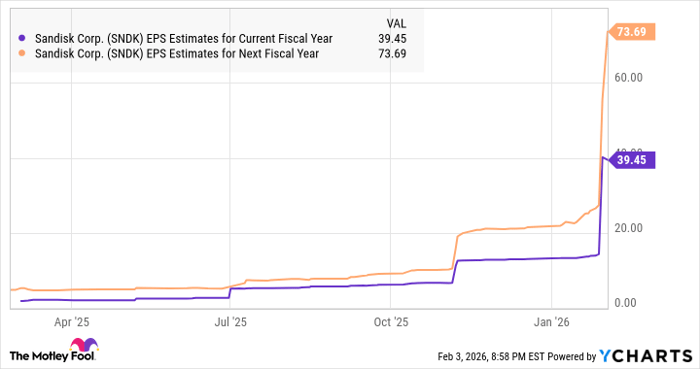
Data by YCharts.
If Sandisk trades at even 26 times earnings by the end of the next fiscal year (in line with the tech-laden Nasdaq-100 index's forward earnings multiple), its stock price could jump to $1,915 per share. That's a 175% jump from its current stock price, which means investors looking for the next big AI stock can consider buying Sandisk hand over fist, as it still has tremendous upside to offer.
Should you buy stock in Sandisk right now?
Before you buy stock in Sandisk, consider this:
The Motley Fool Stock Advisor analyst team just identified what they believe are the 10 best stocks for investors to buy now… and Sandisk wasn’t one of them. The 10 stocks that made the cut could produce monster returns in the coming years.
Consider when Netflix made this list on December 17, 2004... if you invested $1,000 at the time of our recommendation, you’d have $436,126!* Or when Nvidia made this list on April 15, 2005... if you invested $1,000 at the time of our recommendation, you’d have $1,053,659!*
Now, it’s worth noting Stock Advisor’s total average return is 885% — a market-crushing outperformance compared to 192% for the S&P 500. Don't miss the latest top 10 list, available with Stock Advisor, and join an investing community built by individual investors for individual investors.
See the 10 stocks »
*Stock Advisor returns as of February 6, 2026.
Harsh Chauhan has no position in any of the stocks mentioned. The Motley Fool has positions in and recommends Micron Technology. The Motley Fool has a disclosure policy.
Recommended Articles


