




Tesla Stock Dips as Investors Weigh Its Fourth-Quarter Results: Is This a Buying Opportunity?
Key Points
Tesla said it expects to begin production of Cybercab in April.
The company's free cash flow fell sharply in Q4.
Management expects capital expenditures to more than double in 2026.
- These 10 stocks could mint the next wave of millionaires ›
Initially, when electric-car maker Tesla (NASDAQ: TSLA) released its fourth-quarter results, the stock popped. But shortly after the market opened on Thursday, the stock's return for the day turned negative. This has added to the stock's weakness in recent weeks. As of this writing, the stock is down more than 11% over the past month.
The stock's volatility following the earnings report exemplifies the bifurcated takeaway from Tesla's latest quarterly update.
Where to invest $1,000 right now? Our analyst team just revealed what they believe are the 10 best stocks to buy right now, when you join Stock Advisor. See the stocks »
On one hand, Tesla reported a surge in its active supervised full self-driving subscriptions (FSD). Further, it announced plans for its autonomous ride-sharing service, which is still in testing phases, to roll out to seven more major cities in the first half of 2026. And Tesla also said it expects to begin production of a humanoid robot before the end of the year.
Then there's Tesla's fourth-quarter financial results, which were painful to look at. Revenue fell 3% year over year, and earnings per share fell 60%.
So, what should investors do? Buy into the pullback in Tesla's stock price over the past month, hoping that the company's newer initiatives pay off, or exercise caution in light of the company's near-term challenges?
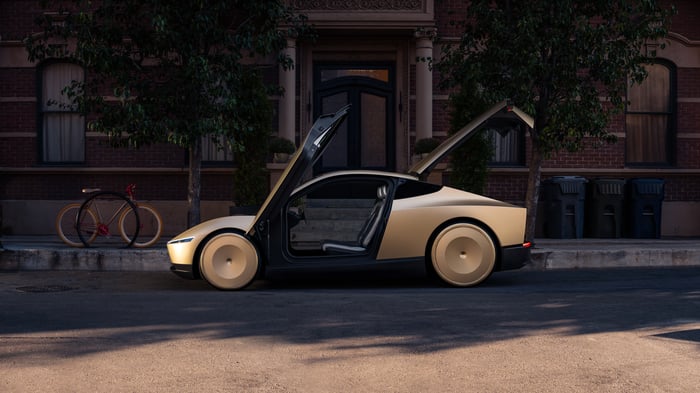
Cybercab. Image source: Tesla.
Tesla's software and robotics ambitions
Likely one of the key factors behind the market's initial upbeat reaction to Tesla's earnings report, Tesla disclosed in its fourth-quarter update that its active FSD subscriptions rose 38% year over year.
This, combined with the company's steady progress in rolling out its autonomous ride-sharing service, Robotaxi, and its plans to begin producing humanoid robots before the end of the year, shows how the company is making more progress in growing its AI (artificial intelligence), software, and fleet-based revenue streams.
In addition, Tesla importantly said in its fourth-quarter update that it expects to start producing its Cybercab, a purpose-built autonomous-driving vehicle that the company says will ship without a steering wheel, in April.
Near-term hurdles
But as investors wait for these catalysts to materialize, Tesla's vehicle deliveries and financials are moving in the wrong direction. Weighing on the quarter's results was an 11% year-over-year decline in automotive revenue as total deliveries during the period fell 16%. In addition, Tesla said in its fourth-quarter earnings call that it plans to begin winding down production of its higher-priced Model X and Model S vehicles next quarter.
And in the outlook section of its quarterly update, the company notably refrained from providing guidance for vehicle deliveries in 2026, leaving investors questioning what deliveries could look like this year. Instead, relating to its volume expectations, Tesla simply said:
We are focused on maximum capacity utilization at our factories. Deliveries and deployments will be impacted by aggregate demand for our products, supply chain readiness and allocation decisions between sale to customers or use for our owned and operated fleet.
Finally, it's worth noting that Tesla's free cash flow is moving in the wrong direction, too. Its fourth-quarter free cash flow was about $1.4 billion, down 30% year over year. And free cash flow will likely remain suppressed throughout 2026, because the company plans to invest heavily in artificial intelligence compute infrastructure and manufacturing. Management forecast 2026 capital expenditures to exceed $20 billion -- more than double its capital expenditures of approximately $8.5 billion in 2025.
All of this means that Tesla stock is highly dependent on the performance of its newer initiatives, namely Robotaxi, the upcoming Cybercab, and its plan for humanoid robots. Of course, Tesla's energy storage business continues to perform nicely, with 14.2 gigawatt-hours of storage deployed in Q4 -- up 29% year over year. So, energy storage sales should contribute nicely to the company's growth over time as well.
But with near-term headwinds in its financials and big spending required for these newer initiatives, I'd be hesitant to buy Tesla stock at its current price -- even with these exciting initiatives on the horizon. Shares currently command an extremely high valuation, as evidenced by their price-to-earnings ratio of about 389 as of this writing.
Given Tesla's extraordinarily high valuation, the market has arguably already priced in a successful rollout of Robotaxi, continued rapid growth in high-margin software revenue, and an eventual return to growth in its autos business. With this in mind, I think staying on the sidelines for now makes sense.
Don’t miss this second chance at a potentially lucrative opportunity
Ever feel like you missed the boat in buying the most successful stocks? Then you’ll want to hear this.
On rare occasions, our expert team of analysts issues a “Double Down” stock recommendation for companies that they think are about to pop. If you’re worried you’ve already missed your chance to invest, now is the best time to buy before it’s too late. And the numbers speak for themselves:
- Nvidia: if you invested $1,000 when we doubled down in 2009, you’d have $496,750!*
- Apple: if you invested $1,000 when we doubled down in 2008, you’d have $48,785!*
- Netflix: if you invested $1,000 when we doubled down in 2004, you’d have $456,457!*
Right now, we’re issuing “Double Down” alerts for three incredible companies, available when you join Stock Advisor, and there may not be another chance like this anytime soon.
See the 3 stocks »
*Stock Advisor returns as of January 29, 2026.
Daniel Sparks and/or his clients have positions in Tesla. The Motley Fool has positions in and recommends Tesla. The Motley Fool has a disclosure policy.
Recommended Articles


