




The 10-Year Yield Just Hit This Level for the First Time in 4 Months; Here's What It Means for Future Returns
Key Points
The 10-year Treasury yield had been trading in a tight range over the past month and a half.
Tense geopolitical relations over Greenland have helped send long-term yields sharply higher.
Are yields likely to keep moving higher, or is there a potential buying opportunity here?
- These 10 stocks could mint the next wave of millionaires ›
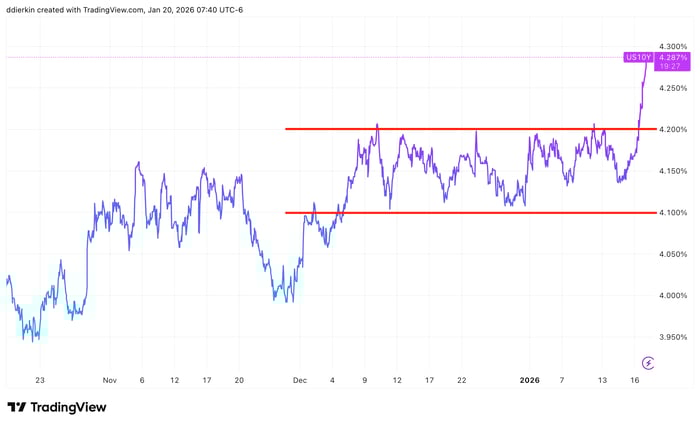
Longer-term U.S. Treasury yields have been stuck in a fairly tight range for several weeks. Bouncing pretty narrowly between the 4.1% and 4.2% levels, they haven't gotten a great deal of interest as a safe haven play in the way gold has, but they also haven't sold off as stocks hover near all-time highs.
This past week, however, the 10-year yield finally had its breakout.
Where to invest $1,000 right now? Our analyst team just revealed what they believe are the 10 best stocks to buy right now. Continue »
Source: TradingView.
Within a couple of trading days, it moved sharply from around 4.15% to a high of 4.31%. That's the highest it's been since August 2025.
The clear catalyst here is geopolitics. Every time President Trump talks about acquiring Greenland, it threatens to shake up relationships with the United States' allies in NATO. In the latest round of rhetoric, Trump has threatened to increase tariffs on multiple European nations, while those countries reconsider trade relationships and dollar-denominated asset exposure.
On one side, higher tariffs generally lead to higher inflation rates. Higher inflation can lead to higher interest rates. This is part of the response we're seeing here.
Image source: Getty Images.
On the other side, if foreign nations consider dumping some of their U.S. asset holdings, such as Treasuries, a flood of supply could hit the market that forces interest rates higher to entice buyers.
In both cases, higher interest rates are a natural response to what we've seen on the political front over the past several days.
As has been the case with tariff talk for a while, threats have usually been short-lived and de-escalated fairly quickly. As that happens, yields could drift lower. That makes U.S. Treasuries a potentially good short-term buy. Although, with the number of moving parts involved, the better bet might be to expect more bond market volatility ahead.
Where to invest $1,000 right now
When our analyst team has a stock tip, it can pay to listen. After all, Stock Advisor’s total average return is 949%* — a market-crushing outperformance compared to 195% for the S&P 500.
They just revealed what they believe are the 10 best stocks for investors to buy right now, available when you join Stock Advisor.
See the stocks »
*Stock Advisor returns as of January 26, 2026.
The Motley Fool has a disclosure policy.
Recommended Articles


