




1 Stock I'd Buy Before FTAI Aviation in 2026
Key Points
FTAI and Hexcel serve different but compatible roles in the aviation sector.
FTAI benefits from aftermarket services and new AI-driven opportunities.
Hexcel’s composite materials are becoming more important for future aircraft and long-term growth.
- 10 stocks we like better than Ftai Aviation ›
FTAI Aviation (NASDAQ: FTAI) and Hexcel (NYSE: HXL) are two attractive stocks in the aviation sector, and while Hexcel looks like the better buy right now for long-term investors, they are actually complementary companies for a portfolio. Here's why.
FTAI Aviation growth prospects
The main difference is that FTAI focuses only on the aerospace aftermarket, while Hexcel's advanced composite materials are used in the original equipment market (OEM). Owning both stocks lets investors benefit when aircraft production is strong (Hexcel) and also when manufacturers like Airbus and Boeing face delays, causing airlines to use and service older planes more often (FTAI Aviation).
Where to invest $1,000 right now? Our analyst team just revealed what they believe are the 10 best stocks to buy right now. Continue »
This "dual threat" of being relevant in both the OEM and aftermarket is part of the reason GE Aerospace (NYSE: GE), the leading engine manufacturer that sells engines under long-term service agreements (LTSA), has performed so well in recent years.

Image source: Getty Images.
FTAI is both a rival to GE Aerospace and arguably a business that benefits the aerospace giant. FTAI owns, leases, and sells aviation equipment. Its primary business is the maintenance and repair of aircraft engines, notably the CFM International (a GE Aerospace joint venture) CFM56 that powers the legacy Airbus A320 family and the Boeing 737s that will still be used by airlines for many years to come.
FTAI will service CFM's newer LEAP engines in the future, once GE Aerospace's LTSAs expire (usually after more than a decade). As such, FTAI both competes with GE Aerospace (for maintaining and servicing engines after the LTSA period expires) and supports its engine sales, as airlines know they can use FTAI to service engines in the future.
A hidden artificial intelligence (AI) stock
Recently, FTAI's stock has surged, far outpacing Hexcel's. This growth is mainly due to the launch of FTAI Power, which will convert CFM56 engines into power turbines for data centers to meet the growing demand for AI. It's an exciting business that builds on FTAI's strengths. It's not unusual -- GE Vernova, for example, makes smaller turbines based on aerospace engines, called aeroderivatives.
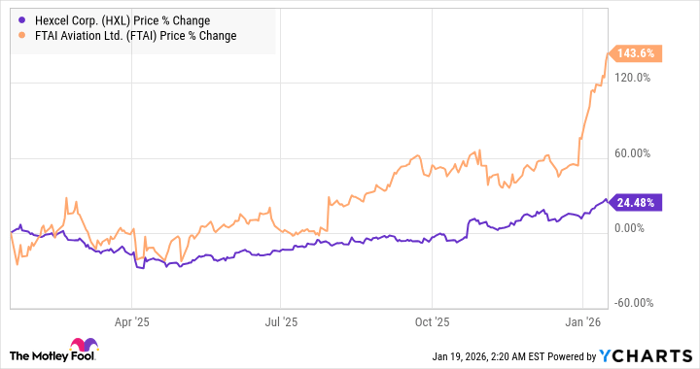
Data by YCharts.
Why Hexcel is a great stock to buy for 2026
Hexcel's advanced composite materials are the future of the aerospace industry, and each new generation of aircraft increasingly uses relatively more of them. They offer strength and weight advantages over traditional materials like aluminum and steel, helping airlines improve productivity and meet their emissions goals.
As such, Hexcel is not only a play on the ramp in aircraft production (both Airbus and Boeing have multyear backlogs), but also on the increased use of its composites on aircraft. For example, consider that the legacy Boeing 737 has just 5% composites by weight while the 737 MAX has 15%, and each plane has a $0.2 million to $0.5 million shipset value to Hexcel.
This gives Hexcel excellent long-term growth prospects as the aerospace industry supply chain bottleneck eases and investors begin to look at companies benefiting from OEM growth (Hexcel) as well as aftermarket growth (FTAI Aviation). That's the next phase of the aerospace recovery, and Hexcel is the ideal way to play it.
Should you buy stock in Ftai Aviation right now?
Before you buy stock in Ftai Aviation, consider this:
The Motley Fool Stock Advisor analyst team just identified what they believe are the 10 best stocks for investors to buy now… and Ftai Aviation wasn’t one of them. The 10 stocks that made the cut could produce monster returns in the coming years.
Consider when Netflix made this list on December 17, 2004... if you invested $1,000 at the time of our recommendation, you’d have $450,525!* Or when Nvidia made this list on April 15, 2005... if you invested $1,000 at the time of our recommendation, you’d have $1,133,107!*
Now, it’s worth noting Stock Advisor’s total average return is 937% — a market-crushing outperformance compared to 195% for the S&P 500. Don't miss the latest top 10 list, available with Stock Advisor, and join an investing community built by individual investors for individual investors.
See the 10 stocks »
*Stock Advisor returns as of January 23, 2026.
Lee Samaha has no position in any of the stocks mentioned. The Motley Fool has positions in and recommends Boeing and GE Aerospace. The Motley Fool recommends Ge Vernova and Hexcel. The Motley Fool has a disclosure policy.
Recommended Articles


