




How Ford Capped Off 2025 in Style for Investors
Key Points
Ford's sales outperformed the broader industry for the 10th consecutive month in December.
It was the automaker's best fourth quarter and annual sales performance since 2019.
Sales data helped investors understand questions about affordability, entry-level sales, and hybrids.
- 10 stocks we like better than Ford Motor Company ›
Last year was a long and unforgiving one for navigators at Detroit automotive icons such as Ford Motor Company (NYSE: F) and General Motors. Plans, decisions, and strategies that take years to adjust had to be made under duress as tariffs, trade policy, and other factors drastically altered the industry landscape.
As Ford dealt with new tariffs on imported vehicles and automotive parts and the end of the $7,500 federal electric vehicle (EV) tax credit that stunted demand, it managed to end the year in style with sales momentum and two key takeaways.
Where to invest $1,000 right now? Our analyst team just revealed what they believe are the 10 best stocks to buy right now. Continue »
By the numbers
Amid the industry's noisy 2025, investors had a couple of questions lingering as the calendar flipped over to 2026. Those questions include how the folks at Ford would respond to consumer demand for affordability as new-vehicle prices continue to climb and test all-time highs. Investors also questioned the strength of Ford's bread-and-butter full-size trucks, and whether its pivot from EVs to an emphasis on hybrids and extended-range vehicles was well-timed and/or could improve profitability.
Before answering those questions, Ford should be commended for a strong end to the year, with the automaker's total U.S. sales jumping 6% to top 2.2 million vehicles -- overall market share increased 0.6 percentage points to 13.2%, and it was Ford's best annual and fourth-quarter sales performance since 2019. Looking specifically at December results, it was Ford's 10th consecutive month of outperforming the industry.
Lingering questions
Detroit's lovely secret for investors is that it doesn't cost the automaker much more to produce a full-size truck, compared to an average sedan, but carries a much higher average transaction price (ATP) as well as margins. That's good news because Ford's F-Series sold over 820,000 trucks last year for an 8.3% sales increase.
Ford also collected the honor for America's best-selling hybrid pickup, with the F-150 hybrid posting record sales 15% higher than the prior year. With all the data compiled, Ford's truck sales for 2025, including pickups and vans alike, topped 1.2 million vehicles in the U.S., cementing the Blue Oval's leadership as America's best-selling truck manufacturer -- music to investors' ears.
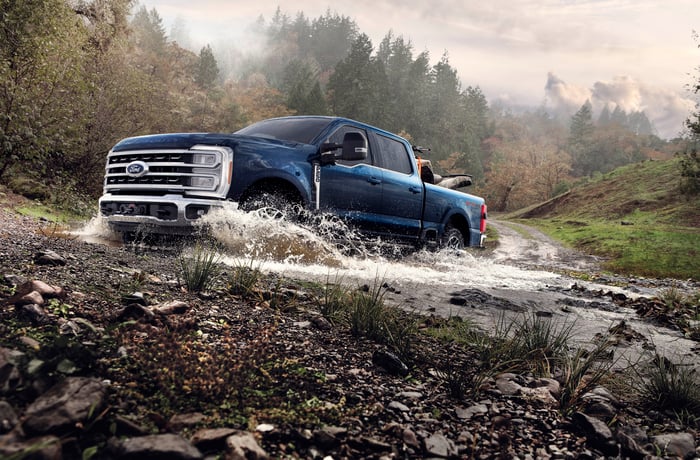
Image source: Ford Motor Company.
With profits in tow thanks to sales of full-size vehicles, let's turn to the next question from investors: What about affordability? This is a bit of a conundrum, because on paper, it's more desirable to have higher ATPs and a more lucrative and profitable sales mix. However, automakers have to listen to the market to support market share and build a future bloodline of consumers by roping them into the brand with entry-level options.
Ford has done exactly this, with combined total sales of entry-level trims on the Maverick, Ranger, and Bronco Sport climbing over 42% during the fourth quarter. Further, Ford is seeing signs of growth with its second-most affordable truck, the well-known Ford Ranger, which posted an annual sales jump of over 53%.
Profits are in tow, and the entry-level segment is covered, but what about Ford's massive pivot from EVs toward hybrids forcing a $19.5 billion special charge? The good news is that sales of hybrids are taking off. In fact, Ford sold a record 228,072 hybrids in 2025, which was good for a near-22% jump over the prior year -- and it was both a fourth-quarter and annual sales record for the automaker.
What's important about the pivot from EVs to hybrids right now is profitability. Investors should recall that Ford lost over $5 billion from its Model-e division, responsible for its EVs, in 2024, and reversing that loss would be a massive win for investors. Here's the kicker: Ford has previously noted that its hybrids are profitable and often more profitable than their gasoline powered counterparts -- a surprising note to many.
What it all means
Ultimately, while 2025 was a bumpy year, filled with difficult and long-term planning and unmatched uncertainty, Ford has managed to cap the year off by answering some very serious questions for investors. Yes, the company's profit machine, full-size trucks and SUVs, is humming along nicely and will power the company's financials higher.
Yes, Ford has heard the market demand for affordable vehicles and is offering entry-level options to get first-time consumers in the door. And lastly, yes, Ford's pivot from EVs comes at a time hybrid sales are surging. Ford has answered some questions and ended 2025 with sales momentum, and that's a great way to start a new year for investors.
Should you buy stock in Ford Motor Company right now?
Before you buy stock in Ford Motor Company, consider this:
The Motley Fool Stock Advisor analyst team just identified what they believe are the 10 best stocks for investors to buy now… and Ford Motor Company wasn’t one of them. The 10 stocks that made the cut could produce monster returns in the coming years.
Consider when Netflix made this list on December 17, 2004... if you invested $1,000 at the time of our recommendation, you’d have $474,578!* Or when Nvidia made this list on April 15, 2005... if you invested $1,000 at the time of our recommendation, you’d have $1,141,628!*
Now, it’s worth noting Stock Advisor’s total average return is 955% — a market-crushing outperformance compared to 196% for the S&P 500. Don't miss the latest top 10 list, available with Stock Advisor, and join an investing community built by individual investors for individual investors.
See the 10 stocks »
*Stock Advisor returns as of January 20, 2026.
Daniel Miller has positions in Ford Motor Company and General Motors. The Motley Fool recommends General Motors. The Motley Fool has a disclosure policy.
Recommended Articles


