

What Is the Smartest Quantum Computing Stock to Buy in 2026?
Key Points
Pure-play developers like IonQ, Rigetti Computing, and D-Wave Quantum are the hottest quantum computing stocks right now.
Big tech giants are also exploring quantum computing in addition to their established generative artificial intelligence (AI) products.
Nvidia is quietly building a quantum AI ecosystem that stands to benefit, no matter which systems succeed in the long run.
- 10 stocks we like better than Nvidia ›
One of the hottest pockets of the artificial intelligence (AI) realm in 2025 was quantum computing. Shares of pure-play quantum developers such as IonQ, Rigetti Computing, and D-Wave Quantum each handily trounced the S&P 500 this year.
What many investors might not fully realize is that several members of the "Magnificent Seven" are also exploring quantum computing technology alongside their existing generative AI efforts. While Alphabet, Amazon, and Microsoft have received some notoriety around their custom quantum processors, I think there's a more lucrative opportunity hiding in plain sight.
Where to invest $1,000 right now? Our analyst team just revealed what they believe are the 10 best stocks to buy right now, when you join Stock Advisor. See the stocks »
I'll detail how Nvidia (NASDAQ: NVDA) is quietly building a full-spectrum quantum computing suite, and explain why this could be a major catalyst for the company as the artificial intelligence (AI) infrastructure era begins.
Image source: Nvidia.
Nvidia is laying the foundation between quantum and accelerated computing
At the moment, quantum computing is an exploratory pursuit. While some businesses are assessing how the technology may be integrated within their existing AI framework, quantum technology has little use at the enterprise level today.
Against this backdrop, pure-play developers are primarily focused on research and development right now. IonQ and Rigetti specialize in gate-based approaches leveraging trapped ions and superconducting techniques. D-Wave, for its part, is more niche -- focusing on quantum annealing processes for optimization tasks.
The main takeaway is that quantum pure plays are currently engaged with the actual physics behind the creation and configuration of quantum bits -- known as qubits -- within new computing architectures.
As mentioned, the big three cloud providers have each designed their own quantum processors -- dubbed Willow (Alphabet), Ocelot (Amazon), and Majorana (Microsoft). While quantum computing is not a meaningful contributor to their respective businesses at this time, it's clear that big tech is fascinated by how this emerging technology may eventually impact the broader AI opportunity.
Nvidia's approach is entirely different from that of its megacap counterparts, as well as the pure plays. Instead of building its own quantum computers, Nvidia is seeking to become a bridge between the software and hardware investments necessary to build these systems.
Nvidia offers a software platform called CUDA-Q, within which developers can write applications that work across a network of CPUs, GPUs, and QPUs (quantum processing units). On the hardware side, Nvidia has built a high-speed interconnect called NVQLink. NVQLink represents a pathway for QPUs and GPUs to seamlessly communicate without straining latency and bandwidth.
Essentially, Nvidia's decision to provide a software and hardware ecosystem allows programmers to easily test their AI workloads across a hybrid quantum-classical computing environment. This is a particularly smart move because it positions Nvidia to be a beneficiary regardless of which quantum processor designs or qubit architecture emerges as the market standard down the road.
Will 2026 be a big year for Nvidia?
Nvidia's growth trajectory is directly tied to the budgets of big tech. As the slope of the lines in the chart illustrate, AI hyperscalers are accelerating their capital expenditures (capex) -- suggesting that data center buildouts, networking equipment, and chip procurement remain high priorities.
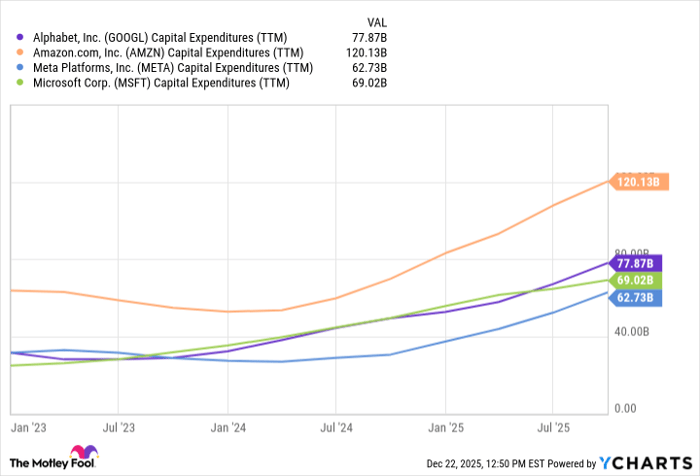
GOOGL Capital Expenditures (TTM) data by YCharts
Research from Goldman Sachs suggests that the hyperscalers alone will contribute nearly half a trillion dollars to AI infrastructure in 2026. While this is great news for Nvidia in the short term, AI infrastructure is expected to become a nearly $7 trillion opportunity by the end of the decade, according to management consulting firm McKinsey & Company.
I bring this up to drive home a couple of key ideas. First, Nvidia appears well-positioned to benefit from rising data center spend going into next year. More importantly, however, AI infrastructure is shaping up to be a longer-term secular opportunity.
Given these dynamics, Nvidia could continue receiving outsized demand for its products as quantum computing becomes a more meaningful contributor to the broader AI narrative over the next several years. So while CUDA-Q and NVQLink may not yet be major contributors to Nvidia's business today relative to its core compute and networking services, I'm encouraged by the company's pursuit of quantum computing and see these products eventually becoming an important storyline in its evolution throughout the AI infrastructure chapter.
Is Nvidia stock still a good buy?
As of this writing (Dec. 22), Nvidia trades at a forward price-to-earnings (P/E) multiple of just 24. Considering Nvidia's current growth in combination with Wall Street's outlook, the stock is valued quite reasonably.
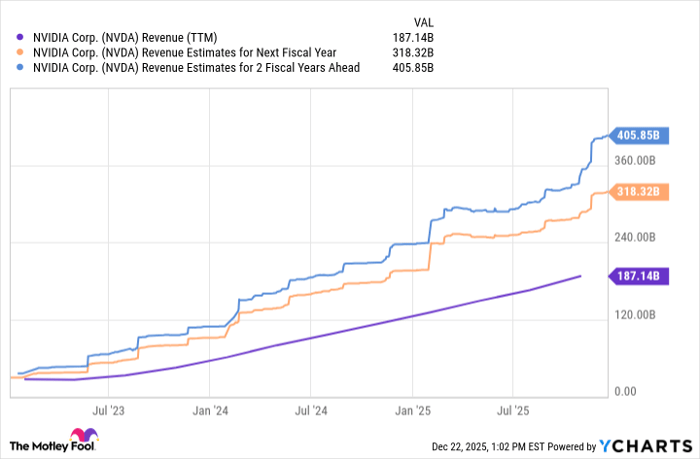
NVDA Revenue (TTM) data by YCharts
In my eyes, quantum computing represents just another pillar supporting Nvidia's growth arc as AI continues to dominate the market. For these reasons, I think Nvidia is headed for further valuation expansion heading into 2026 and well beyond -- making it a compelling buy-and-hold opportunity for investors with a long-term time horizon.
Should you buy stock in Nvidia right now?
Before you buy stock in Nvidia, consider this:
The Motley Fool Stock Advisor analyst team just identified what they believe are the 10 best stocks for investors to buy now… and Nvidia wasn’t one of them. The 10 stocks that made the cut could produce monster returns in the coming years.
Consider when Netflix made this list on December 17, 2004... if you invested $1,000 at the time of our recommendation, you’d have $504,994!* Or when Nvidia made this list on April 15, 2005... if you invested $1,000 at the time of our recommendation, you’d have $1,156,218!*
Now, it’s worth noting Stock Advisor’s total average return is 986% — a market-crushing outperformance compared to 196% for the S&P 500. Don't miss the latest top 10 list, available with Stock Advisor, and join an investing community built by individual investors for individual investors.
See the 10 stocks »
*Stock Advisor returns as of December 26, 2025.
Adam Spatacco has positions in Alphabet, Amazon, Meta Platforms, Microsoft, and Nvidia. The Motley Fool has positions in and recommends Alphabet, Amazon, Goldman Sachs Group, IonQ, Meta Platforms, Microsoft, and Nvidia. The Motley Fool recommends the following options: long January 2026 $395 calls on Microsoft and short January 2026 $405 calls on Microsoft. The Motley Fool has a disclosure policy.
Recommended Articles


