




GDP Outperforms Cycle, Consumer Confidence Continues to Decline, Why Is US Economy 'Strong on Paper, Weak in Feeling'?
TradingKey - According to the latest preliminary data released by the U.S. Bureau of Economic Analysis (BEA), the annualized year-over-year growth rate of U.S. real Gross Domestic Product (GDP) reached 4.3% in the third quarter of 2025, significantly exceeding market expectations of 3.3% and the previous quarter's growth of 3.8%. This performance marks the fastest expansion in two years.
Against the backdrop of falling inflation and stable employment, the U.S. economy is exhibiting a rather counterintuitive state.
On one hand, the recently released third-quarter annualized GDP growth rate, at a robust 4.3%, marks the fastest expansion in nearly two years; on the other hand, consumer confidence indicators continue to decline, indicating no improvement in U.S. consumers' cautious sentiment regarding the future. This divergence between "strong macroeconomic data and subdued microeconomic sentiment" is becoming the most salient characteristic of the current U.S. economy.
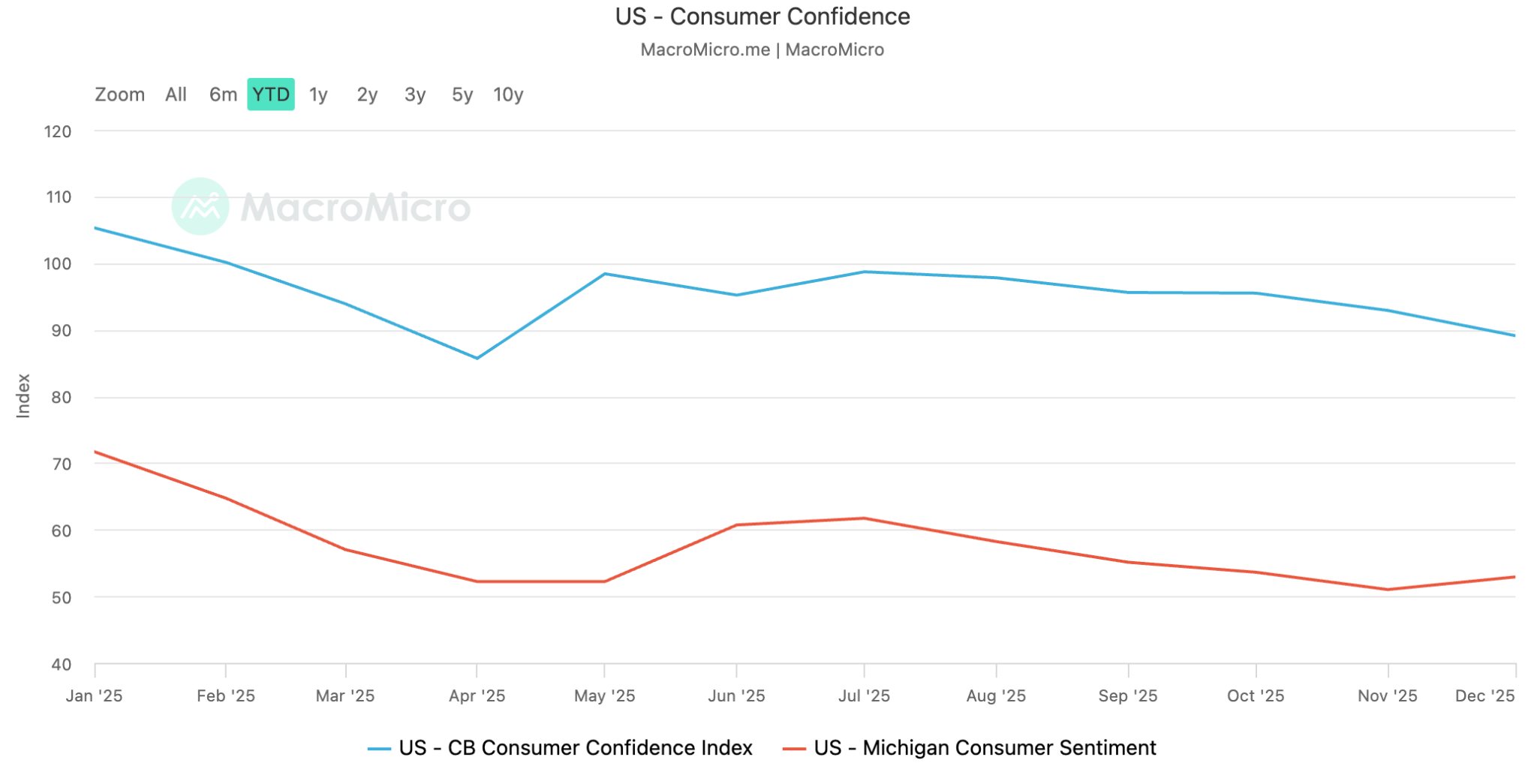
[Consumer Confidence Continues to Decline, Source: Macromicro]
Based on official statistics, the resilience of the U.S. economy is undeniable. The better-than-expected GDP growth in the third quarter was primarily driven by household consumption expenditure, with service consumption remaining robust. There have been no systemic signs of contraction in the corporate sector, nor has the job market significantly deteriorated.
In a high-interest rate environment, such performance is sufficient to allay market fears of a "hard landing" and explains why U.S. Treasury yields rebounded after the data release.
The problem, however, is that this growth has not translated into a sense of security for consumers.
The persistent decline in consumer confidence is not due to economic deterioration, but rather because high growth has not alleviated the real pressures faced by average households. Rents, insurance, medical costs, and food prices remain elevated, while credit card interest rates and mortgage rates have stayed high for an extended period, keeping household cash flow consistently tight.
This divergence is not coincidental; rather, it is a result of structural changes in the U.S. economy .
The current strength of GDP stems more from the consumption capacity of high- income groups, government spending, and capital-intensive investments, rather than a broad-based recovery in purchasing power. While technology, artificial intelligence, and high-end service industries continue to expand, this growth has not directly translated into improved disposable income for middle- and lower-income groups.
Concerns about inflation and long-term financial conditions remain prominent in the University of Michigan Consumer Sentiment Index, implying that even if the economy avoids a recession, households are inclined to adopt more defensive behaviors. This psychological state will not immediately drag down GDP but will gradually weaken consumption sustainability in the coming quarters.
From a policy perspective, this situation of "weak sentiment, strong official data" also puts the Federal Reserve in a dilemma.
On one hand, GDP and employment data support maintaining higher interest rates for longer, as inflation has not fully returned to the target range. On the other hand, weak confidence and elevated interest rates are continuously eroding U.S. household consumption levels. If monetary policy relies excessively on macroeconomic growth figures while overlooking microeconomic pressures, economic resilience could be rapidly depleted in the later stages.
More critically, should the labor market weaken again, this divergence could quickly converge and move downward in tandem .
Historical experience indicates that when consumer confidence remains low for an extended period and growth predominantly relies on a few sectors, the economy's ability to buffer shocks significantly diminishes. Should credit tighten or asset prices correct, the outwardly strong growth could rapidly lose momentum.
In summary, the current U.S. economy is not in a traditional boom cycle but rather resembles a form of "resilient growth compressed by high interest rates and elevated costs." GDP outperforming expectations more reflects structural advantages and short-term support than a widely felt sense of economic comfort. The sustained weakening of consumer confidence, moreover, signals to the market that the foundation of this growth is not robust.
In the foreseeable future, the key for the U.S. economy lies in whether its growth rate can translate into tangible improvements for most households. Until this question is answered, the label of "weak sentiment, strong official data" will likely remain an enduring characteristic of the U.S. economy.
Recommended Articles


