




Standard Chartered Cuts 2026 Solana Prediction To $250, Eyes $2,000 By 2030
Standard Chartered has lowered its end-2026 price target for Solana to $250, down from $310, while leaving its longer-dated trajectory intact. The bank’s roadmap still points to $2,000 by 2030 as the bank argues the chain’s activity mix is rotating away from memecoin-led trading toward stablecoin-based micropayments.
The revised forecast comes as the bank’s digital assets research team frames the current drawdown as a period when “performance differentiation” across crypto should become more visible, rather than a tape where everything trades as a single risk bucket.
Why Standard Chartered Lowers The 2026 Solana Target, Boosts Long View
Behind the 2026 haircut is a more skeptical view on how quickly Solana can convert its cost and throughput advantages into sustained, fee-generating economic activity beyond speculative bursts. In Standard Chartered’s telling, Solana is in the middle of a narrative transition that is strategically attractive but not instantaneous in market terms.
Geoffrey Kendrick, Standard Chartered’s head of global digital assets research, anchored the shift in decentralized exchange (DEX) flow composition. “When we initiated coverage of Solana in May 2025, we observed that activity on the network was largely concentrated in memecoin trading on DEXs.” “Composition of DEX flows has shifted from memecoin trading toward SOL–stablecoin pairs.”
That rotation, Kendrick argued, accelerated over 2025 as capital moved away from meme-focused activity which he said peaked in mid-January around the launch of the Trump token and toward tokenized dollars. The implication is that Solana’s DEX activity is beginning to resemble a payments-adjacent rail more than a single-cycle casino, even if overall volumes have cooled.
Standard Chartered also flagged Solana’s ultra-low transaction costs as a key enabler for “micropayment” use cases, including AI-driven payments, where even modest fee overhead can break unit economics.
One of the more striking metrics in the report is stablecoin turnover: Kendrick said stablecoin velocity on Solana is already two to three times higher than on Ethereum, suggesting Solana may be carving out a distinct role for high-frequency, low-value transfers.
The bank tied that possibility to “internet-native” payment protocols such as Coinbase-backed x402, while cautioning that the repositioning will take time to translate into market leadership.
That slower timeline is part of why Standard Chartered expects Solana to lag Ethereum in the 2026–2027 window, even as the bank becomes more constructive on Solana’s longer-run upside if micropayment demand compounds.
Despite trimming the 2026 target, Standard Chartered’s longer-term schedule remains aggressive: $400 in 2027, $700 in 2028, $1,200 in 2029, and $2,000 by end-2030, according to reporting by The Block. The bank’s framework implies that Solana’s “micropayments” phase is expected to matter more as the cycle matures, with Kendrick also projecting Solana to outperform Bitcoin over 2027–2030.
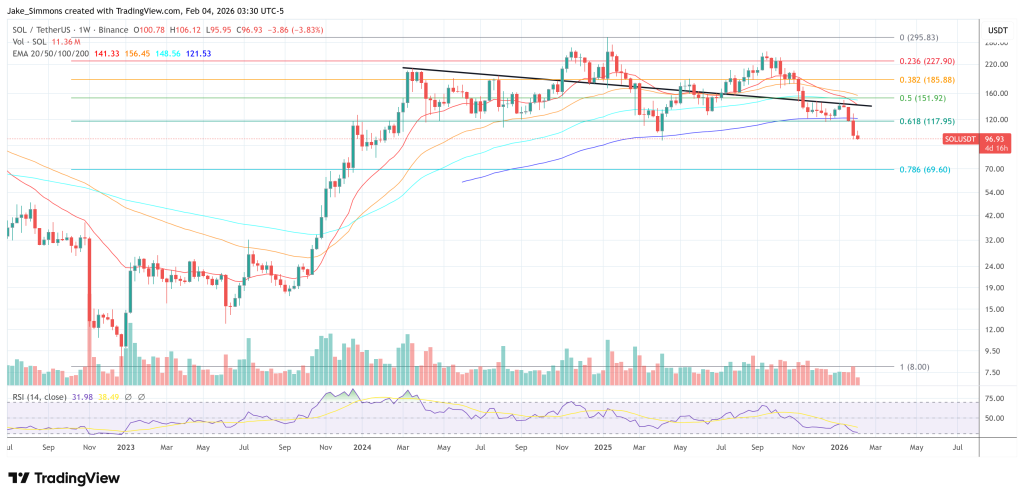
At press time, SOL traded at $96.93.
Recommended Articles


