




Morgan Stanley Goes From Crypto Curious to Crypto Committed as Wall Street ‘Opens the Pipes’
Morgan Stanley is accelerating its push into crypto, signaling a major shift in TradFi as digital assets move from speculative fringe to mainstream institutional play.
The Wall Street giant, managing $9.3 trillion in assets, recently appointed Amy Oldenburg as Head of Digital Asset Strategy, a move that formalizes crypto as a core execution priority rather than a research exercise.
Morgan Stanley Moves From Crypto Research to Full-Scale Execution
The timing is notable. The Grayscale Bitcoin Mini Trust ETF (BTC) is now available on Morgan Stanley’s platform. This unlocks regulated Bitcoin exposure to more than $7.4 trillion in advisor-managed assets.
“2026 is going to be explosive for crypto,” commented fintech journalist Frank Chaparo, as Morgan Stanley simultaneously hires dozens of crypto roles while opening these investment “pipes” to its client base.
Oldenburg, who previously worked for Morgan Stanley in emerging markets, is tasked with coordinating product development, partnerships, and trading across the firm’s units.
“When institutions turn against you, you want to hold your keys, you want to hold your coins,” she said.
Her appointment signals measured yet decisive institutional steps into digital assets amid changing regulatory frameworks. This includes clearer stablecoin rules and guidance, allowing banks to act as crypto intermediaries.
Morgan Stanley’s crypto journey over the past two years has been marked by rapid evolution.
- In 2024, advisors could recommend spot Bitcoin ETFs from firms like BlackRock and Fidelity to eligible high-net-worth clients—a cautious first step.
- By 2025, access expanded dramatically: restrictions were lifted, allowing all wealth management clients, including those with retirement accounts, to invest in crypto funds.
Advisors were encouraged to treat Bitcoin as “digital gold,” allocating 2–4% in risk-tolerant portfolios while managing volatility through monitoring tools and structured products.
- September 2025 marked another milestone with plans to launch direct crypto trading via E*TRADE, initially supporting Bitcoin, Ether, and Solana.
- Early 2026 saw Morgan Stanley file with the SEC for its own spot Bitcoin and Solana ETFs, then an Ethereum ETF.
With this, Morgan Stanley positions itself to compete with major issuers like BlackRock and Fidelity in a market that grew to over $114 billion in assets for Bitcoin ETFs alone.
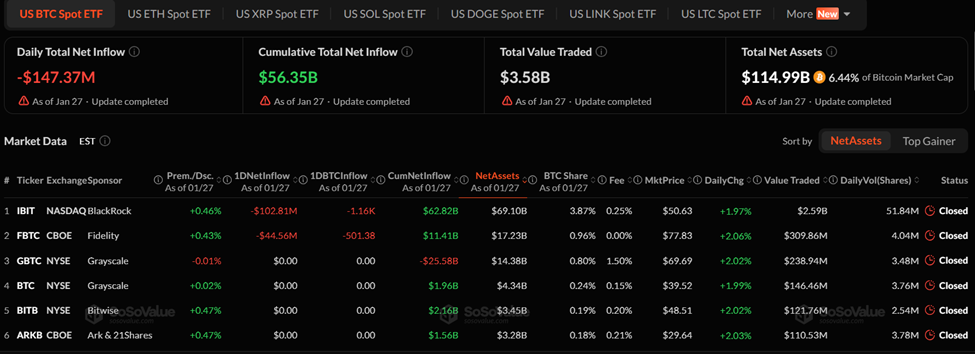 Bitcoin ETF Total Net Assets. Source: SoSoValue
Wall Street Momentum and Morgan Stanley’s Crypto Commitment
The push reflects broader Wall Street momentum. CoinMarketCap reports that 60% of the top 25 US banks have launched or announced Bitcoin services, including trading and custody. JPMorgan, Wells Fargo, and Citi are among the leaders.
For Morgan Stanley, moving beyond distribution to issuance and direct trading demonstrates a commitment to making digital assets a permanent fixture of institutional portfolios.
The hiring spree also suggests intent but raises questions about execution. Some industry observers, like Felix Hartmann, have pointed to entry-level salaries for senior crypto roles.
This suggests that compensation structures may need to be adjusted to attract crypto-native talent. Still, the firm’s strategy appears to balance speed and compliance, ensuring growth while maneuvering regulatory uncertainty.
In short, Morgan Stanley has gone from cautious observer to active participant in crypto markets. By offering ETF exposure, planning direct trading, filing proprietary funds, and building internal capacity, the bank is cementing digital assets as a core component of wealth management and institutional strategy.
As Wall Street increasingly opens its crypto “pipes,” 2026 may well be remembered as the year TradFi fully embraced the digital asset market.
Recommended Articles


