




Is Bitcoin Really In A Bear Market? Why January 20 Matters
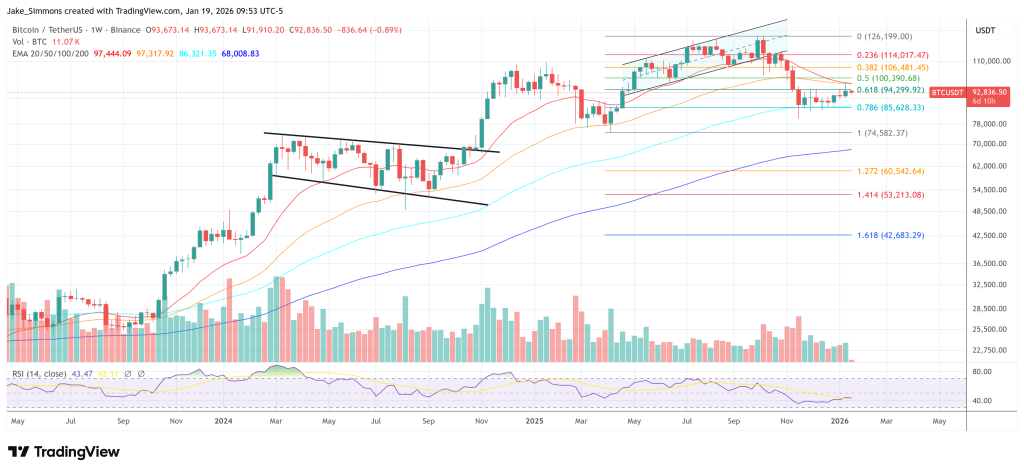
Bitcoin is down 36% from its recent peak, and the “bear market” label is already circulating across crypto X. But in a thread on Sunday, trader Cristian Chifoi argues that calling a regime shift on the drawdown alone misses the more tradable signal: what happens after the first meaningful rebound, and how price behaves around a tight set of time-based “seasonality windows.”
Chifoi’s core claim is that many commentators default to reactive narratives after volatility has already printed. “The simplest way to determine if the Bitcoin bear market has started is not after we had a 36% correction, as all of crypto analysts online suggest,” he wrote. “The same analysts that suggested a supercycle in November 2021 on, while the price was pumping 100%+.” In his framing, the bear-market question is less about the magnitude of the drop and more about whether any bounce that follows looks like strength or a structurally weak countertrend move that fails over time.
Is Bitcoin In A Bear Market?
Chifoi’s first lens is a cross-check between Bitcoin and USDT dominance (USDT.D), which he describes as an “inverted BTC chart” used as a confluence signal. He also emphasizes timing as the primary indicator, arguing the drawdown has already met a minimum duration he tracks across cycles.
“If you are a trader or not, I also suggest you use time as your first indicator, and price as the second,” he wrote. “We had a 77 day correction from top to bottom already. The price couldn’t get lower. That is the signal, rest is noise.”
From there, his bear-market confirmation playbook hinges on how far Bitcoin can bounce and how long it can sustain momentum. He outlines USDT.D targets: first around 5.5%, then lower levels like 4.7% and maps them to potential BTC levels. A push “lil’ over 100k,” he said, could still qualify as a “dead cat bounce” if it persists for weeks without follow-through. In that case, the bounce itself becomes evidence of weakness rather than a green light for a renewed uptrend.
His second scenario is more uncomfortable for both “cycle is dead” skeptics and early-bear callers: Bitcoin makes a higher high, potentially into the $115,000–$120,000 range, but then stalls out over a multi-week window. Even that, in Chifoi’s view, could be consistent with a bear-market transition if time passes and price cannot “deliver more gains,” turning a nominal breakout into a distribution-like top.
“It is the same game!” he added, arguing that traders should be watching for the same failure mode at different price levels rather than anchoring to a single number.
Chifoi’s second framework is seasonality, centered on a window around January 20 (plus or minus a few days) extending into late March or early April. He says he has been tracking this as a primary decision point since the start of 2026, and frames it as a fork between two paths: either Bitcoin rallies into that date to set a pivot high and roll over, or it forms a pivot low around that date and then pushes higher into the next time pivot.
“A pump into the January 20, over $100-$110k would mean a pivot high and the continuation down into next time pivot,” he wrote. The alternative, he said, is “January 20 pivot low, and then continuation up to next time pivot,” adding he is watching this week’s price action “until Friday” for confirmation.
At the time of writing, Chifoi leans toward the latter interpretation. “For now it seems pretty clear that we are developing a pivot low, and the next move is the opposite one versus what we had from October 6th until now,” he said.
Chifoi positions most market participants into two “camps”: those calling for a supercycle or declaring the cycle framework broken, and those asserting a bear market began in October and ends in October 2026 “just like 2022.” He argues both could get forced into poor positioning if Bitcoin prints a new high in the coming weeks before selling off after April.
His own risk case is broader and more time-focused: a new high followed by a sustained decline into late 2026 or early 2027, which he calls his “next important time pivot.” In that context, the operational takeaway is less about predicting a bear market today and more about letting the next rebound and the January-to-spring window define whether this is a reset inside a broader uptrend or the start of a longer distribution-to-downtrend transition.
“Pay attention these next few weeks,” Chifoi wrote. “I do not know what will happen, but the plan is already set up and will adapt my positioning accordingly, whichever scenario plays out, because I already know what to do in either of the cases.”
At press time, BTC traded at $92,836.
Recommended Articles


