



Breaking: Gold reaches all-time high near $4,380 amid safe-haven flows

Source Fxstreet

Gold (XAU/USD) rises and hits its record high around $4,380 during the Asian session on Monday. The precious metal gains momentum as the Israel-Iran conflict and the rising in US-Venezuela tensions boost the safe-haven demand.

Furthermore, the recent soft US inflation and cool jobs reports have fueled market expectations for at least two 25-basis-point rate cuts from the US Federal Reserve (Fed) next year. Lower interest rates could reduce the opportunity cost of holding Gold, supporting the non-yielding precious metal.
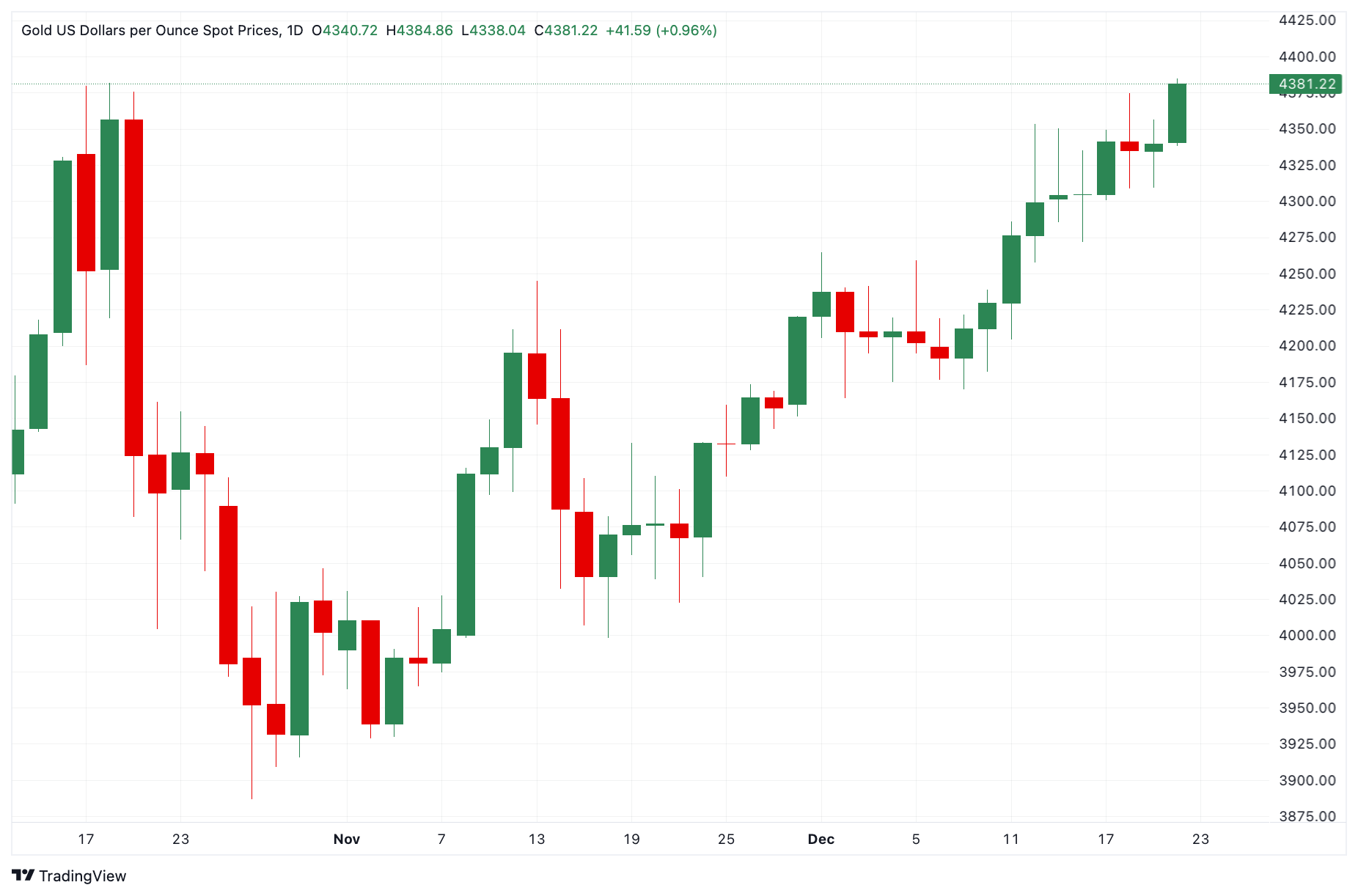
Gold Daily Chart


Risk sentiment FAQs

In the world of financial jargon the two widely used terms “risk-on” and “risk off'' refer to the level of risk that investors are willing to stomach during the period referenced. In a “risk-on” market, investors are optimistic about the future and more willing to buy risky assets. In a “risk-off” market investors start to ‘play it safe’ because they are worried about the future, and therefore buy less risky assets that are more certain of bringing a return, even if it is relatively modest.

Typically, during periods of “risk-on”, stock markets will rise, most commodities – except Gold – will also gain in value, since they benefit from a positive growth outlook. The currencies of nations that are heavy commodity exporters strengthen because of increased demand, and Cryptocurrencies rise. In a “risk-off” market, Bonds go up – especially major government Bonds – Gold shines, and safe-haven currencies such as the Japanese Yen, Swiss Franc and US Dollar all benefit.

The Australian Dollar (AUD), the Canadian Dollar (CAD), the New Zealand Dollar (NZD) and minor FX like the Ruble (RUB) and the South African Rand (ZAR), all tend to rise in markets that are “risk-on”. This is because the economies of these currencies are heavily reliant on commodity exports for growth, and commodities tend to rise in price during risk-on periods. This is because investors foresee greater demand for raw materials in the future due to heightened economic activity.

The major currencies that tend to rise during periods of “risk-off” are the US Dollar (USD), the Japanese Yen (JPY) and the Swiss Franc (CHF). The US Dollar, because it is the world’s reserve currency, and because in times of crisis investors buy US government debt, which is seen as safe because the largest economy in the world is unlikely to default. The Yen, from increased demand for Japanese government bonds, because a high proportion are held by domestic investors who are unlikely to dump them – even in a crisis. The Swiss Franc, because strict Swiss banking laws offer investors enhanced capital protection.

Disclaimer: For information purposes only. Past performance is not indicative of future results.
placeholder
US Dollar's Decline Predicted in 2026: Morgan Stanley's Outlook on Currency VolatilityMorgan Stanley forecasts a 5% drop in the dollar by mid-2026, attributed to continued Fed rate cuts. A recovery may follow as growth improves and funding currency dynamics shift favorably toward the euro and Swiss franc.
Author  Mitrade
Nov 25, Tue
Morgan Stanley forecasts a 5% drop in the dollar by mid-2026, attributed to continued Fed rate cuts. A recovery may follow as growth improves and funding currency dynamics shift favorably toward the euro and Swiss franc.
placeholder
Gold's Historic 2025 Rally: Can the Momentum Last Through 2026?Following a historic surge in 2025 that saw prices climb over 60% and break records more than 50 times, gold investors are now looking ahead to assess whether the precious metal can sustain its momentum into 2026. Despite outperforming most major asset classes and heading for its best annual performance since 1979, analysts are divided on the outlook—with some seeing further room for gains and others cautioning that risks are rising.
Author  Mitrade
Dec 09, Tue
Following a historic surge in 2025 that saw prices climb over 60% and break records more than 50 times, gold investors are now looking ahead to assess whether the precious metal can sustain its momentum into 2026. Despite outperforming most major asset classes and heading for its best annual performance since 1979, analysts are divided on the outlook—with some seeing further room for gains and others cautioning that risks are rising.
placeholder
Cryptocurrencies Extend Losses as Year-End Caution and Thinning Liquidity Weigh on MarketThe cryptocurrency market declined on Monday, mirroring a pullback in global risk assets as investors turned cautious ahead of key U.S. economic data. The broad-based retreat highlighted thinning liquidity and growing risk aversion across financial markets as the year draws to a close.
Author  Mitrade
Dec 16, Tue
The cryptocurrency market declined on Monday, mirroring a pullback in global risk assets as investors turned cautious ahead of key U.S. economic data. The broad-based retreat highlighted thinning liquidity and growing risk aversion across financial markets as the year draws to a close.
placeholder
BOJ Set to Hike Rates Amid Inflation Pressures and Yen Weakness The Bank of Japan is expected to raise its benchmark interest rate to 0.75% on December 19, marking its first increase since early 2025, amidst ongoing inflation and a weakening yen. Analysts predict additional hikes in 2026 as the central bank navigates renewed monetary policy normalization under Governor Kazuo Ueda.
Author  Mitrade
Dec 18, Thu
The Bank of Japan is expected to raise its benchmark interest rate to 0.75% on December 19, marking its first increase since early 2025, amidst ongoing inflation and a weakening yen. Analysts predict additional hikes in 2026 as the central bank navigates renewed monetary policy normalization under Governor Kazuo Ueda.
placeholder
Oil Prices Surge Amid U.S. Crackdown on Venezuelan Tankers and Middle East Tensions Oil prices rose in early Asian trading as the U.S. targets Venezuelan oil tankers amid geopolitical worries over Iran. Supply disruption fears contribute to rising Brent and WTI crude prices.
Author  Mitrade
2 hours ago
Oil prices rose in early Asian trading as the U.S. targets Venezuelan oil tankers amid geopolitical worries over Iran. Supply disruption fears contribute to rising Brent and WTI crude prices.
Related Instrument
goTop
quote