




AUD/USD firms as traders digest latest tariff headlines and Fed Minutes
- The AUD/USD is heading toward psychological resistance as concerns surrounding trade uncertainty intensify.
- Fed Minutes solidify expectations for a September rate cut amid concerns of rising inflation from tariffs.
- The US Dollar faces renewed pressure from policy and trade uncertainty, which are supporting the Australian Dollar.
The Australian Dollar (AUD) is trading in a well-defined range against its US Dollar (USD) counterpart on Wednesday, as markets digest the latest Fed Minutes and fresh tariff-related headlines.
Although tariffs are set to take effect in August, lingering trade uncertainty continues to weigh on the Greenback. The latest round of tariff letters was sent to countries including Libya, Iraq, and the Philippines on Wednesday.
At the time of writing, AUD/USD is trading around 0.6540, with resistance firming at 0.6550.
The Federal Open Market Committee (FOMC) Minutes from June revealed that most policymakers remain cautious about reducing interest rates prematurely. However, many also acknowledged the potential for tariffs to exacerbate inflationary pressure.
On Tuesday, President Trump called for the immediate resignation of Fed Chair Powell, urging his replacement with someone more inclined to cut rates. Speaking at the White House on Wednesday, Trump reiterated his position, stating the US should have “the lowest interest rates in the world.”
Despite the political rhetoric, the CME FedWatch Tool continues to reflect expectations of a rate cut in September. With these projections largely priced in, the AUD/USD has shown little reaction to the Fed report.
Broadening wedge pattern keeps AUD/USD price action in check
AUD/USD is trading near 0.6540, with resistance firming at 0.6550, a level that aligns with the 61.8% Fibonacci retracement of the September-April decline.
Price action currently remains within a broadening, rising wedge formation. This is a pattern, characterized by a series of higher highs and higher lows, which widens toward the top.
The pair is currently consolidating just below the upper boundary of the wedge, with support layered near the 50-day Exponential Moving Average at 0.6476 and the 200-day EMA at 0.6437.
A recent Golden Cross, where the 50-day EMA moved above the 200-day EMA, supports a bullish medium-term outlook.
Meanwhile, the Relative Strength Index (RSI)near 54 indicates a slight bullish bias above the neutral zone at the 50 mark.
AUD/USD daily chart
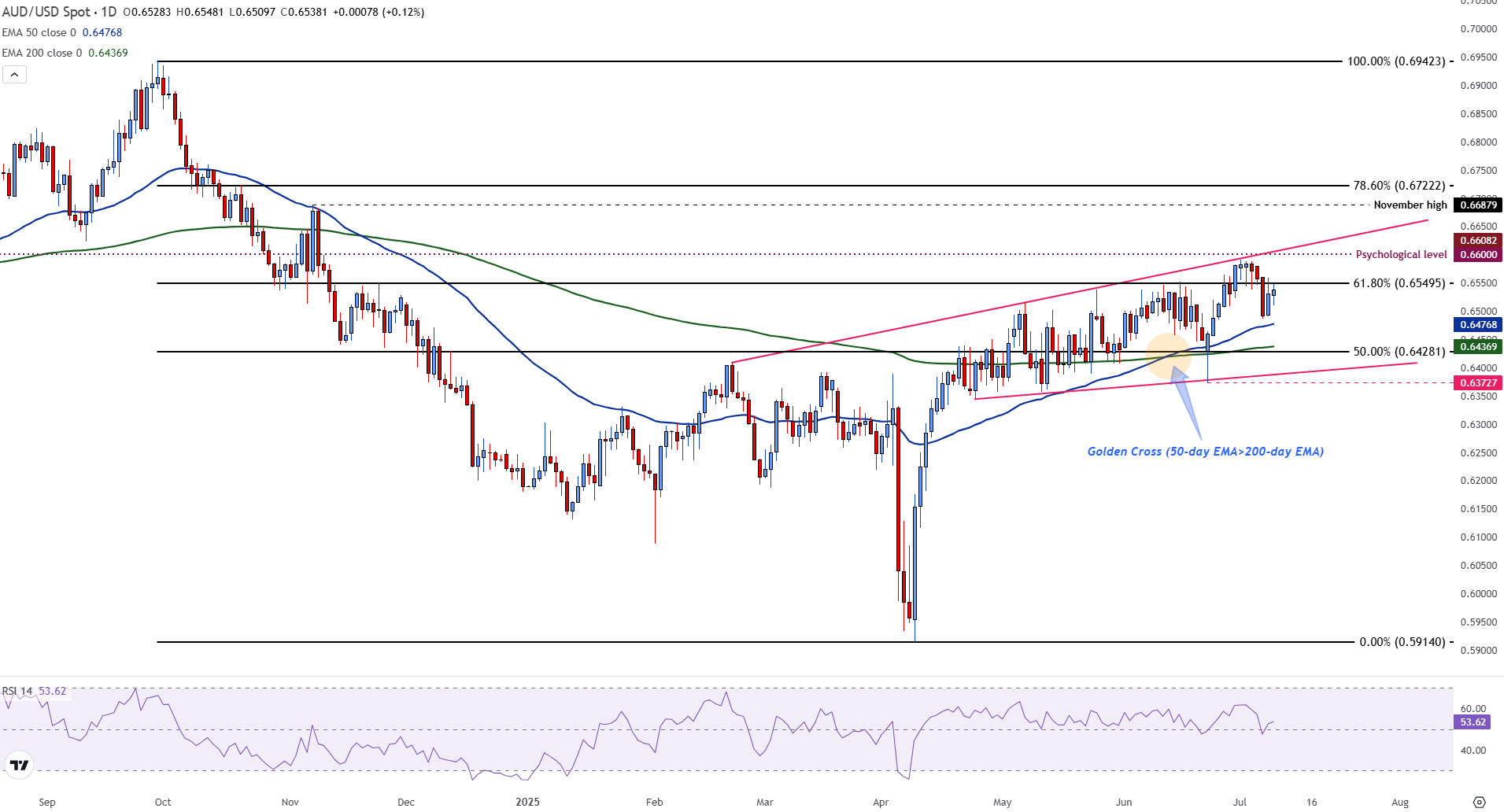
A sustained breakout above 0.6550 would confirm bullish momentum and likely attract additional buying interest. In this case, the next upside target lies at the psychological 0.6600 level, followed by a potential advance toward the November high of 0.6688.
Conversely, a break below 0.6470 would signal weakening bullish pressure and suggest a potential downside reversal within the wedge structure. This would expose deeper support at 0.6428, near the 50% Fibonacci level, with further downside risk toward the 200-day EMA at 0.6437.
Fed FAQs
Monetary policy in the US is shaped by the Federal Reserve (Fed). The Fed has two mandates: to achieve price stability and foster full employment. Its primary tool to achieve these goals is by adjusting interest rates. When prices are rising too quickly and inflation is above the Fed’s 2% target, it raises interest rates, increasing borrowing costs throughout the economy. This results in a stronger US Dollar (USD) as it makes the US a more attractive place for international investors to park their money. When inflation falls below 2% or the Unemployment Rate is too high, the Fed may lower interest rates to encourage borrowing, which weighs on the Greenback.
The Federal Reserve (Fed) holds eight policy meetings a year, where the Federal Open Market Committee (FOMC) assesses economic conditions and makes monetary policy decisions. The FOMC is attended by twelve Fed officials – the seven members of the Board of Governors, the president of the Federal Reserve Bank of New York, and four of the remaining eleven regional Reserve Bank presidents, who serve one-year terms on a rotating basis.
In extreme situations, the Federal Reserve may resort to a policy named Quantitative Easing (QE). QE is the process by which the Fed substantially increases the flow of credit in a stuck financial system. It is a non-standard policy measure used during crises or when inflation is extremely low. It was the Fed’s weapon of choice during the Great Financial Crisis in 2008. It involves the Fed printing more Dollars and using them to buy high grade bonds from financial institutions. QE usually weakens the US Dollar.
Quantitative tightening (QT) is the reverse process of QE, whereby the Federal Reserve stops buying bonds from financial institutions and does not reinvest the principal from the bonds it holds maturing, to purchase new bonds. It is usually positive for the value of the US Dollar.
Recommended Articles


