




USD/INR trades firmly near lifetime highs ahead of extended weekend in India
- The Indian Rupee remains weak near all-time lows of around 92.00 against the US Dollar.
- FIIs continue to dump their stakes in the Indian equity market.
- Trump announces that he will unveil the name of the new Fed Chair soon.
The Indian Rupee (INR) holds onto weekly losses against the US Dollar (USD) at open on Friday. The USD/INR pair trades close to its all-time high of 92.00 posted on Wednesday. The outlook for the pair remains broadly firm as the Indian Rupee is expected to continue facing backlash amid the consistent withdrawal of foreign funds from the Indian stock market.
Foreign Institutional Investors (FIIs) are consistently offloading their stake in the Indian equity market amid the absence of a trade deal announcement between the United States (US) and India. However, negotiators from both nations have been expressing optimism about reaching a consensus soon.
On Wednesday, US President Donald Trump also praised Indian Prime Minister (PM) Narendra Modi during his visit to the World Economic Forum (WEF) at Davos, and expressed confidence that both nations will have a good deal. “I have great respect for your Prime Minister. He’s a fantastic man and a friend of mine. We are going to have a good deal,” Trump said, Moneycontrol reported.
So far in January, FIIs have remained net sellers in 14 of 15 trading days and have sold shares worth Rs. 36,591.01 crore.
On the economic data front, India’s flash HSBC Purchasing Managers’ Index (PMI) data for January has come in stronger than expected. The Composite PMI rose sharply to 59.5 from 57.8 in December, driven by strong output in both manufacturing and the services sector. The Manufacturing PMI came in at 56.8, higher than the prior reading of 55.0. The Services PMI expanded to 59.3 from 58.0 in December.
Going forward, there will be an extended weekend in the Indian markets as they will remain closed on Monday due to Republic Day.
Daily Digest Market Movers: US Dollar weakens despite US-EU disputes being resolved
- The US Dollar’s rally against the Indian Rupee hits a pause after posting a fresh all-time high as the former faces selling pressure despite resolving geopolitical and trade disputes between the US and the European Union (EU) over Greenland’s entitlement.
- At the time of writing, the US Dollar Index (DXY), which tracks the Greenback’s value against six major currencies, wobbles near the two-week low of 98.26.
- US-EU disputes resolved after President Donald Trump rolled back 10% tariffs imposed on several members of the old continent and ruled out fears of military action on Greenland, after meeting with NATO Secretary General, Mark Rutte, in which they reached a framework of a “future deal with respect to Greenland, and in fact, the entire Arctic Region”.
- Market experts believe that the US-NATO framework is a temporary solution, but Trump’s “America First” priority, even at the cost of other nations’ reputation, is unfavorable for the US Dollar in the long run.
- “While a Greenland deal solves the immediate problem of tariffs and invasion, it doesn’t solve the core issue of the seeming alienation of allies from one another. And that’s not a good place to be if you want to preserve the USD’s reserve-currency status," analysts at Macquarie Group said.
- On the monetary policy front, investors keenly await the announcement of the Federal Reserve’s (Fed) next Chair, which is expected soon. US President Trump said on Thursday that he has decided on the successor to Chair Jerome Powell, and will announce soon. “I’ll be telling you soon. I have somebody that I think will be very good,” Trump said.
- According to recent comments from White House officials, National Economic Council Director Kevin Hassett, BlackRock executive Rick Rieder, current Fed Governor Christopher Waller, and Michelle Bowman, and former Fed governor Kevin Warsh are top contenders to replace Fed’s Powell.
Technical Analysis: USD/INR holds onto gains near 92.00
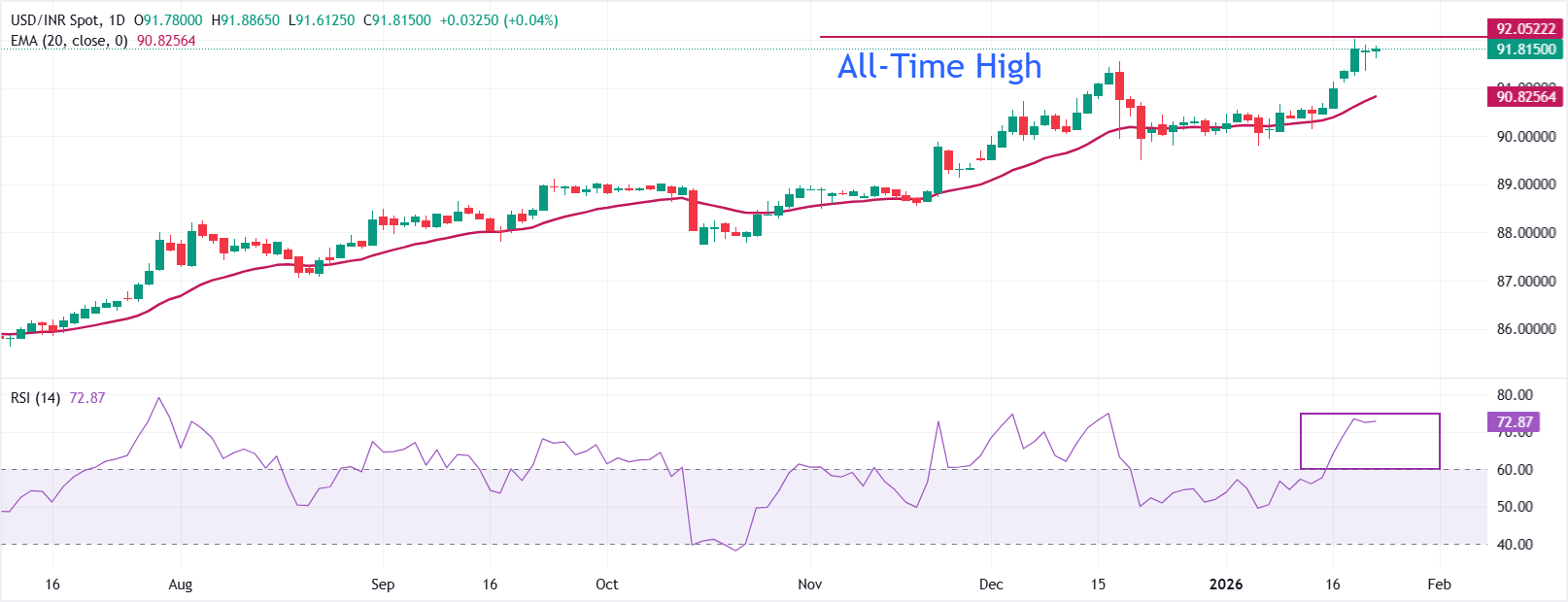
USD/INR trades firmly at 91.8115 as of writing. The 20-day Exponential Moving Average (EMA) trends higher at 90.8253 and underpins the advance. Price holds above this rising 20-day EMA, keeping the near-term bias upward.
The 14-day Relative Strength Index (RSI) at 72.84 (overbought) signals stretched momentum. Immediate support sits at the 20-day EMA, and bulls would retain control as long as the price is above it.
A pullback toward the average at 90.8253 could attract buyers, while a close below it would shift focus to consolidation.
(The technical analysis of this story was written with the help of an AI tool.)
Indian Rupee FAQs
The Indian Rupee (INR) is one of the most sensitive currencies to external factors. The price of Crude Oil (the country is highly dependent on imported Oil), the value of the US Dollar – most trade is conducted in USD – and the level of foreign investment, are all influential. Direct intervention by the Reserve Bank of India (RBI) in FX markets to keep the exchange rate stable, as well as the level of interest rates set by the RBI, are further major influencing factors on the Rupee.
The Reserve Bank of India (RBI) actively intervenes in forex markets to maintain a stable exchange rate, to help facilitate trade. In addition, the RBI tries to maintain the inflation rate at its 4% target by adjusting interest rates. Higher interest rates usually strengthen the Rupee. This is due to the role of the ‘carry trade’ in which investors borrow in countries with lower interest rates so as to place their money in countries’ offering relatively higher interest rates and profit from the difference.
Macroeconomic factors that influence the value of the Rupee include inflation, interest rates, the economic growth rate (GDP), the balance of trade, and inflows from foreign investment. A higher growth rate can lead to more overseas investment, pushing up demand for the Rupee. A less negative balance of trade will eventually lead to a stronger Rupee. Higher interest rates, especially real rates (interest rates less inflation) are also positive for the Rupee. A risk-on environment can lead to greater inflows of Foreign Direct and Indirect Investment (FDI and FII), which also benefit the Rupee.
Higher inflation, particularly, if it is comparatively higher than India’s peers, is generally negative for the currency as it reflects devaluation through oversupply. Inflation also increases the cost of exports, leading to more Rupees being sold to purchase foreign imports, which is Rupee-negative. At the same time, higher inflation usually leads to the Reserve Bank of India (RBI) raising interest rates and this can be positive for the Rupee, due to increased demand from international investors. The opposite effect is true of lower inflation.
Recommended Articles


