


I'm Thinking About Pulling the Trigger on This Producer of a Mineral Deemed "Critical" to the U.S.
Key Points
United States Antimony is in the midst of a steep pullback.
The company is the only domestic producer of antimony with scale.
- 10 stocks we like better than United States Antimony ›
For decades, the world was heavily reliant on China for rare-earth elements and other critical materials that U.S. companies need, meaning China could control output and pricing to suit its aims. But with a growing awareness of how these elements are essential components in a variety of military equipment and high-tech gear, Western nations are waking up to the fact that they need to source the materials from places other than China.
This has ushered in renewed investor interest in materials stocks, including United States Antimony (NYSE: UAMY). First, the elephant in the room needs to be addressed. This stock sits 57% below its 52-week high as I write this, and is down 17% over the past month. Many investors interpret those drops as signs of a falling knife, not invitations to get involved, but the stock's recent weakness may spell opportunity for risk-tolerant market participants.
Will AI create the world's first trillionaire? Our team just released a report on the one little-known company, called an "Indispensable Monopoly" providing the critical technology Nvidia and Intel both need. Continue »
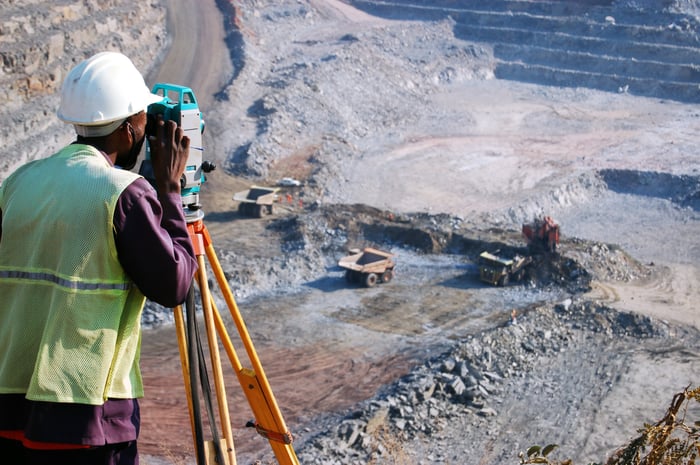
United States Antimony is a volatile stock, but it has rebound potential. Image source: Getty Images.
U.S. Antimony has enviable positioning
Another elephant in the room that needs to be addressed: U.S. Antimony's first-quarter results stunk up the joint. Revenue declined, and the company posted a loss after notching a profit in the year-ago period. CEO Gary Evans noted that there will be bumps along the way as a business builds at the rapid pace U.S. Antimony is.
The urgency behind U.S. Antimony's scaling makes sense. Uncle Sam classifies antimony as a "critical" mineral. China is the world's largest producer. It's potentially problematic that the U.S. consumes over 50 million pounds of the mineral per year, while importing 90% of that amount.
U.S. Antimony is attempting to make the U.S. less dependent on imports of its namesake mineral, and the government sees value in those efforts. The company landed a sole-source contract from the federal government worth as much as $245 million, with an initial $10 million order revealed last September. The company had $39 million in revenue in 2025.
The bull thesis is solidified by the fact that, among other applications, antimony is crucial in the production of munitions and semiconductors. Focusing on the former: A reason aggressive investors should consider the stock is that the U.S. has depleted significant portions of its weapons stockpiles recently, suggesting a credible rearmament cycle is likely to boost demand for antimony. Best of all, it'll be the government footing that bill. That may be a sign of long-term support for antimony spending and the possibility of revenue clarity for U.S. Antimony.
More than just antimony
From an investing perspective, antimony is the attention-grabber, but investors considering U.S. Antimony shouldn't sleep on the clinoptilolite zeolite side of the business. That mineral is essential to end markets such as agriculture, animal feed, environmental cleanup, healthcare, and water filtration, among others.
Bottom line: U.S. Antimony has me interested and considering a roll of the dice on the stock.
Should you buy stock in United States Antimony right now?
Before you buy stock in United States Antimony, consider this:
The Motley Fool Stock Advisor analyst team just identified what they believe are the 10 best stocks for investors to buy now… and United States Antimony wasn’t one of them. The 10 stocks that made the cut could produce monster returns in the coming years.
Consider when Netflix made this list on December 17, 2004... if you invested $1,000 at the time of our recommendation, you’d have $463,900!* Or when Nvidia made this list on April 15, 2005... if you invested $1,000 at the time of our recommendation, you’d have $1,294,401!*
Now, it’s worth noting Stock Advisor’s total average return is 978% — a market-crushing outperformance compared to 211% for the S&P 500. Don't miss the latest top 10 list, available with Stock Advisor, and join an investing community built by individual investors for individual investors.
See the 10 stocks »
*Stock Advisor returns as of May 31, 2026.
Todd Shriber has no position in any of the stocks mentioned. The Motley Fool has no position in any of the stocks mentioned. The Motley Fool has a disclosure policy.
Recommended Articles


