


Inflation Is Soaring, and the Federal Reserve Could Do Something It Hasn't Done Since 2023. Here's What It Means for Stocks.
Key Points
Rising oil prices have triggered a spike in inflation, which could force the Federal Reserve to raise interest rates soon.
The stock market was trading in bear territory the last time the Fed was hiking interest rates, three years ago.
The S&P 500 index is currently trading at the second-most expensive valuation in its history, which creates significant downside risk.
- 10 stocks we like better than S&P 500 Index ›
The Consumer Price Index (CPI), a measure of inflation, came in at an annualized rate of 3.8% in April, nearly twice the Federal Reserve's 2% target. To make matters worse, the Producer Price Index (PPI) increased even faster, suggesting there is more inflation on the business side that could be passed on to consumers in the coming months.
May 2023 was the last time the CPI was this high, and the Fed was raising the federal funds rate (overnight interest rate) to bring it under control. The S&P 500 index was in the throes of a bear market at the time, because rising interest rates are a significant headwind for corporate earnings.
Will AI create the world's first trillionaire? Our team just released a report on the one little-known company, called an "Indispensable Monopoly" providing the critical technology Nvidia and Intel both need. Continue »
After six interest rate cuts since September 2024, Wall Street is now predicting the Fed's next move will be a hike. Could this derail the current bull market in stocks?

Image source: Getty Images.
All signs point to higher inflation
Rising oil prices are the key driver of inflation right now. Following an attack on its territory by the U.S. back in February, Iran closed the critical Strait of Hormuz waterway, through which 25% of the world's seaborne oil supply transits each day. This sparked fears of a global oil shortage and sent the price of West Texas Intermediate (WTI) crude soaring to around $120 per barrel, more than double its opening price at the start of 2026.
Fortunately, the U.S. and Iran have agreed to a ceasefire while they negotiate a long-term peace deal, so tensions have eased. But a barrel of WTI still trades at an elevated price of $89, because according to a report by the International Energy Agency, it could take several months for Middle Eastern oil producers to ramp production up to prewar levels.
That doesn't bode well for the inflation outlook, because oil prices influence the cost of every product that travels by truck, plane, or boat. Therefore, consumers are facing higher prices not only at the gas pump, but also at the grocery store and at the mall.
In fact, the PPI came in at an annualized rate of 6% in April, with the energy component soaring by 22.7%. If businesses continue passing those cost increases on to consumers, then April's CPI reading of 3.8% might be tame compared to what lies ahead in the next few months.
Keeping inflation at around 2% each year is one of the Fed's primary objectives, so conventional wisdom suggests it should be lifting interest rates right now. According to the CME Group's FedWatch tool, which calculates the probability of interest rate moves based on activity in the 30-Day Fed Funds futures market, Wall Street is expecting at least one rate hike by January 2027. However, there might be more hikes in the pipeline if oil remains elevated into the new year.
Rate hikes would come at a bad time for the stock market
Higher interest rates often squeeze household budgets because consumers are forced to allocate more money to mortgages and other debts, leaving them with less money to spend on discretionary goods. That alone is bad for corporate earnings, but higher rates also increase the cost of credit for businesses, which directly affects their bottom line.
The Fed's last campaign to hike interest rates started in March 2022 and ended in August 2023. During that period, the S&P 500 plunged by more than 20%, the technical definition of a bear market. The index has since more than doubled from its low point, which highlights the advantages of long-term investing, but its elevated valuation poses a significant risk to investors right now.
The S&P currently trades at a cyclically adjusted price-to-earnings ratio of 39.5, making this the second-most expensive stock market in history, behind only the dot-com bubble of the early 2000s.
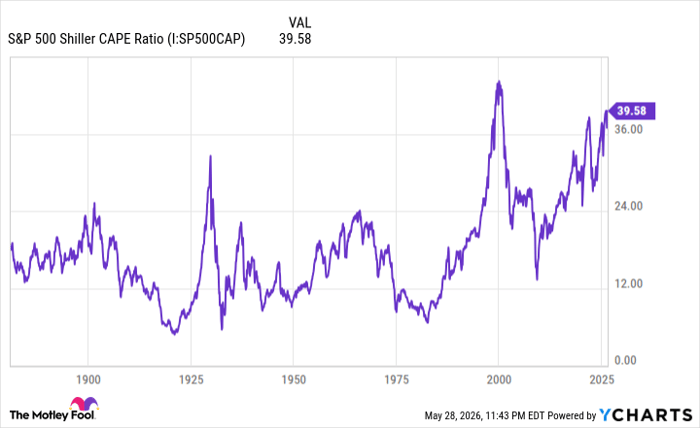
S&P 500 Shiller CAPE Ratio data by YCharts
Since investors are paying such a steep premium for earnings right now, any external shock that reduces overall corporate profits could spark a very sharp correction. Based on recent history alone, rising interest rates could certainly be the trigger.
To end on a positive note, it's important to remember that the S&P 500 has overcome every sell-off, correction, and bear market since its inception, so any weakness from here could be a great buying opportunity for long-term investors.
Should you buy stock in S&P 500 Index right now?
Before you buy stock in S&P 500 Index, consider this:
The Motley Fool Stock Advisor analyst team just identified what they believe are the 10 best stocks for investors to buy now… and S&P 500 Index wasn’t one of them. The 10 stocks that made the cut could produce monster returns in the coming years.
Consider when Netflix made this list on December 17, 2004... if you invested $1,000 at the time of our recommendation, you’d have $463,900!* Or when Nvidia made this list on April 15, 2005... if you invested $1,000 at the time of our recommendation, you’d have $1,294,401!*
Now, it’s worth noting Stock Advisor’s total average return is 978% — a market-crushing outperformance compared to 211% for the S&P 500. Don't miss the latest top 10 list, available with Stock Advisor, and join an investing community built by individual investors for individual investors.
See the 10 stocks »
*Stock Advisor returns as of May 31, 2026.
Anthony Di Pizio has no position in any of the stocks mentioned. The Motley Fool has positions in and recommends CME Group. The Motley Fool has a disclosure policy.
Recommended Articles


