


Nvidia Recently Plowed $3.8 Billion Into These 2 Artificial Intelligence (AI) Stocks
Key Points
While Nvidia's main business is designing chips and other artificial intelligence infrastructure, it also invests some of its capital in public and private companies.
Most of Nvidia's investments are in companies with which it has partnerships, such as suppliers and customers.
Following Nvidia's investments can provide insight into how the company at the center of AI views certain parts of the AI ecosystem.
- 10 stocks we like better than Nvidia ›
While investors know Nvidia (NASDAQ: NVDA) as the chipmaker at the center of the artificial intelligence (AI) universe, the company also invests in other companies, several of which are publicly traded.
These are typically other AI companies that Nvidia partners with or that are key suppliers or customers.
Will AI create the world's first trillionaire? Our team just released a report on the one little-known company, called an "Indispensable Monopoly" providing the critical technology Nvidia and Intel both need. Continue »
Nvidia's investment portfolio swelled close to $18.4 billion at the end of the first quarter of this year. During this time, Nvidia plowed $3.8 billion into two AI stocks: one it already owned and the other a new position.
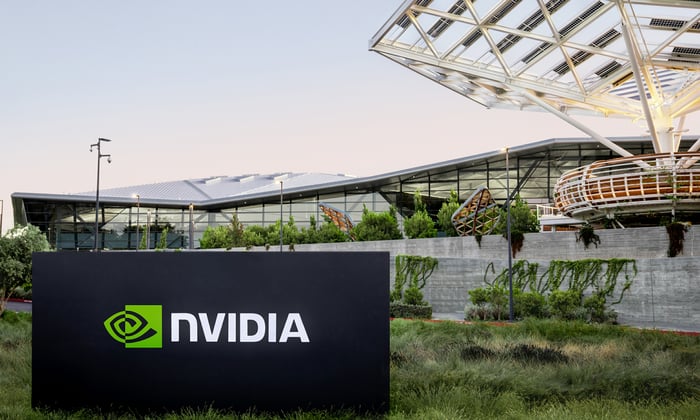
Image source: Nvidia.
Doubling down on CoreWeave
In the quarter, Nvidia increased its stake in the AI data center company CoreWeave (NASDAQ: CRWV) by 95%. Its position in the company increased by more than $1.9 billion at the end of the quarter, bringing the total position to more than $3.65 billion.
Nvidia and CoreWeave have long had a partnership, as CoreWeave purchases graphics processing units (GPUs) from Nvidia and deploys them in its data centers to rent compute to companies looking to deploy AI solutions.
In January, the companies announced they had expanded their relationship in order for CoreWeave to accelerate the construction of more than 5 gigawatts of AI data centers by 2030. Data center build-out is key to the AI revolution, so it's in Nvidia's interest to see CoreWeave grow.
Along with the announcement, Nvidia said it had invested $2 billion into Class A shares of CoreWeave at an average cost of $87.20 per share. Now owning more than 47 million shares, Nvidia's stake is close to 9% in the company.
While CoreWeave is one of the larger data center companies and is likely to continue to benefit as long as AI remains strong, the company's balance sheet is a bit worrisome. Building data centers is a capital-intensive business, and CoreWeave is highly leveraged. It has significantly diluted shareholders' equity.
At the end of the first quarter, CoreWeave's total debt-to-equity ratio, a measure of default risk, was high at 5.2. The company's total liabilities-to-equity ratio, which focuses more on overall leverage, was also very high at 10.6.
The company's outstanding share count has also more than doubled over the past year, driven by multiple private offerings, typically involving convertible notes that can eventually be converted into shares.
I'm not a huge fan of CoreWeave due to these balance sheet issues and the growing competition in the space. If the AI trade does take a turn for the worse, CoreWeave could take a big hit.
A new partnership
In March, Nvidia also announced a new partnership with Coherent (NYSE: COHR). Coherent is a leader in photonics, making components like lasers and optical transceivers that are becoming increasingly important for AI infrastructure.
Nvidia and Coherent's non-exclusive agreement involves a multibillion-dollar purchase commitment from Nvidia and future access and capacity rights to Coherent's advanced laser and optical networking products. The partnership also includes a $2 billion investment from Nvidia to support research and development.
Coherent's products have become important to Nvidia as data centers scale to thousands of GPUs, which require more and more data movement between GPUs before that data is eventually fed into the GPUs.
Specifically, Nvidia uses Coherent's silicon photonics to build Spectrum-X switches. These Ethernet networking platforms are key for "building multi-tenant, hyperscale AI clouds," according to Nvidia.
Coherent is similar to Micron. While Micron differs in that it provides memory that sits on GPUs and feeds them data, both companies have become key components of the AI supply chain, especially as the industry scales.
Coherent's stock has been on a big run, rising nearly 370% over the past year. The stock also trades at close to 70 times forward earnings, although at a more manageable 10.5 times forward revenue.
This is also another stock that will likely live and die with the AI trade, but seems to be in a good spot at the moment. I think investors can take a small position right now, but should wait for pullbacks to add at better entry points or practice dollar-cost averaging to build the position more slowly.
Should you buy stock in Nvidia right now?
Before you buy stock in Nvidia, consider this:
The Motley Fool Stock Advisor analyst team just identified what they believe are the 10 best stocks for investors to buy now… and Nvidia wasn’t one of them. The 10 stocks that made the cut could produce monster returns in the coming years.
Consider when Netflix made this list on December 17, 2004... if you invested $1,000 at the time of our recommendation, you’d have $463,900!* Or when Nvidia made this list on April 15, 2005... if you invested $1,000 at the time of our recommendation, you’d have $1,294,401!*
Now, it’s worth noting Stock Advisor’s total average return is 978% — a market-crushing outperformance compared to 211% for the S&P 500. Don't miss the latest top 10 list, available with Stock Advisor, and join an investing community built by individual investors for individual investors.
See the 10 stocks »
*Stock Advisor returns as of May 31, 2026.
Bram Berkowitz has no position in any of the stocks mentioned. The Motley Fool has positions in and recommends Coherent, Micron Technology, and Nvidia. The Motley Fool has a disclosure policy.
Recommended Articles


