


President Donald Trump's Social Security Double Whammy Can Expedite Its Insolvency
Key Points
Although Social Security is in no danger of running out of money, the sustainability of its existing payout schedule, including cost-of-living adjustments (COLAs), is very much in question.
The president's "Big, Beautiful Bill" is projected to widen Social Security's funding shortfall and accelerate the timeline for the Old-Age and Survivors Insurance trust fund (OASI) to exhaust its asset reserves.
Furthermore, Trumpflation is leading to larger annual COLAs, which can drain the OASI's asset reserves even faster.
- The $23,760 Social Security bonus most retirees completely overlook ›
For most retirees, Social Security income isn't a luxury -- it's a necessity to make ends meet. For a quarter-century, Gallup has conducted annual surveys to gauge retirees' reliance on the income they receive and found that up to 90% rely on Social Security income to cover at least some portion of their expenses.
Strengthening Social Security's financial outlook should be a top priority of all elected officials, including President Donald Trump. But because of actions taken by the president, America's leading retirement program is facing the possibility of sweeping benefit cuts even sooner than expected.
Will AI create the world's first trillionaire? Our team just released a report on the one little-known company, called an "Indispensable Monopoly" providing the critical technology Nvidia and Intel both need. Continue »

President Trump delivering remarks. Image source: Official White House Photo by Molly Riley.
Although Social Security won't run out of money, its foundation has been crumbling for decades
Before going any further, let me assuage any fears for current and future beneficiaries about Social Security payouts: The program isn't going bankrupt, and payments won't be halted.
More than 91% of Social Security's income comes from the 12.4% payroll tax on earned income (wages and salaries, but not investment income). As long as Americans keep working, money will continue to be collected for disbursement to eligible recipients. If you're owed a Social Security benefit, you're on track to receive one.
The issue is the sustainability of the existing payout schedule, including cost-of-living adjustments (COLAs). Since 1985, the Social Security Board of Trustees has cautioned of a long-term unfunded obligation. In other words, the projected income 75 years following the release of an annual report is expected to be insufficient to cover outlays. This 75-year shortfall stood at $25.1 trillion in 2025.
But the more immediate problem is the expected depletion of the asset reserves for the Old-Age and Survivors Insurance trust fund (OASI). This is the fund that doles out monthly payments to retired-worker beneficiaries and survivors of deceased workers.
The 2025 Trustees Report predicts that the OASI's asset reserves (i.e., excess income collected since inception) will be depleted by 2033. Though the OASI doesn't need a cent in its asset reserves to continue paying benefits, an estimated 23% sweeping cut to payouts awaits if it's exhausted.
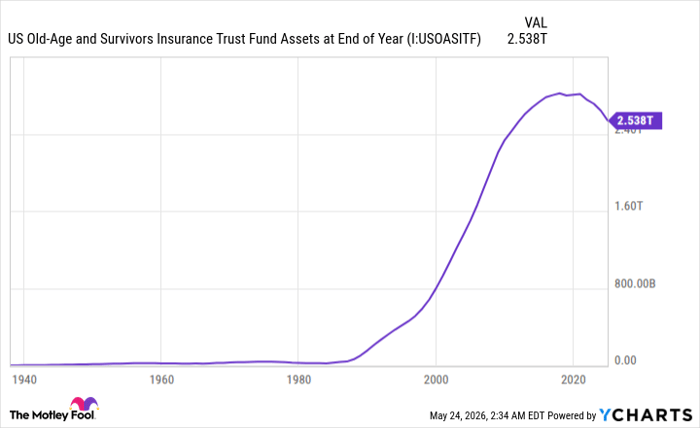
The OASI's asset reserve exhaustion date is rapidly approaching. US Old-Age and Survivors Insurance Trust Fund Assets at End of Year data by YCharts.
Trump's "Big, Beautiful Bill" accelerates the OASI's insolvency timeline
While Donald Trump promised not to touch Social Security on the campaign trail, several decisions made by the president since the start of his second term threaten to accelerate the OASI's asset reserve insolvency timeline.
For starters, Trump's flagship tax and spending law, the "Big, Beautiful Bill," or BBB for short, is projected to be a net-negative for Social Security.
For some Americans, the BBB is helping them keep more cash in their pockets. Though far from a comprehensive list, the BBB introduced several temporary tax cuts from 2025 through 2028:
- The "senior deduction" allows eligible seniors 65 and up to take an additional $6,000 off their income, or $12,000 if filing jointly.
- The "no tax on tips" rule allows workers a dollar-for-dollar deduction of up to $25,000 on tips.
- The "no tax on overtime" provision provides dollar-for-dollar deductions on overtime pay up to $12,500, or $25,000 if filing jointly.
But these tax breaks for some Americans come at the detriment of Social Security. With less earned income exposed to the payroll tax between 2025 and 2028, the program will collect less income.
According to an August 2025 estimate from the Social Security Administration's Office of the Actuary, Trump's Big, Beautiful Bill will increase the program's costs by $168.6 billion over 10 years (2025-2034) and shift the OASI's asset reserve depletion timeline forward by one quarter, to the fourth quarter of 2032.

Image source: Getty Images.
Trumpflation is threatening to further expedite the OASI's insolvency crunch
But the BBB isn't the only way President Trump is potentially damaging the solvency of the OASI's asset reserves. Trumpflation is also threatening to do a number on America's leading retirement program.
Some degree of inflation (rising prices) is perfectly normal and healthy for the U.S. economy. Trumpflation refers to the effects on U.S. inflation from decisions made by the president.
For instance, Trump instituted sweeping global tariffs in early April 2025, along with higher reciprocal tariffs on dozens of countries deemed to have adverse trade imbalances with America. Even though the U.S. Supreme Court struck down these tariffs in February 2026 (Trump has since announced a new sweeping tariff), the added cost of import duties modestly lifted U.S. inflation in 2025.
We're witnessing another round of Trump-driven inflation with the Iran war. The president's decision to attack Iran on Feb. 28 led the latter to close the Strait of Hormuz, thereby disrupting approximately 20 million barrels per day of petroleum liquids (roughly 20% of the world's crude oil demand). We've witnessed oil and fuel prices soar, and are just starting to see the effects of inflation adversely impacting businesses.
In February, trailing 12-month (TTM) inflation was 2.4% and moving toward the Federal Reserve's long-term target of 2%. By April, TTM inflation had jumped to 3.8%. According to the Cleveland Fed's Inflation Nowcasting tool, TTM inflation for May should approach 4.2%.
On the one hand, Trumpflation should lead to above-average Social Security COLAs. Since the program's annual "raise" is designed to match the inflationary pressures beneficiaries are facing, higher inflation almost certainly means a beefier Social Security check in 2027.
But therein lies the problem. The OASI's asset reserves are already on the downswing (i.e., annual outlays outweigh income), and progressively larger cost-of-living adjustments, driven by Trump's tariffs and the Iran war, threaten to further accelerate the timeline to the OASI's asset reserve insolvency. Yes, Social Security checks are on track to be notably larger in 2027, but this could come at a significant cost to the program's financial outlook.
The Big, Beautiful Bill and Trumpflation are a double whammy that can accelerate an already precarious situation for Social Security.
The $23,760 Social Security bonus most retirees completely overlook
If you're like most Americans, you're a few years (or more) behind on your retirement savings. But a handful of little-known "Social Security secrets" could help ensure a boost in your retirement income.
One easy trick could pay you as much as $23,760 more... each year! Once you learn how to maximize your Social Security benefits, we think you could retire confidently with the peace of mind we're all after. Join Stock Advisor to learn more about these strategies.
View the "Social Security secrets" »
The Motley Fool has a disclosure policy.
Recommended Articles


