


Rigetti Computing (RGTI) Stock: $2B Quantum Initiative Fuels Rally — Is Rigetti a Buy at $25.50?
TradingKey - Rigetti RGTI at $25.50 after pulling back from the 2.618 Fib breakout. $2B federal quantum initiative, 36-qubit government delivery, Lyra 100+ qubit late 2026. RSI 59. Target $27.77.
Rigetti Computing (NASDAQ: RGTI) currently stands at $25.50 for the Memorial Day long weekend, retreating from last week’s 2.618 Fibonacci extension breakout above $26.97 to retest the 0.236 Fibonacci retracement at $24.86 on the 2H. The RSI indicator has relaxed from 77-81 down to a neutral-bullish 59.22, showing neither bearish divergences, and the black trendline drawn along the $15.48 lows, above the $19.43 MA50, remains intact. The structure stands. But what we added since our May 26 article is a new fundamental catalyst, which is arguably the most important piece of the puzzle.
A recent US government Quantum Computing Initiative to help fund domestic development of fault-tolerant systems, with a reported investment pool of $2 billion in total, aims to help ensure the US stays ahead of the Chinese. For a company with ~$4.8 million in quarterly revenue, getting a slice of the federal quantum pie would be a major development in terms of the fundamental investment case.
The $2 Billion Federal Quantum Computing Initiative And The Outlook For Rigetti
The $2 billion quantum computing initiative is the US government following up on an award made earlier this month to IBM to build a semiconductor foundry for quantum computing as part of the CHIPS Act. Rather than being an infrastructure investment in a single company as seen in the case of IBM, this $2 billion program will support various segments of the domestic quantum computing ecosystem. This includes hardware companies, software stack companies, and cloud access platforms. The US quantum company sits at the intersection of all three categories because Rigetti builds superconducting-based quantum computing processors and has a cloud access platform that it calls QCS. Furthermore, the company has contracts in place with various US government entities; this is the arrangement responsible for the delivery of a 36-qubit system in the first quarter. This is not a hypothetical arrangement; Rigetti CEO Subodh Kulkarni has pointed to years of government collaboration as the basis for current revenue.
The government is treating quantum computing as a national security technology in the same way as advanced semiconductors; in other words, ceding leadership to China is unacceptable regardless of near-term ROI. This means that the initiative funding environment is far less dependent on the Warsh Fed interest rates. The pace of the quantum computing initiative is dependent on technology roadmaps rather than Fed interest rate moves. In short, if Warsh cuts rates or keeps rates high, government contract revenue is expected to ramp up throughout 2026.
Lyra And The Importance Of The 100-Qubit Milestone In Late 2026
Rigetti’s subsequent computer generation, known as Lyra, could be what prompts investors to determine if Rigetti stocks will climb further or plateau where they are. Anticipated in the late 2026 period, the system will be tuned for more than 100 qubits with higher fidelity. It isn’t the number of qubits that is interesting to investors, because the company IBM has already produced systems with over a 1000 qubits. But, what they are watching is the quality of the systems at scale, especially the qubits’ individual coherence times, two-qubit fidelity, and its technique for error correction.
Should the computer Lyra be released in the second half of 2026, with improved fidelity at the 100-qubit scale, the scope of solvable problems to become commercially viable on the Rigetti quantum computer will expand, such as optimization challenges and quantum chemistry simulations, which are the problems the quantum computing community thinks have the best chance for demonstrating practical quantum advantage. Alternatively, a delivery delay or a failure to meet the fidelity targets on these qubits, for Lyra, would be bearish for RGTI.
There are currently, a focus on hybrid quantum-AI workflows, where a group of financial institutions and pharmaceutical companies have begun testing the QCS platform, provided by Rigetti on the cloud. The testing by these institutions are exploring hybrid workflows, that might be valuable for portfolio optimization or drug discovery. These pilots are not currently contributing to Rigetti revenue streams, but the pilots might transition to being revenue-driving commercial contracts for Rigetti.
The pivotal question is when the performance of the Rigetti computer can reach or surpass the performance of classical computing. This will occur with the debut of the Lyra computer in late 2026 when customers must determine whether to scale up or pause their pilots.
RGTI Technical Analysis — 0.236 Fib Hold At $24.86 With RSI Reset To 59
In terms of chart setup, RGTI shares are approaching the 0.236 Fib retracement level at $24.86 following a breakout at the 2.618 Fibonacci level. There is not a lot of follow-through selling in this retracement, while the long lower wicks shown in the red candles indicate buying. Meanwhile, the ascending black trendline at $15.48 remains intact, while the $19.43 MA50 is below this.
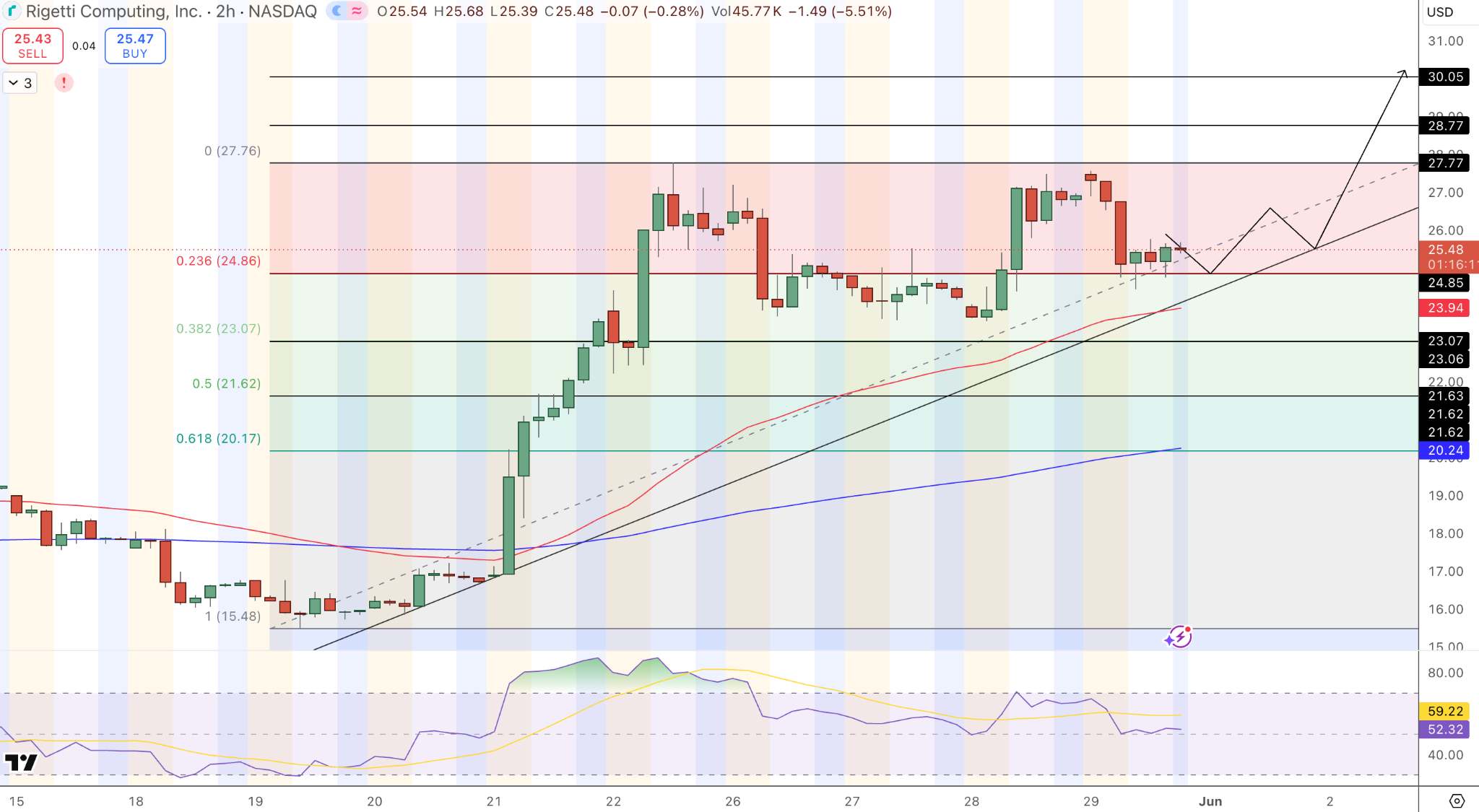
Rigetti Computing (RGTI) Price Chart - Source: Tradingview
The RSI indicator has come off its overbought level of 77 to 81 and is now back at a neutral-bullish range reading of 59.22, with no divergence. For RGTI shares to continue higher, the 2.272 Fib level extension is at $27.77, while the next Fib level at 3.0 is $28.77.
Long Trade
- Entry: Long above $25.43 (0.236 Fib and trendline confirmation)
- Target 1: $27.77 (2.272 Fib)
- Target 2: $28.77 (Fib 3.0 extension)
- Stop loss: Below $24.85 (below 0.236 Fib level support)
What Does The $2 Billion Federal Quantum Initiative Mean For RGTI And How Does It Benefit The Stock?
It was reported by multiple news outlets this past week that the US federal government will be funding a $2 billion quantum computing program to speed domestic development of commercially viable fault-tolerant systems. This effort will keep the US technology ahead of the Chinese government. This is an important catalyst and should benefit RGTI, considering both RGTI's government contracting agreements, its QCS cloud access platform, and its superconducting quantum roadmap, which has consistently been highlighted by CEO Subodh Kulkarni as being built for government contract applications as a precursor to commercial use cases.
While both the $2 billion program and the IBM CHIPS Act quantum foundry award are a significant boost to a quantum ecosystem that needs capital support, this does not mean the US government is giving up the race against China. RGTI CEO Subodh Kulkarni has been very vocal in the earnings call that government contracts are the core revenue foundation for RGTI while RGTI continues to develop its commercial offerings.
What Is The Lyra Quantum System And Why Does It Matter?
RGTI is developing a 100-plus qubit quantum system called Lyra in 2026. In a previous earnings update, RGTI management described its plans to introduce the Lyra system late in 2026 with more than 100 qubits and better qubit fidelity. The focus is not on the number of qubits, it is on the quality of the qubits, as coherence times, gate fidelity, and other qubit quality metrics are improving, which expands the use cases for the system from just a few problem sets into multiple larger and more commercially viable problem sets.
If Lyra delivers as planned in late 2026, it would expand the use cases of RGTI's current commercial pilot projects in the QCS platform with commercial clients in the financial services and pharmaceutical industries into the more commercially viable optimisation and molecular simulations markets. The failure of this launch, if it occurs, or the Lyra system performing worse than the fidelity guidance management provided in Q2 would be the most important downside catalyst for the stock in H2 2026.
Should I Buy RGTI At $25.48, Following Its Pullback From The Breakout?
This is the type of setup where we would expect continuation into the next upside leg. RSI has reset from overbought 77 at 81 to a neutral-bullish 59.22 without any sign of a bearish divergence, which is the ideal profile after a consolidation after a breakout. The RSI reset is supported by the fact that the 0.236 Fib at $24.86 and the ascending trendline from $15.48 have both held. This was a relatively shallow pullback with little follow-through from the selling on the pullback. We would be looking to enter long above $25.43 towards $27.77 and $28.77 with a stop below $24.85.
Bottom Line
RGTI's recent pullback in price from the 2.618 breakout towards $25.48 appears to be just another example of RSI reset within a trend. Momentum came from 77 cooling off towards 59.22 with no divergence and the trend line from $15.48 is still intact.
Additionally, the recently announced $2 billion quantum computer program is a fundamental government funding catalyst to RGTI that is structurally insulated from the higher-for-longer rate environment. The Lyra 100-plus qubit system in late 2026 is the critical technical milestone to validate government funding to RGTI and help it expand its commercial use case pipeline for its QCS platform. The target is $27.77 and $28.77 for the long above $25.43. This is speculative and should be sized accordingly given RGTI's pre-commercial status.
Recommended Articles


