


Meet the Spectacular Vanguard ETF With 45.8% of Its Portfolio Parked in Nvidia, Alphabet, Apple, and Microsoft
Key Points
The Vanguard Mega Cap Growth ETF holds 59 of America's largest growth companies.
Its top four positions are Nvidia, Apple, Alphabet, and Microsoft, which have a combined value of over $17 trillion.
Artificial intelligence is a massive tailwind for the Vanguard ETF right now because of its portfolio composition, but that also creates risks.
- 10 stocks we like better than Vanguard Mega Cap Growth ETF ›
The CRSP U.S. Total Market Index is made up of all 3,498 companies listed on American stock exchanges. However, the 59 largest companies represent a staggering 70% of the index's total market capitalization, highlighting the extreme concentration of wealth in the corporate sector.
The CRSP U.S. Mega Cap Growth Index exclusively holds those 59 companies. Its top four positions are Nvidia, Apple, Alphabet, and Microsoft, which isn't a surprise given their enormous combined market cap of $17.4 trillion.
Will AI create the world's first trillionaire? Our team just released a report on the one little-known company, called an "Indispensable Monopoly" providing the critical technology Nvidia and Intel both need. Continue »
The Vanguard Mega Cap Growth ETF (NYSEMKT: MGK) is an exchange-traded fund (ETF) that tracks the performance of the Mega Cap Growth Index by holding the same stocks. Here's how adding it to a diversified portfolio could lead to strong long-term returns.

Image source: Getty Images.
A basket of America's best growth stocks
Given the sheer size of the four largest holdings in the CRSP U.S. Mega Cap Growth Index (and by extension, the Vanguard ETF), they represent a whopping 45.8% of the value of its entire portfolio.
|
Stock |
Vanguard ETF Portfolio Weighting |
|---|---|
|
1. Nvidia |
13.77% |
|
2. Apple |
11.79% |
|
3. Alphabet |
11.55% |
|
4. Microsoft |
8.69% |
Data source: Vanguard. Portfolio weightings are accurate as of April 30, 2026, and are subject to change.
Those four companies are very different, but they have one thing in common: They are operating at the forefront of the artificial intelligence (AI) revolution.
- Nvidia supplies some of the world's best data center chips and components for processing AI training and AI inference workloads. Its new Vera Rubin platform will start shipping later this year, and it could dramatically reduce the cost of deploying AI software, thereby fostering broader adoption of this revolutionary technology.
- Apple has fitted its latest iPhones, iPads, and Mac computers with custom chips that are designed to run its Apple Intelligence suite of AI applications. Apple has an installed base of 2.5 billion devices worldwide, so it could soon be the biggest distributor of AI to consumers.
- Alphabet has integrated features like AI Overviews and AI Mode into its Google Search platform, creating a faster and more convenient search experience for users. Google Cloud is also experiencing blistering demand for its AI data center infrastructure, some of which is powered by custom chips that Alphabet designed alongside Broadcom.
- Microsoft has embedded its AI assistant, Copilot, into its flagship software products, including Windows and 365 (Word, Excel, and Outlook). Its Azure cloud platform competes with Google Cloud, and it's consistently the fastest-growing part of the entire organization, thanks to demand for AI-related services.
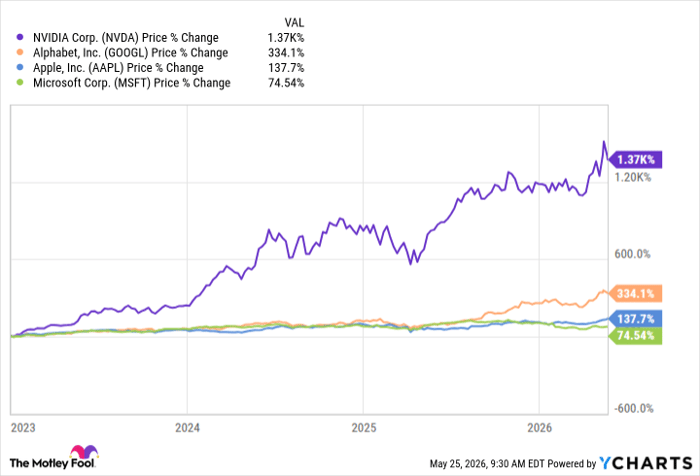
The AI boom started gathering momentum in early 2023, when OpenAI's ChatGPT application amassed over 100 million users and sparked a development race among America's biggest tech companies. Since then, Nvidia, Apple, Alphabet, and Microsoft have delivered a median return of 236%, so they have been a key source of upside for the Vanguard ETF.
NVDA data by YCharts
Some of the other AI powerhouses in the Vanguard ETF include Broadcom, Amazon, Meta Platforms, Tesla, and Palantir Technologies. But even though the technology sector accounts for 70% of the ETF (by value), it does offer a splash of diversification with positions in pharmaceutical giant Eli Lilly, payments powerhouses Visa and Mastercard, and industrial titan Boeing.
Should investors buy the Vanguard ETF right now?
The Vanguard Mega Cap Growth ETF has delivered a compound annual return of 13.6% since it was established in 2007, comfortably outpacing the average annual return of 10.3% in the S&P 500 (SNPINDEX: ^GSPC) over the same period. However, given its highly concentrated portfolio of just 59 stocks, investors probably shouldn't park all of their money in this one fund.
Instead, it might be a better idea to add the ETF to a diversified portfolio of other funds or individual stocks to minimize potential downside risks. Tech giants are spending hundreds of billions of dollars to develop AI right now, which could lead to significant losses if the technology fails to live up to expectations over the long term. That could drag down their stock prices, which would directly lead to losses for the ETF, too.
Investors who parked $10,000 in an S&P 500 index fund back in 2007 would be sitting on $64,407 today. But had they split the $10,000 by placing $5,000 in the S&P 500 and the other $5,000 in the Vanguard ETF, they would have $88,587 today instead. Meanwhile, they would have smoothed out some of the volatility that comes with significant exposure to the technology sector.
As a result, this Vanguard ETF looks like a great buy, but risk management might be key to generating the best results over the long run.
Should you buy stock in Vanguard Mega Cap Growth ETF right now?
Before you buy stock in Vanguard Mega Cap Growth ETF, consider this:
The Motley Fool Stock Advisor analyst team just identified what they believe are the 10 best stocks for investors to buy now… and Vanguard Mega Cap Growth ETF wasn’t one of them. The 10 stocks that made the cut could produce monster returns in the coming years.
Consider when Netflix made this list on December 17, 2004... if you invested $1,000 at the time of our recommendation, you’d have $472,852!* Or when Nvidia made this list on April 15, 2005... if you invested $1,000 at the time of our recommendation, you’d have $1,317,207!*
Now, it’s worth noting Stock Advisor’s total average return is 984% — a market-crushing outperformance compared to 210% for the S&P 500. Don't miss the latest top 10 list, available with Stock Advisor, and join an investing community built by individual investors for individual investors.
See the 10 stocks »
*Stock Advisor returns as of May 28, 2026.
Anthony Di Pizio has no position in any of the stocks mentioned. The Motley Fool has positions in and recommends Alphabet, Amazon, Apple, Boeing, Broadcom, Eli Lilly, Mastercard, Meta Platforms, Microsoft, Nvidia, Palantir Technologies, Tesla, and Visa. The Motley Fool has a disclosure policy.
Recommended Articles


