


Where Will Boeing Stock Be in 10 Years?
Key Points
Boeing's future hinges on its next-generation narrow-body aircraft.
Funding and engine choices are critical uncertainties for Boeing over the next decade, and investors face risks tied to its strategic decisions.
- 10 stocks we like better than Boeing ›
Boeing (NYSE: BA) is one of the more fascinating stocks on the market for investors who prefer a long-term buy-and-hold approach. If you are one of them, it's important to understand that the key determinant of the company's future is its next-generation narrow-body aircraft, which is likely to launch in about a decade. There's a lot to unpack here, and much of it might surprise you.
Boeing's next aircraft
In a sense, the next narrow-body is always the key event in the company's future. Widebodies are obviously hugely important (not least because they tend to generate higher-margin aftermarket/service revenue). Still, the cash flow cycle of narrowbodies typically funds the next generation of aircraft.
Will AI create the world's first trillionaire? Our team just released a report on the one little-known company, called an "Indispensable Monopoly" providing the critical technology Nvidia and Intel both need. Continue »
Unfortunately, the 737 MAX (first delivered in 2017) hasn't delivered the kind of cash flow Boeing's management and investors had hoped for. A combination of high-profile crashes, COVID-19 lockdowns, and quality control issues sent its free cash flow (FCF) in one direction and its debt in the other. Indeed, according to the Wall Street consensus, the company will only start generating more than $10 billion in annual FCF in 2028.
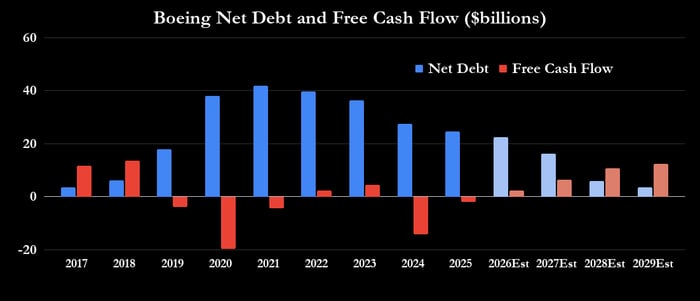
Data source: S&P Global Market Intelligence. Chart by the author.
This takes us back to the first long-term consideration -- namely, former Boeing CEO Dave Calhoun's assertion that a new narrow-body will cost $50 billion to develop. How will Boeing fund it?
What engine will the next narrow-body use?
GE Aerospace (NYSE: GE) and its joint venture with Safran, CFM International, dominate the aircraft engine market. CFM engines power the 737 MAX, and they're one of two options on the Airbus (OTC: EADSY) A320neo family. As such, GE and Boeing enjoy a close relationship, but the former's engine development could force Boeing into a momentous and pivotal decision in the next decade.
As previously discussed, CFM's Revolutionary Innovation for Sustainable Engines (RISE) includes an unducted open fan engine (an example of which is shown below), which CFM believes could result in a 20% reduction in fuel burn compared to today's engines.

Image source: CFM International.
Airbus is actively testing open-fan engines as part of the RISE program, and the European Union recently launched an initiative to support open-fan engines (Safran is leading the initiative, with Airbus as one of many partners). Boeing is believed to prefer a ducted engine for its next narrow-body.
A Reuters report claims that CFM is also studying a ducted-engine design, but this would run counter to GE Aerospace CEO Larry Culp's determination to be "all in" on open fan.
Where will Boeing be in a decade?
The key question is whether Boeing will need to issue debt or raise additional equity to finance a new narrow-body aircraft. The next question is, what type of engine will it have? If it aims for a ducted engine, will it fall behind Airbus in terms of efficiency if its European rival opts for an open fan engine?
These questions may seem esoteric, but they will determine Boeing's long-term future, and there is no clear answers yet. However, we can say that Boeing will almost certainly launch a new narrow-body in a decade, and it's up to investors to decide whether they are willing to carry the risks discussed above.
Should you buy stock in Boeing right now?
Before you buy stock in Boeing, consider this:
The Motley Fool Stock Advisor analyst team just identified what they believe are the 10 best stocks for investors to buy now… and Boeing wasn’t one of them. The 10 stocks that made the cut could produce monster returns in the coming years.
Consider when Netflix made this list on December 17, 2004... if you invested $1,000 at the time of our recommendation, you’d have $477,813!* Or when Nvidia made this list on April 15, 2005... if you invested $1,000 at the time of our recommendation, you’d have $1,320,088!*
Now, it’s worth noting Stock Advisor’s total average return is 986% — a market-crushing outperformance compared to 208% for the S&P 500. Don't miss the latest top 10 list, available with Stock Advisor, and join an investing community built by individual investors for individual investors.
See the 10 stocks »
*Stock Advisor returns as of May 25, 2026.
Lee Samaha has no position in any of the stocks mentioned. The Motley Fool has positions in and recommends Boeing, GE Aerospace, and Safran. The Motley Fool has a disclosure policy.
Recommended Articles


