


2 High-Yield Energy Stocks to Buy and Hold Forever
Key Points
Oil refiner HF Sinclair is seeing higher margins from its shift to renewable diesel fuel.
AI data center projects are turning to Williams Companies to provide stable power.
Both of these energy stocks offer investors dividend yields above 2.5%.
- 10 stocks we like better than HF Sinclair ›
The energy sector is a key part of the global economy and encompasses a wide range, from an oil-producing and refining company such as HF Sinclair (NYSE: DINO) to a midstream company such as The Williams Companies (NYSE: WMB), which transports natural gas through its pipelines.
What those two have in common is elite dividends that more than double the S&P 500 average of 1.06%. Here are three reasons to buy each stock.
Will AI create the world's first trillionaire? Our team just released a report on the one little-known company, called an "Indispensable Monopoly" providing the critical technology Nvidia and Intel both need. Continue »
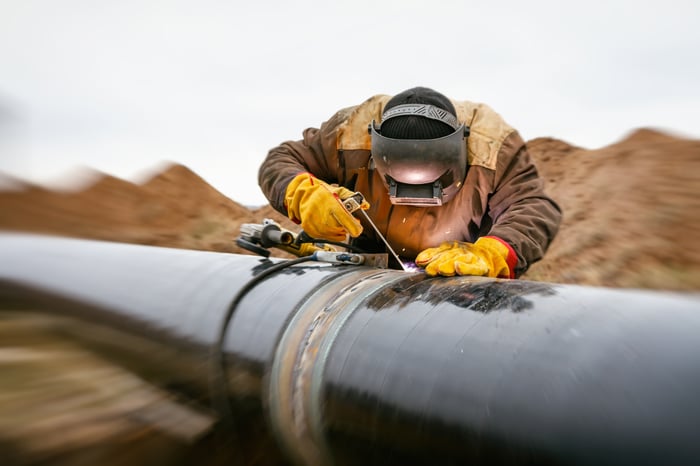
Image source: Getty Images.
HF Sinclair's transition to renewable diesel
HF Sinclair has converted several traditional refining assets into renewable diesel facilities, which allows it to capitalize on lucrative environmental credits and the growing demand for low-carbon fuels. In the first quarter of 2026, the company reported a massive shift toward profitability, swinging from a loss per share (EPS) of $0.02 in 2025 to an earnings per share of $3.56 in 2026.
It also reported that revenue increased 12% year over year to $7.1 billion. The rise was driven by higher adjusted refinery gross margins in the West region and higher overall refined product sales volumes.
By leveraging its existing infrastructure to produce renewable products, HF Sinclair avoids the massive greenfield costs competitors face, positioning itself as a leader in a market increasingly defined by carbon-intensity regulations and tax incentives.
Aggressive and disciplined capital returns
For many investors, the most attractive aspect of HF Sinclair is its unwavering commitment to returning capital to its owners. The company maintains a shareholder-first mentality, utilizing its robust cash flow -- which totaled nearly $460 million from operations in the first quarter -- to fund dividends and buybacks. It started a $1 billion stock buyback program in 2024 and in the first quarter, bought back $76 million of its stock.
It has kept its dividend at $0.50 for the past two years, but over the past decade, it has increased it by 51%. The yield, at its current price, is around 2.8%.
Recently, the company completed a massive share repurchase program, retiring more than 6% of its outstanding shares in just two years. This reduction in share count naturally boosts EPS and provides a consistent floor for the stock price. The stock buybacks and the above-average dividend have led to a total return of more than 257% over the past 10 years.
Regional market dominance and complexity
HF Sinclair's geographic footprint provides it with a moat that larger coastal refiners often lack. Many of its refineries are located in the Mid-Continent and Rocky Mountain regions, where it benefits from proximity to cheap crude oil feedstocks and faces limited competition from international imports. These landlocked markets often command higher margins because the cost of transporting fuel from the Gulf Coast acts as a natural price support.
The company's facilities are highly complex, enabling them to process heavier, lower-cost grades of crude that simpler refineries cannot handle. This technical advantage ensures that HF Sinclair can maintain healthy crack spreads even when market conditions for lighter oils become squeezed, providing essential margin safety in the energy space.
Williams benefits from the data center power boom
While Williams is traditionally viewed as a steady utility-like infrastructure play, it has found a powerful modern growth catalyst in artificial intelligence (AI). AI data centers require massive, uninterrupted power, and tech companies are turning to natural gas to power them. Williams handles one-third of all natural gas in the U.S., and its pipeline network, especially the Transco corridor, puts it in a great spot to meet the increased demand.
The company also expanded pipeline capacity and advanced a series of infrastructure and power-linked deals, including three new pacts, a $2.3 billion, 682-megawatt behind-the-meter deal, called Project Neo, and its Atlas natural gas supply for an unnamed data center in the Northeast, as well as the Aristotle pipeline to support Ohio data center demand.
A contract-driven, resilient business model
Williams operates primarily on a fee-based, long-term contract model, which shields it heavily from the direct volatility of commodity price swings. Because the company is paid based on the volume of natural gas moving through its gathering, processing, and transmission assets rather than the spot price of the gas itself, its revenue streams are highly secure.
This structural stability was on display in its first-quarter earnings report. It reported EPS of $0.70, up 25% year over year. The company reported cash flow from operations of $1.6 billion, up 12% over the same period a year earlier.
Williams attributed part of the improvement to higher net rates, expansion projects, new volumes from the Gulf of Mexico, higher storage revenues, and increased gathering activity in the western United States.
The company kept its 2026 adjusted earnings before interest, taxes, depreciation, and amortization (EBITDA) guidance of $8.05 billion to $8.35 billion, up 6% at the midpoint. It also said it expects annual EPS of $2.20 to $2.38, an increase of 9% at the midpoint. Williams expects capital expenditures of up to $7.6 billion, signaling continued investment in growth projects.
A reliable track record of dividend growth
For income-focused investors looking for steady compounding, Williams stands out as a disciplined returner of capital. The company raised its dividend this year by 5% to $0.525 per share, yielding around 2.6% at its current share price. The company has increased its dividend for eight consecutive years. That dividend has a coverage ratio of 2.76x on an adjusted funds from operations basis, plenty safe for continued increases.
Two great long-term stocks
HF Sinclair offers a compelling investment thesis driven by its successful strategic transition into the renewable diesel market and its solid regional dominance. The Williams Companies provides investors with a resilient, infrastructure-backed growth opportunity that is uniquely positioned to capitalize on the AI data center boom. This powerful growth catalyst is supported by a highly stable, fee-based contract model that insulates revenue from commodity price volatility.
Both stocks stand out as premier choices for income and value-focused portfolios due to their elite, reliable dividend profiles and disciplined approach to returning capital to shareholders. Both companies offer dividend yields that more than double the S&P 500 average. Together, they present a balanced mix of defensive, contract-driven cash flows, explosive modern tech-sector tailwinds, and aggressive capital return programs.
Should you buy stock in HF Sinclair right now?
Before you buy stock in HF Sinclair, consider this:
The Motley Fool Stock Advisor analyst team just identified what they believe are the 10 best stocks for investors to buy now… and HF Sinclair wasn’t one of them. The 10 stocks that made the cut could produce monster returns in the coming years.
Consider when Netflix made this list on December 17, 2004... if you invested $1,000 at the time of our recommendation, you’d have $477,813!* Or when Nvidia made this list on April 15, 2005... if you invested $1,000 at the time of our recommendation, you’d have $1,320,088!*
Now, it’s worth noting Stock Advisor’s total average return is 986% — a market-crushing outperformance compared to 208% for the S&P 500. Don't miss the latest top 10 list, available with Stock Advisor, and join an investing community built by individual investors for individual investors.
See the 10 stocks »
*Stock Advisor returns as of May 23, 2026.
James Halley has positions in Williams Companies. The Motley Fool has no position in any of the stocks mentioned. The Motley Fool has a disclosure policy.
Recommended Articles


